Deep corner cabinet organization starts with one problem: the back corner hides things you still need. A deep corner cabinet can waste space when items sit behind blind spots, loose stacks, and hard-to-reach cabinet zones.
The best fix is a measuring-first system. Measure corner cabinet space, divide the cabinet into zones, choose the right organizers, store items by use, and reset the space before clutter returns. This turns deep kitchen cabinet storage into clear, easy access storage.
What is deep corner cabinet organization?
Deep corner cabinet organization means arranging a deep or blind kitchen corner cabinet so items stay visible, reachable, grouped, and easy to return.
This kitchen cabinet organization system uses measuring, decluttering, zoning, organizers, labels, and regular resets. It fixes common deep cabinet problems like blind corner cabinet storage, poor visibility, wasted shelf space, and items getting lost in the back.
Example: If your mixing bowls disappear behind old serving trays, deep corner cabinet organization gives each item a clear zone.
Why does deep corner cabinet organization need a measuring-first plan?
Deep corner cabinet organization needs a measuring-first plan because the wrong organizer can block the door, waste shelf space, or fail to reach the back corner.
Measure the cabinet before buying bins, lazy Susans, pull-outs, or shelf risers. Deep cabinets vary by depth, width, height, shelf spacing, cabinet shape, and door clearance. A lazy Susan that looks useful online can fail if the door opening is too narrow or the shelf height is too short.
A measuring-first plan also helps you understand how much usable space you have. The full cabinet size does not always equal usable space. Hinges, frames, shelves, and awkward corners reduce access.
Example: A 28-inch deep corner cabinet may only allow a 20-inch turntable if the door opening is narrow. That is why cabinet organizer measurements matter before buying.
How should you measure depth, width, height, and door clearance?
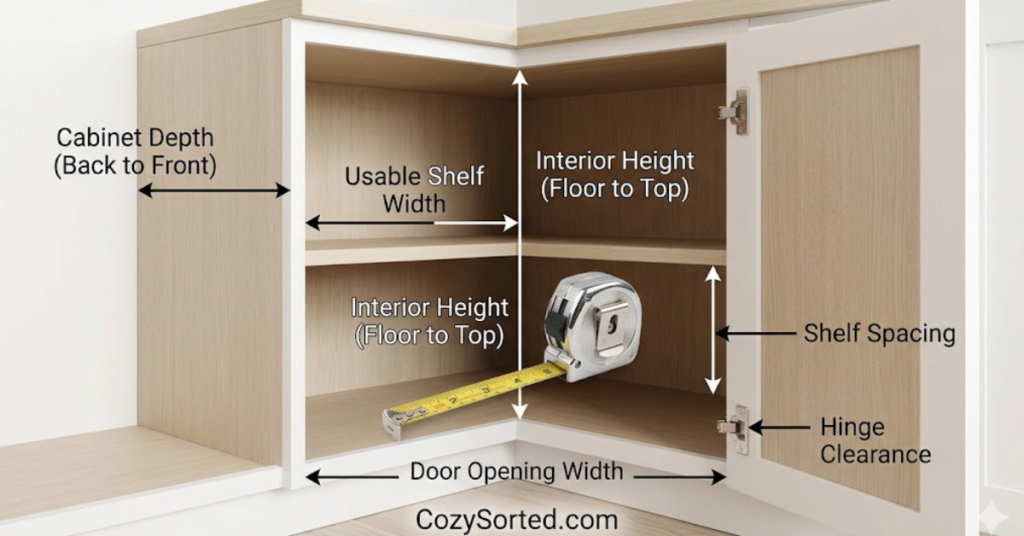
Key measurements for a deep corner cabinet are listed below.
- Measure cabinet depth from the front edge to the deepest back corner.
- Measure usable shelf width across the open area, not the full cabinet frame.
- Measure interior height from the shelf surface to the shelf or cabinet top above it.
- Measure deep cabinet shelf spacing if the cabinet has fixed shelves.
- Measure door opening width between the frame edges when the door is fully open.
- Check hinge clearance so organizers do not hit the door or side hinge.
- Measure organizer diameter or tray size before choosing a lazy Susan, bin, or pull-out shelf.
Example: If the door opening is 14 inches wide, a 16-inch bin will not slide out easily.
How should you identify blind spots and reach zones?
Blind spots and reach zones show which areas are easy or hard to access.
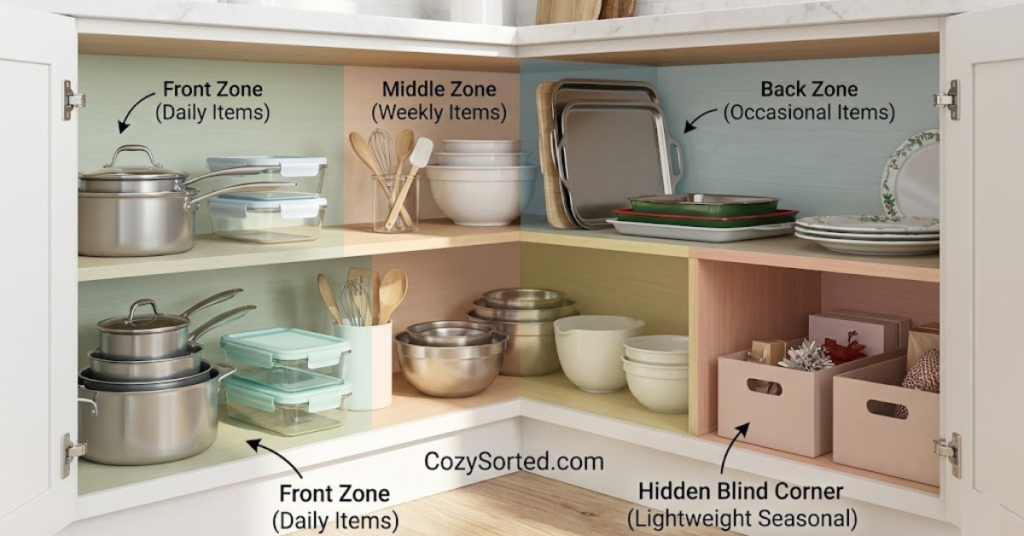
A deep cabinet should not be filled from front to back without a plan. The front zone should hold daily-use items. The middle zone should hold weekly-use items. The back corner should hold light items you use less often.
Use these reach zones:
- Front zone: daily cookware, bowls, oils, snacks, and lunch containers
- Middle zone: baking tools, pantry overflow, mixing bowls, and serving items
- Back zone: holiday dishes, picnic items, party trays, and spare containers
- Hidden blind corner: lightweight seasonal items only
Example: Keep your daily pan in the front zone. Put the large holiday tray in the back corner.
How should you match organizer size to cabinet shape?
Organizer size should match the cabinet shape, opening, and shelf layout.
Different cabinet shapes need different storage tools. An L-shaped cabinet does not use space the same way as a diagonal corner cabinet. A blind base cabinet needs a different setup from an upper corner cabinet.
Match the organizer to the cabinet type:
- Use full-round lazy Susans for round open corner shelves
- Use kidney-shaped lazy Susans for corner cabinets with folding doors
- Use half-moon organizers for blind base cabinets
- Use rectangular bins for straight shelves with deep back space
- Use wedge bins for pie-cut shelves or odd angles
- Use shelf risers for tall shelves with wasted vertical space
Example: A half-moon cabinet organizer works better than a round tray when the cabinet has a hidden blind side.
How does deep corner cabinet organization maximize hidden space?
Deep corner cabinet organization maximizes hidden space by making the back corner visible, reachable, and assigned to a clear purpose.
The goal is not only to maximize corner cabinet storage. The goal is to make items easier to see, grab, and return. Deep corner cabinet storage works best when each zone has one job.
Use turntables, pull-outs, bins, shelf risers, vertical dividers, and labels. These tools reduce clutter because they create smaller groups inside one large awkward cabinet.
Example: Instead of stacking snacks, cans, and baking tools together, place snacks in one handled bin, cans on a lazy Susan, and baking tools in one back-zone container.
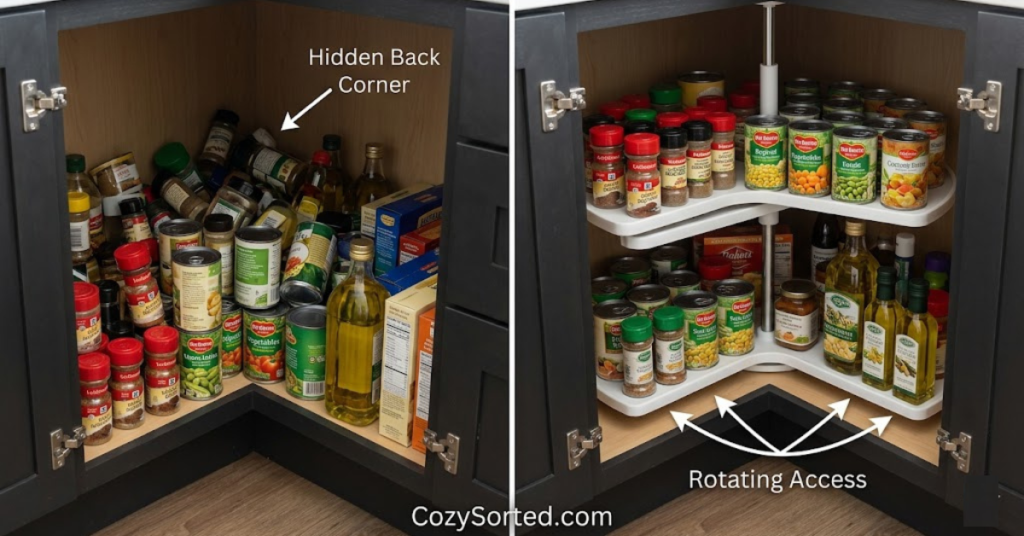
How do lazy Susans improve deep corner access?
Lazy Susans improve deep corner access by rotating items toward the front.
A lazy Susan corner cabinet works well for jars, spices, bottles, cans, bowls, and small pantry goods. A tiered lazy Susan organizer adds height when you need two visible layers. A kidney-shaped tray fits many corner cabinets with folding doors.
Choose the shape based on the cabinet. Full-round trays fit open round shelves. Pie-cut trays fit angled corner cabinets. Half-moon trays help with blind cabinet access.
Do not overload a lazy Susan. Heavy jars, tall bottles, and unstable stacks can tip when the tray turns.
Example: Use a deep cabinet lazy Susan for oils, vinegar, sauces, and small jars that you use each week.
How do pull-out shelves and swing-out organizers use blind corners?
Pull-out shelves and swing-out organizers use blind corners by bringing hidden items forward.
These organizers work well in base corner cabinet storage because lower cabinets often hold heavier items. Pots, pans, small appliances, mixing bowls, and cookware need stronger support than small pantry goods.
Check slide clearance, weight rating, and door opening before installation. Pull-out cabinet shelves need enough side space to move. Swing-out cabinet organizers need room to open without hitting the door frame.
Renters should avoid screw-in hardware unless the landlord approves it.
Example: A blind corner pull-out is useful for a stand mixer, large pot, or Dutch oven because you do not need to reach into the back.
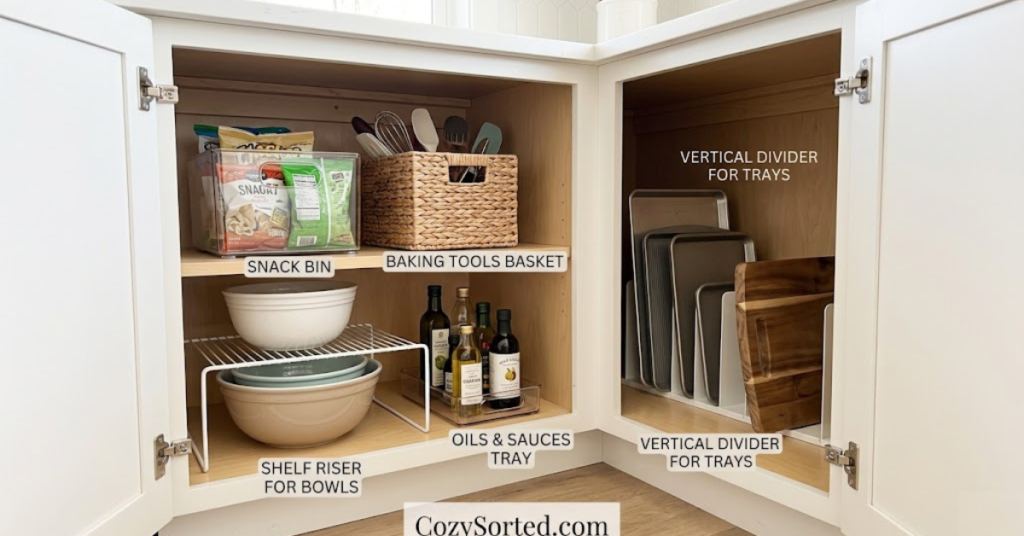
How do bins, baskets, and shelf risers control loose items?
Bins, baskets, and shelf risers control loose items by creating smaller categories inside a deep cabinet.
Loose items create clutter when they spread across the shelf. Clear bins for cabinets help you see what is inside. Handled storage baskets help you pull out a full group at once. Shelf risers for cabinets create a second level without stacking items into messy piles.
Use each organizer for one job:
- Use clear bins for snacks, packets, lids, and pantry overflow
- Use handled baskets for back-zone items that need easy retrieval
- Use shelf risers for bowls, plates, cans, and short containers
- Use wedge bins for angled lazy Susan shelves
- Use small trays for oils, sauces, and baking bottles
Example: Put all food container lids in one handled bin instead of letting them slide across the shelf.
How does vertical space improve storage capacity?
Vertical space improves storage capacity by using the height between shelves instead of only the cabinet floor.
Deep cabinets often waste space above short items. Shelf risers, stackable cabinet bins, pan racks, lid dividers, and vertical file-style storage help use that height.
Do not overstack heavy or fragile items. Tall stacks hide lower items and make the cabinet harder to use. Use vertical kitchen cabinet storage only when each item stays easy to remove.
Example: Store cutting boards, trays, and pan lids upright in a divider instead of stacking them flat in the back.
Recommended Video
Recommended Video: Search YouTube for “how to organize a blind corner kitchen cabinet” to watch a visual guide.
How should deep corner cabinet organization store items by use?
Deep corner cabinet organization should store items by how often they are used.
Use frequency zones to stop important items from disappearing into the back corner. Daily-use items stay in front. Weekly-use items stay in the middle. Occasional and seasonal items go deeper if they are light and safe to lift.
This system works better than grouping by item type alone. A deep cabinet should match real kitchen habits, not only product categories.
Example: If you use a rice cooker twice a week, keep it in the middle zone. If you use a turkey platter twice a year, place it in the back zone.
What everyday items deserve the front zone?
Everyday items that deserve the front zone are listed below.
- Store daily cookware near the front
- Store frequently used bowls near eye level or hand level
- Store lunch containers in one easy-grab bin
- Store snack bins where family members can reach them
- Store oils and small pantry items on a tray or turntable
- Store appliance attachments in front if used often
Front-zone cabinet storage should let you grab one item without moving three other items.
Example: Keep your most-used pan, oil, and lunch containers in the first 8 to 12 inches of the cabinet.
What seasonal or bulky items belong in the back?
Seasonal or bulky items belong in the back when they are lightweight, rarely used, and safe to retrieve.
Use back corner cabinet storage for holiday dishes, extra serving bowls, party trays, picnic items, specialty appliances, vases, and backup containers. These items do not need daily access, so they can sit deeper inside the cabinet.
Avoid storing heavy cast iron, stacked glassware, or large breakable dishes in the back. Awkward lifting can cause damage or strain.
Example: A lightweight picnic basket belongs in the back. A heavy cast iron pan belongs in the front zone or on a pull-out shelf.
How should pots, pans, lids, appliances, and pantry goods be grouped?
Common deep corner cabinet categories are listed below.
- Group pots and pans in one cookware zone
- Group lids and trays in one vertical divider
- Group small appliances by use frequency
- Group baking supplies in one handled bin
- Group pantry overflow in clear containers
- Group snacks in one front-zone bin
- Group mixing bowls by size and weight
- Group food containers with matching lids nearby
Each category needs one zone or one container. Mixed categories create clutter because every item competes for the same space.
Example: Do not store lids, snacks, and appliance cords in one bin. Give each group a clear home.
How should labels and clear containers support retrieval?
Labels and clear containers support retrieval by making hidden categories visible before the cabinet becomes messy again.
Use front-facing labels on bins, baskets, and containers. Keep label names short. Use names like “snacks,” “baking,” “lids,” “serving,” and “pantry overflow.”
Clear container cabinet storage helps you see what is running low. Labels help every person return items to the same place.
For food storage, check dates during each reset. Expired food should not stay hidden in a deep kitchen cabinet.
Example: A clear bin labeled “baking” can hold vanilla, sprinkles, baking powder, and small measuring tools.
What organizer setup works best for a deep corner cabinet?
The best organizer setup for a deep corner cabinet depends on cabinet location, depth, item weight, and installation limits.
Upper corner cabinets need lighter storage. Base corner cabinets need stronger organizers. Renter-friendly cabinet organization needs removable tools. The best corner cabinet organizer is the one that improves reach without creating new clutter.
Use the cabinet role first. Then choose the organizer. A pantry overflow cabinet needs bins and turntables. A cookware cabinet needs pull-outs, pan racks, and strong dividers.
Example: A renter with an upper corner cabinet should use clear bins, shelf risers, and a freestanding lazy Susan instead of screw-in hardware.
How do upper corner cabinets need different storage?
Upper corner cabinets need lighter, more visible storage because they are harder to reach overhead.
Use clear bins, lazy Susans, risers, labeled snack containers, lightweight bowls, mugs, and pantry overflow. Keep heavy appliances out of upper corner cabinet storage because overhead lifting is harder and less safe.
Wall corner cabinet organization should focus on visibility. Items should be easy to see before you reach for them.
Example: Put tea, coffee, mugs, and snack packets in clear bins. Keep a heavy blender in a lower cabinet.
How do base corner cabinets need stronger organizers?
Base corner cabinets need stronger organizers because they often hold heavier and bulkier items.
Use pull-out shelves, swing-out trays, tiered lazy Susans, pan racks, and sturdy bins. Check the weight rating before storing cookware, Dutch ovens, mixers, or stacked dishes.
Lower corner cabinet organizers should match the access angle. A deep base cabinet needs a tool that brings items forward, not a tool that pushes them deeper.
Example: Store heavy cookware on a sturdy cabinet pull-out. Store lids in a vertical divider next to the pans.
How do renters organize without drilling?
Renters can organize a deep corner cabinet without drilling by using removable and freestanding organizers.
No-drill cabinet organizer options include freestanding lazy Susans, handled bins, shelf risers, tension rods, non-slip liners, stackable baskets, and removable labels.
Avoid permanent hardware unless your rental agreement allows it. A renter-friendly kitchen storage setup should improve access without damaging the cabinet.
Example: Use a non-slip liner, two clear handled bins, and one shelf riser to organize snacks, lids, and bowls in a rental kitchen.
What mistakes make a deep corner cabinet harder to use?
Common mistakes make a deep corner cabinet harder to use by hiding items, blocking access, or overloading awkward spaces.
The biggest mistakes are overstacking, buying the wrong organizer size, ignoring cabinet door clearance, mixing unrelated categories, and placing heavy items in the back. These mistakes turn awkward cabinet storage into a daily problem.
A good cabinet system protects visibility. Each item should have a clear place and a clear path out of the cabinet.
Example: A deep cabinet becomes hard to use when baking tools, food containers, pans, and holiday dishes sit in one mixed pile.
Why does overstacking create hidden clutter?
Overstacking creates hidden clutter because users cannot see or remove one item without disturbing several others.
Mismatched stacks fail fast. Nested containers, mixed bowls, stacked pans, and random lids hide what sits underneath. The deeper the cabinet, the worse the stack becomes.
Use risers, dividers, and fewer layers. A deep cabinet works better with two clear levels than five unstable piles.
Example: Stack only matching bowls together. Use a shelf riser for plates instead of placing bowls on top of them.
Why can the wrong lazy Susan waste corner space?
The wrong lazy Susan can waste corner space when it is too small, too tall, unstable, or the wrong shape for the cabinet.
Check diameter, shelf height, door opening, weight limit, and item shape before buying. A round turntable can leave unused corners in a square shelf. A tall two-tier lazy Susan can hit the shelf above it.
Use this before-buying checklist:
- Measure the cabinet opening
- Measure the shelf height
- Measure the tray diameter
- Check the weight limit
- Match the tray shape to the cabinet shape
- Test item height before loading
Example: A 12-inch turntable may waste space in a large corner cabinet if a 16-inch tray fits better.
Why should heavy items not sit in awkward back zones?
Heavy items should not sit in awkward back zones because they are harder to lift, slide, and retrieve safely.
Keep cast iron, stand mixers, Dutch ovens, stacked dishes, and glassware away from deep back zones. These items need easy access and strong support.
Use front zones or pull-out organizers for heavy cabinet item storage. A heavy item should move toward you, not force you to reach behind other items.
Example: Store a Dutch oven on a pull-out shelf. Store a light picnic tray in the back corner.
What should you store inside a deep corner cabinet after measuring it?
After measuring a deep corner cabinet, store items that fit the access level, shelf height, and organizer type.
Give the cabinet one main role. It can be a cookware zone, pantry overflow zone, appliance zone, or seasonal storage zone. One clear role prevents the cabinet from turning into a junk drawer.
The best deep corner cabinet items are large enough to find, light enough to retrieve, and useful enough to keep.
Example: A deep cabinet can hold mixing bowls, serving pieces, pantry overflow, and baking tools when each category has a zone.
Which kitchen categories fit a deep corner cabinet best?
Kitchen categories that fit a deep corner cabinet best are listed below.
- Store cookware when the cabinet has strong access
- Store mixing bowls when the shelf height allows stacking
- Store serving pieces when they are used less often
- Store pantry overflow in clear bins
- Store snacks in front-zone containers
- Store baking tools in one handled basket
- Store lids and trays in vertical dividers
- Store lightweight seasonal items in the back
The best-fit logic is simple. Put easy-use items in front and low-use items deeper.
Example: Store baking supplies together if you bake weekly. Move holiday plates to the back.
Which items should stay out of a deep corner cabinet?
Some items should stay out of a deep corner cabinet because they are too heavy, too fragile, too small, or used too often.
Avoid sharp tools, daily spices if hidden, fragile glass, very heavy appliances, expired food, and unrelated junk. Small loose items get lost in deep storage. Fragile items break when stacked or pulled from the back.
A deep cabinet should not become a catch-all place for items without a home.
Example: Do not store knives, loose medicine, random cords, or broken containers inside a deep kitchen cabinet.
Should you use a lazy Susan, pull-out shelves, or bins in a deep corner cabinet?
You should choose a lazy Susan, pull-out shelves, or bins based on access, budget, weight, and installation needs.
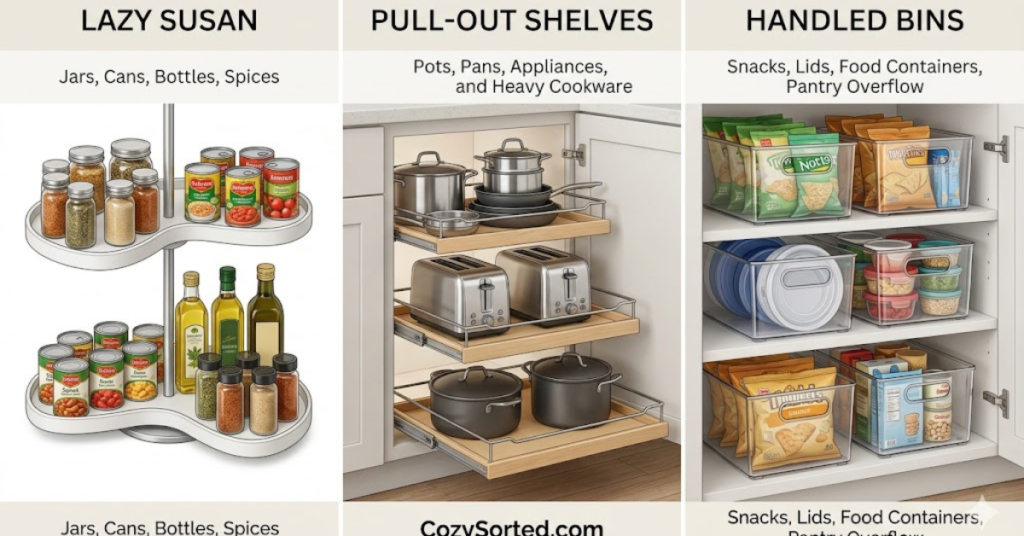
A lazy Susan works best for round, medium-weight items. Pull-out shelves work best for heavy or bulky items. Bins work best for low-cost, flexible, and renter-friendly cabinet organization.
Use this simple choice guide:
- Choose a lazy Susan for jars, cans, bottles, and spices
- Choose pull-out shelves for pots, pans, appliances, and heavy cookware
- Choose bins for snacks, lids, food containers, and pantry overflow
- Choose shelf risers when the cabinet has tall empty space
- Choose vertical dividers for lids, trays, boards, and pans
Example: Use bins in an apartment cabinet. Use pull-outs in an owned home with a deep blind base cabinet.
When is a lazy Susan better?
A lazy Susan is better when the cabinet holds round, medium-weight, frequently accessed items.
Use it for jars, cans, spices, bottles, bowls, and pantry goods. A rotating cabinet organizer works best when the cabinet opening allows smooth turning and the items are not too tall.
Do not use a lazy Susan for loose lids, heavy cast iron, or unstable stacks. Those items shift when the tray rotates.
Example: Use a pantry lazy Susan for sauces, oils, and jars in a deep corner cabinet.
When are pull-out shelves better?
Pull-out shelves are better when the cabinet stores heavy, bulky, or hard-to-lift items.
Use pull-out shelf cabinet storage for pots, pans, appliances, mixing bowls, and cookware. A blind base pull-out brings items forward, so you do not need to reach into the back corner.
Pull-out shelves cost more than bins and may need installation. They work best in owned homes or approved rentals.
Example: Use a sliding shelf storage setup for a stand mixer, large pot, or heavy pan set.
When are bins better?
Bins are better when the cabinet needs low-cost, flexible, and renter-friendly organization.
Use clear cabinet bins for snacks, lids, food containers, baking items, packets, and pantry overflow. Choose handled bins for cabinets so you can pull out the whole category at once.
Bins work well when your cabinet has odd angles or when you cannot install hardware.
Example: Use one bin for snack bags, one bin for lids, and one bin for baking packets.
How do you keep a deep corner cabinet organized long term?
You keep a deep corner cabinet organized long term by resetting zones, checking labels, removing unused items, and avoiding category creep.
Category creep happens when random items slowly enter a zone. A cookware zone turns messy when snack bags, lids, party plates, and appliance parts get added without a plan.
A long-term cabinet organization system needs small resets. It does not need a full cleanout every week.
Example: After a grocery trip, return pantry overflow to the same bin instead of pushing new items into the front zone.
How often should you reset the cabinet?
Reset the cabinet every 4 to 8 weeks, or whenever items start getting buried again.
Quick resets work best after grocery trips, seasonal cooking, holidays, and pantry restocks. A cabinet reset routine keeps labels, zones, and containers useful.
Use this short checklist:
- Remove items that do not belong
- Throw away expired pantry goods
- Return each category to its zone
- Move daily-use items back to the front
- Check bins, labels, and shelf risers
- Wipe the shelf before restocking
Example: Reset the cabinet after holiday cooking because serving dishes and trays often move out of place.
How should you maintain labels, zones, and inventory?
Maintain labels, zones, and inventory by keeping every item category visible and easy to return.
Replace unclear labels. Remove expired food. Check duplicate containers. Keep front zones clear. Update categories when your kitchen routine changes.
A label should name the category, not every item inside it. Use short names like “lids,” “snacks,” “baking,” “serving,” and “pantry overflow.”
Example: If your family stops using plastic lunch containers, reduce that bin and give more space to daily cookware.
Deep corner cabinet organization works when you measure corner cabinet space first, maximize corner cabinet storage with the right organizers, and keep deep kitchen cabinet storage easy to reach over time.

Mike Mann writes practical home organization and small-space living guides for CozySorted. His work focuses on apartment-friendly storage, clutter-free routines, bedroom organization, and simple systems that help renters, apartment dwellers, and small-space homeowners create calmer, easier-to-maintain homes.