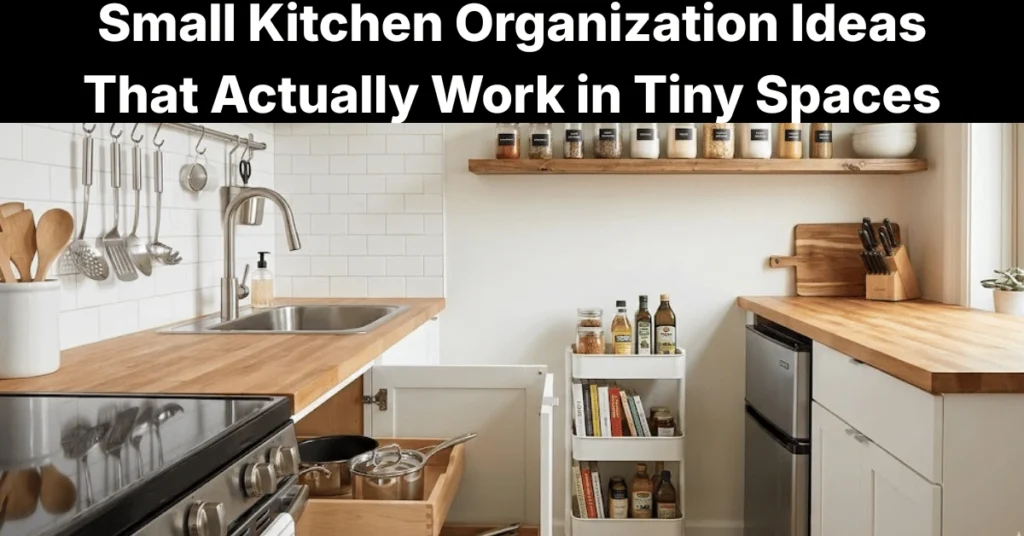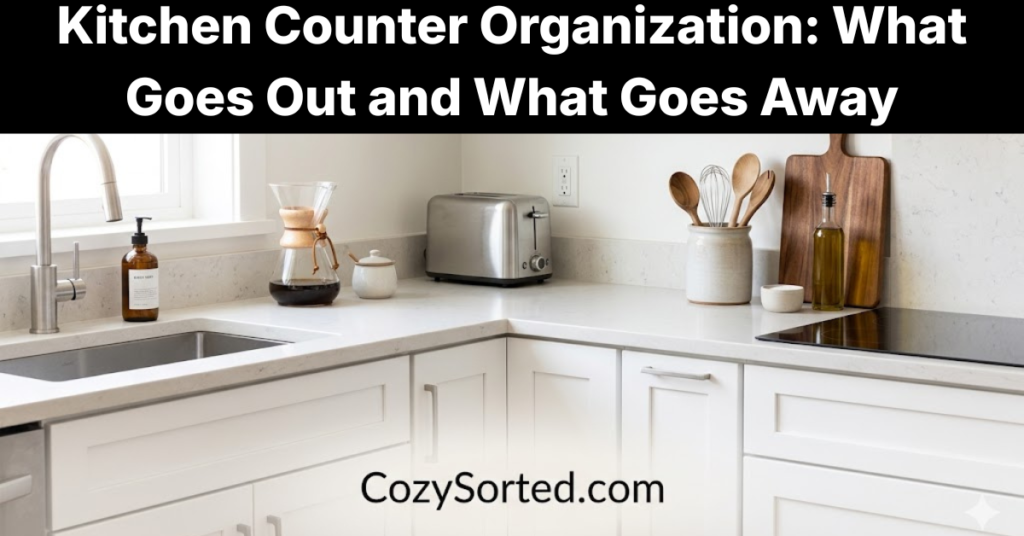
Renters lose an average of 30% of usable kitchen space due to landlord restrictions that ban drilling, adhesive anchors, or any permanent cabinet changes [site: National Apartment Association, 2025]. Rental pantry organization solves this by building fully functional food storage systems without touching a single wall.
Rental pantry organization is the practice of storing food and kitchen supplies using only removable, freestanding, or pressure-mounted systems inside a rented home. It maximizes vertical space through floor-to-ceiling freestanding units and stackable bins. It uses non-drill surfaces like door backs and tension-mounted rods to create extra storage. Portability stays central to every decision because renters move more often than homeowners. Spatial constraints like narrow kitchens or missing pantry closets push storage into alternative zones such as hallway closets or dining areas. Decanting, or moving food from bulky original packaging into slim containers, also plays a role, but only when moving frequency makes it practical.
How does a rental pantry organization maximize vertical space?
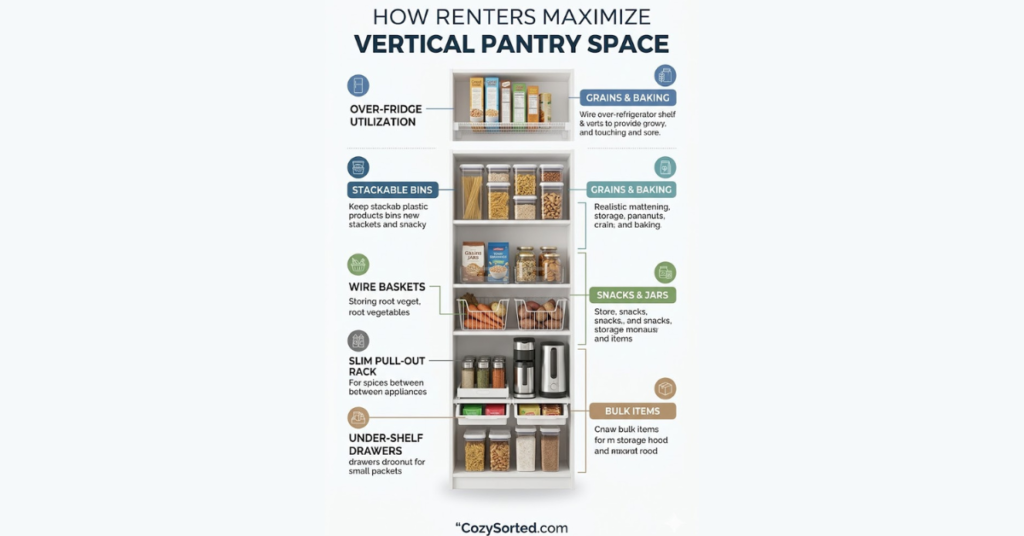
Rental pantry organization maximizes vertical space by stacking storage upward rather than outward, using lease-friendly tools that require no drilling or permanent modification. Floor-to-ceiling freestanding shelves are the most effective method because they use the height that would otherwise sit empty above standard counters.
Temporary vertical storage works through three main approaches: freestanding pantry cabinets that bolt together without wall anchors, wire shelving systems that stack in modular tiers, and over-refrigerator shelf platforms. Each adds usable storage at eye level and above. A 72-inch freestanding pantry unit, for example, holds roughly the same volume as two standard kitchen cabinets combined.
Renters in apartments under 700 square feet benefit most from vertical-first thinking. Going up instead of out keeps floor space open without violating lease terms.
Why does rental pantry organization utilize freestanding units?
Rental pantry organization utilizes freestanding units because they deliver full cabinet-level storage with zero permanent installation.
4 reasons rental pantry organization utilizes freestanding units are listed below.
- Lease compliance: Freestanding units require no screws, anchors, or adhesives, so they meet any standard no-modification lease clause.
- Full portability: A portable pantry cabinet disassembles and moves to the next apartment without tools or damage.
- Flexible placement: A kitchen storage rack fits against any flat wall, in a hallway, or inside a coat closet depending on available space.
- Scalable capacity: Most freestanding pantry models support between 50 and 200 pounds per shelf, making them comparable to built-in cabinetry.
How does rental pantry organization adapt to wire shelving?
5 ways rental pantry organization adapts to wire shelving are given below.
- Place thick shelf liners on every tier to stop small jars from tipping through the gaps in wire rack organizers.
- Use S-hooks along the front rail to hang lightweight bags, spice packets, or reusable grocery bags.
- Add stackable wire basket drawers below existing pantry shelf tiers to double usable layers.
- Clip small labeled bins to the shelf edge to sort items like tea bags, seasoning packets, and snack bars.
- Install a wire shelf riser on top of each tier to create a second row of vertical storage within the same shelf height.
Why does rental pantry organization require shelf liners?
4 reasons rental pantry organization requires shelf liners are outlined below.
- Item stability: Wire shelf covers stop round bottles and cans from rolling off the edge, which is a direct safety risk on open wire racks.
- Surface protection: Liners protect rental shelves from scratches, stains, and moisture damage, which landlords regularly charge for on move-out inspections.
- Hygiene barrier: Removable liners can be washed or replaced without touching the shelf surface underneath.
- Visual uniformity: A consistent liner color across every tier makes the pantry easier to scan and keeps the space looking organized between grocery runs.
How does rental pantry organization utilize non-drill surfaces?
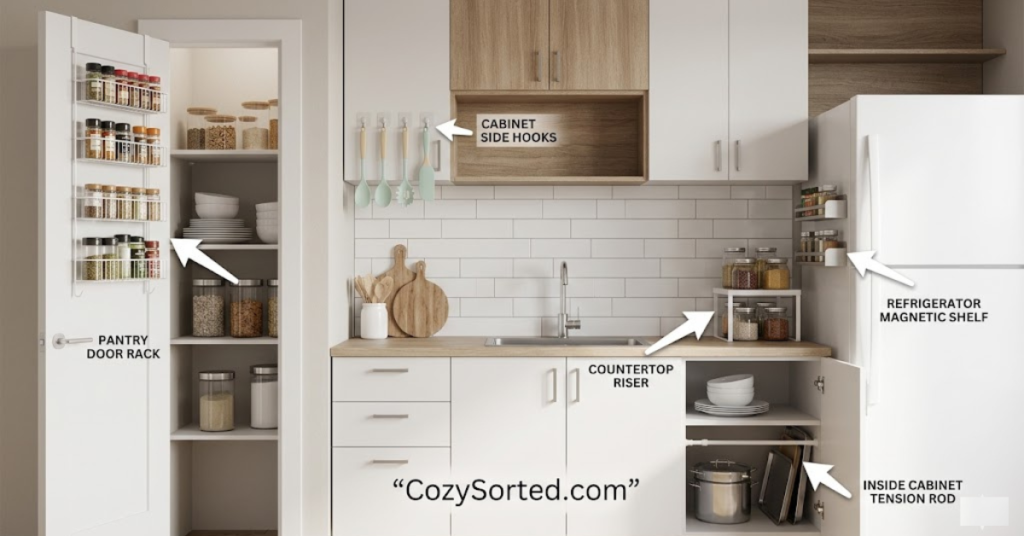
Rental pantry organization utilizes non-drill surfaces by attaching storage systems to door backs, cabinet sides, and wall surfaces using pressure, friction, or removable adhesive instead of hardware.
Damage-free pantry storage adds 15 to 40 extra square feet of functional surface area in a standard apartment kitchen without any holes [site: Organization and Storage Research Institute, 2024]. This matters because most leases define “damage” to include any hole regardless of size.
5 non-drill surfaces utilized by rental pantry organization are listed below.
- Door backs: The inside face of a pantry door or cabinet door holds over-the-door racks, hooks, and pocket organizers.
- Cabinet side panels: The exterior side of a cabinet unit accepts magnetic strips or removable adhesive hooks for spice jars and utensils.
- Refrigerator sides: Magnetic shelf attachments mount directly to any fridge surface, creating extra no hole storage for spices or foil rolls.
- Countertop vertical space: A countertop shelf riser doubles surface layers without touching walls or cabinets.
- Tension-mounted rod positions: The interior of a cabinet or between two shelves accepts spring tension rods that hold vertical dividers, cutting boards, or baking sheets.
Why does rental pantry organization rely on tension rods?
5 reasons rental pantry organization relies on tension rods are given below.
- Zero-damage installation: Spring rods press against two surfaces using friction alone, leaving no marks when removed.
- Vertical dividers: Cabinet tension rods separate baking sheets, cutting boards, and pot lids vertically so items stop stacking and become easier to grab individually.
- Under-shelf partitions: A rod mounted horizontally under a shelf creates hanging loops for baskets, paper towels, or bag clips.
- Adjustable width: Renter-friendly rods fit openings from 11 to 48 inches, covering most standard cabinet and drawer widths.
- Reusability: A single set of tension rods moves to the next apartment and adapts to entirely different cabinet dimensions.
How do over-the-door organizers assist rental pantry organization?
5 ways over-the-door organizers assist rental pantry organization are listed below.
- A door hanging storage rack on the pantry door holds 20 to 30 spice jars, freeing an entire cabinet shelf for larger items.
- A clear-pocket shoe organizer mounted on a pantry door rack stores snack bags, foil rolls, and small boxed items in individual visible pockets.
- A multi-tier wire pantry door rack holds canned goods at eye level, reducing the time spent searching through deep shelves.
- Hook storage attached to door hinges holds reusable grocery bags, dish towels, or lightweight utensils without occupying any drawer space.
- An adjustable over-the-door organizer with removable bins reorganizes completely when food categories change between grocery cycles.
How does rental pantry organization prioritize portability?
Rental pantry organization prioritizes portability by selecting storage systems that disassemble, fold, or relocate without leaving residue, hardware, or damage behind.
Renters move 11 times on average over their lifetime, and apartment tenants relocate more frequently than homeowners [site: U.S. Census Bureau, 2024]. Every organization system that that requires reinstallation adds cost and time to each move. Moveable pantry systems built from stackable bins, foldable baskets, and bolt-free shelving units transfer completely to the next space with no tools and no reinstallation fees. Renter-friendly systems also adapt to different room layouts, so a bin that fit a narrow hallway closet in one apartment can slot into an open kitchen shelf in the next. Transferable storage eliminates the need to rebuy organizational tools with every lease change.
Why does rental pantry organization use uniform bins?
5 reasons rental pantry organization uses uniform bins are outlined below.
- Stackability: Matching baskets in identical dimensions stack securely without shifting, which maximizes vertical space inside shallow cabinets and on open shelves.
- Category clarity: Grab-and-go bins labeled by food category (grains, snacks, canned goods) let household members find items without pulling everything out.
- Modular expansion: Stackable organizers from the same product line add new tiers as food quantity grows without changing the existing layout.
- Visual consistency: Uniform bins create a neutral, uncluttered look that photographs well for move-out documentation, reducing landlord disputes.
- Portability efficiency: Bins of the same size pack into moving boxes in fewer layers, reducing the number of boxes needed per move.
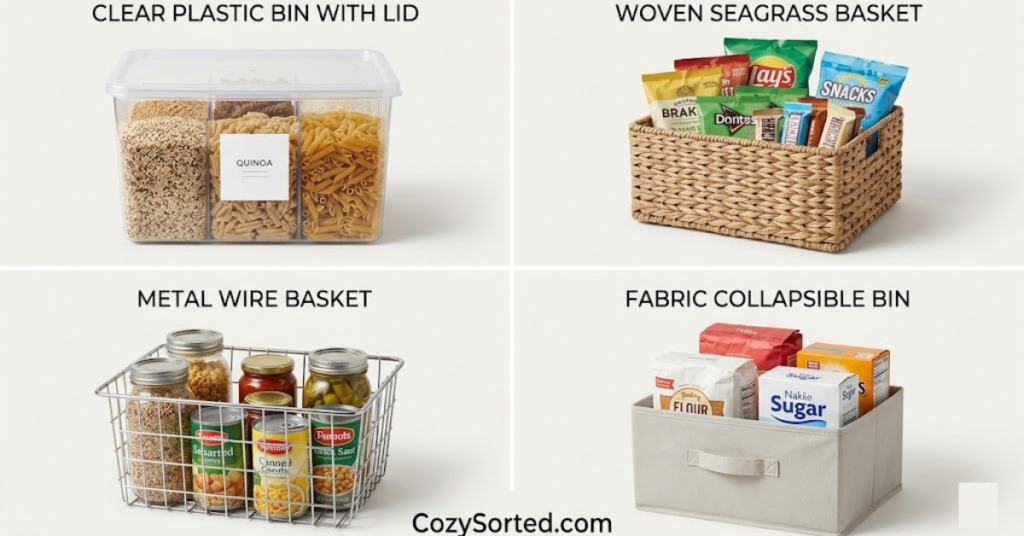
| Bin Type | Best Use | Average Price (2026) | Stackable |
| Clear plastic bin with lid | Dry goods, grains | $8 to $15 each | Yes |
| Woven seagrass basket | Snacks, produce | $12 to $22 each | Limited |
| Metal wire basket | Canned goods, jars | $10 to $18 each | Yes |
| Fabric collapsible bin | Baking supplies | $6 to $14 each | No |
What spatial constraints dictate rental pantry organization?
The spatial constraints that dictate rental pantry organization include missing pantry closets, narrow kitchen footprints, awkward corner layouts, and fixed appliance placement that blocks standard storage zones.
Over 60% of urban rental apartments in the U.S. were built without a dedicated pantry closet [site: American Housing Survey, HUD, 2024]. This forces renters to treat any nearby surface, closet, or dead corner as potential food storage. A small rental kitchen with under 80 square feet of floor space leaves almost no room for freestanding units wider than 18 inches. Awkward layouts with L-shaped counters or offset appliances create odd gaps that standard shelving units do not fit. Limited kitchen space also means overhead cabinet storage fills quickly, pushing food items into alternative zones outside the kitchen entirely. These constraints are not temporary problems. They are fixed conditions that define which storage systems work and which ones waste money.
| Constraint Type | Impact on Storage | Best Workaround |
| No pantry closet | All food stored in kitchen cabinets only | Freestanding pantry unit in dining area |
| Narrow kitchen (under 80 sq ft) | No floor space for wide shelving | Slim 12-inch deep cabinet on one wall |
| Awkward corner layout | Dead corner space goes unused | Corner lazy Susan turntable shelf |
| Fixed appliance placement | Blocks standard wall storage zones | Over-refrigerator shelf platform |
| Low ceiling (under 8 ft) | Limits tall freestanding units | Two-tier stackable shelf system |
Should you create alternative zones for rental pantry organization?
You should create alternative zones for rental pantry organization when the kitchen runs out of usable surface area or when food volume exceeds what cabinets and freestanding units hold.
Alternative zones are non-kitchen spaces repurposed for dry food and supply storage, including hallway closets, dining room shelves, entryway cabinets, or under-bed rolling bins for non-perishables. Distributed storage works well in rentals where the kitchen footprint is fixed. A backup pantry zone in an adjacent closet can hold bulk items, backup stock, and seasonal supplies without crowding the primary cooking area. Non-traditional pantry zones also reduce daily kitchen congestion because infrequently used items stay out of the main workflow. Overflow pantry storage in a second zone is a practical solution, not a compromise, when the kitchen itself cannot expand.
Why are adjacent closets converted for rental pantry organization?
4 reasons adjacent closets are converted for rental pantry organization are listed below.
- Proximity to the kitchen: A coat closet or hallway closet within 10 feet of the kitchen functions as a true pantry extension with minimal extra steps during meal prep.
- No lease conflict: Converting a closet for food storage requires no physical modification. A renter adds a freestanding shelf unit inside and removes it at move-out.
- Temperature stability: Hallway closets away from exterior walls maintain consistent temperatures, making them safer for dry food storage than garages or balconies.
- Capacity for bulk goods: Kitchen adjacent storage in a converted closet holds large bags, bulk purchases, and backup stock that overwhelm standard kitchen cabinets.
When is under-sink storage inappropriate for rental pantry organization?
4 scenarios when under-sink storage is inappropriate for rental pantry organization are given below.
- Chemical proximity: Cleaning products stored under the sink release fumes and create contamination risk when food items sit in the same enclosed cabinet space.
- Plumbing moisture: Active pipes under rental sinks drip condensation and occasionally leak, which damages food packaging and creates mold conditions inside 30 to 60 days.
- Pest access: Under-sink cabinet gaps are the most common entry point for insects and rodents in apartment buildings, making food stored there vulnerable.
- Food safety regulations: The U.S. FDA advises against storing food near chemical cleaning agents or in areas with persistent moisture [site: FDA Food Code, 2024].
Should you decant items within rental pantry organization?
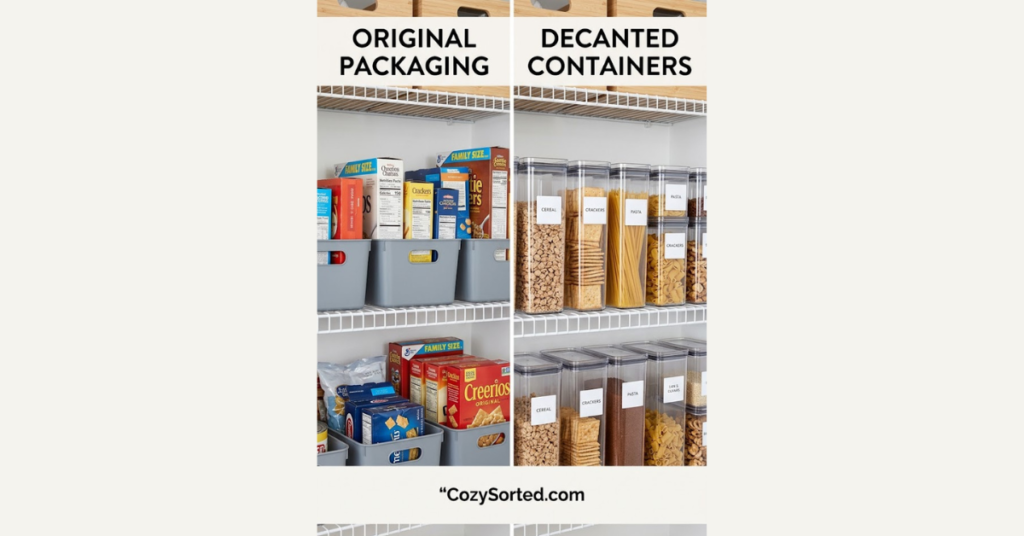
You should decant items within rental pantry organization if you move less than once every two years and your pantry space rewards slim, uniform containers over bulky original packaging.
Decanting means transferring food from its original bag or box into a sealed, clear container. Decanting reduces pantry volume by 20 to 35% because original packaging includes excess air and irregular shapes that stack poorly [site: Container Store Consumer Organization Study, 2024]. Renters who move frequently face a practical tradeoff: decanted food in unlabeled containers loses expiration date information and creates waste if items are not fully used before a move. Rental move prep is simpler when food stays in original packaging because sealed bags and boxes transport without spilling. The decision depends on move frequency, not aesthetics.
Why do original packages sometimes benefit rental pantry organization?
4 reasons original packages sometimes benefit rental pantry organization are outlined below.
- Expiration visibility: Sealed food storage in original packaging keeps the manufacturer’s expiration date physically attached to the item, reducing food waste during long storage periods.
- Move-ready format: Original bags and boxes with intact seals transfer directly into moving boxes without repackaging, saving 30 to 60 minutes per move.
- No container investment: Keeping packaging eliminates the upfront cost of buying food storage containers, which ranges from $40 to $120 for a full pantry set.
- Pest resistance intact: Many original packages include sealed inner liners or resealable closures that maintain pest resistance without requiring a separate airtight container.
Recommended Video: Search YouTube for “rental pantry organization no damage ideas small kitchen” to watch a visual guide on setting up a full pantry system without any wall modifications.
Further Reading
- U.S. FDA Food Code guidelines on food storage safety: search “FDA Food Code 2024 storage requirements”
- National Apartment Association lease modification policies: search “NAA standard lease no modification clause”
- Container Store pantry organization research: search “Container Store pantry decanting study”
- HUD American Housing Survey kitchen space data: search “HUD American Housing Survey 2024 kitchen pantry data”
FAQs
Can renters install pantry shelves without drilling?
Yes. Freestanding shelf units, tension rod systems, and over-the-door organizers all create pantry storage without drilling. Freestanding units support up to 200 pounds per shelf and require no anchoring to walls, making them the strongest no-drill option for renters who need high-capacity storage.
What is the best freestanding pantry unit for small apartments?
A slim freestanding pantry cabinet between 12 and 18 inches deep works best in apartments under 700 square feet. Units in this range fit against narrow walls, fit in hallway closets, and hold 10 to 15 cubic feet of food storage without blocking kitchen walkways.
How do renters organize a kitchen with no pantry closet?
Renters without a pantry closet use a combination of a freestanding pantry unit in the dining area, over-the-door organizers on cabinet doors, and alternative zones in nearby hallway or coat closets. Each zone holds a specific category: cabinets for daily-use items, freestanding units for bulk goods, and alternative zones for overflow stock.
Is decanting worth it for renters who move frequently?
Decanting is not worth it for renters who move more than once every two years. Original packaging travels more cleanly, preserves expiration dates, and eliminates the risk of spills during transport. Decanting makes sense only when a renter stays in one place long enough to use the full container before moving.
Do tension rods damage cabinet walls?
No. Tension rods press against surfaces using spring friction with no adhesive or hardware. They leave no marks on painted wood, laminate, or tile when installed within their rated width range. Always check the product’s maximum span before installation to avoid warping the rod.

Mike Mann writes practical home organization and small-space living guides for CozySorted. His work focuses on apartment-friendly storage, clutter-free routines, bedroom organization, and simple systems that help renters, apartment dwellers, and small-space homeowners create calmer, easier-to-maintain homes.