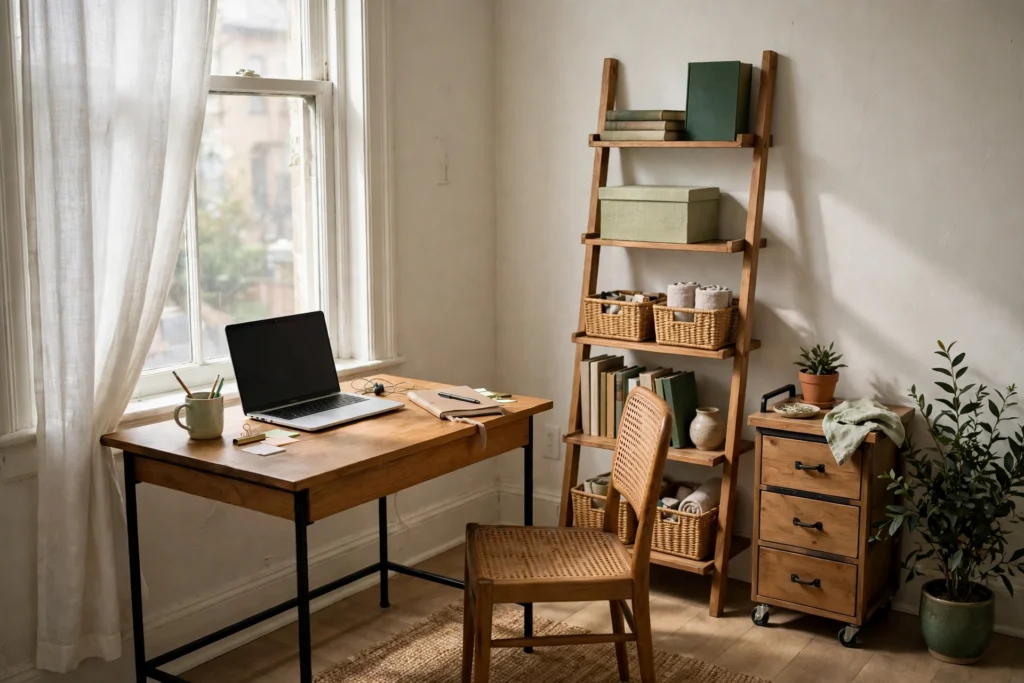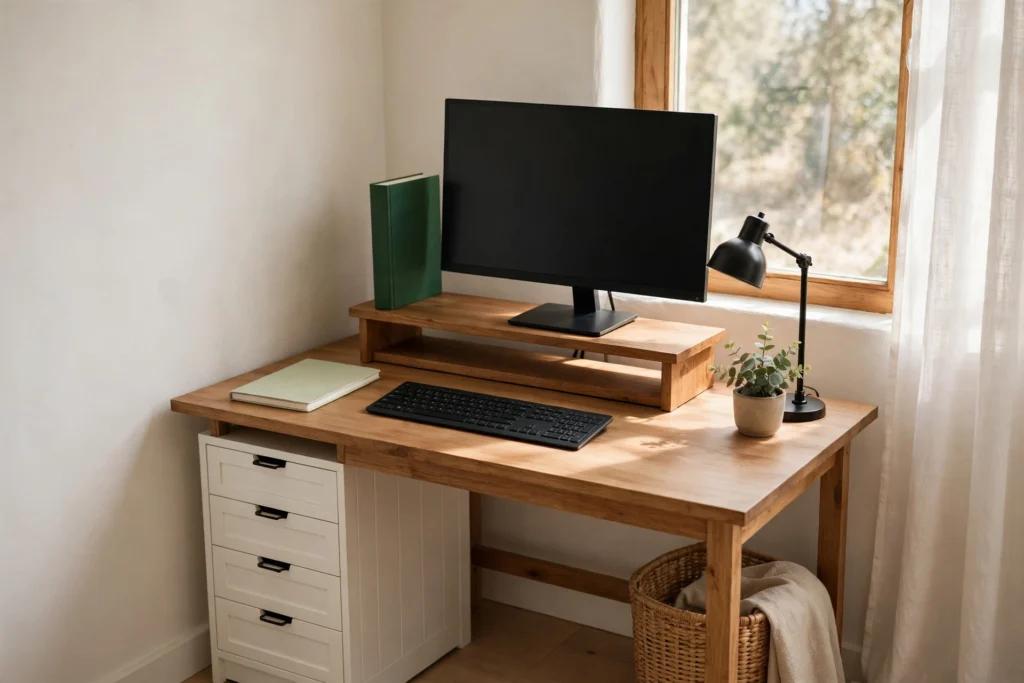
Paper piles are not a tidiness problem. They are what happens when paper has no workflow: no decision when it arrives, no stages to move through, and no exits. A home office filing system that actually holds is a small machine with four parts: a decision for every sheet (keep it or release it), three stages that give each kept sheet a home matched to how often it is touched, one shallow structure of categories and labels that makes anything findable in under a minute, and a short maintenance rhythm that moves paper down the stages and out of the house before it can become a pile again. Build those four parts once, and the desk stops being where paper lives, because every sheet that enters the office already has a fate.
Which Papers Should You Keep, and Which Should Leave?
Keep a sheet only if it passes one of three tests, and release everything else the day you make the decision. You need the original itself: signed agreements, certificates, official documents whose paper form is the proof, anything an authority would want to see as an original rather than a copy. You will genuinely consult it again: the reference manual for the equipment you own, the contract you are mid-way through, the records an ongoing matter depends on. You cannot get it again: the annotated letter, the one-off document no institution can reissue. A sheet that passes none of the three leaves, by one of three exits: recycling for the ordinary, shredding for anything carrying personal, financial, or account details (the sensible general practice for sensitive paper), or scanning and then releasing the original when a digital copy serves every purpose the paper did and the original itself is not the proof.
The tests cut deeper than they look. Duplicates fail all three. Statements and bills that the issuer keeps available fail the second and third. Expired documents, last year’s insurance schedule, the manual for a machine you no longer own, fail everything. What survives the tests in a typical home office is a surprisingly thin stack, which is the point: filing systems do not collapse under important documents; they collapse under paper that was never decided. One caution belongs here and nowhere fancier: tax and legal records carry retention expectations that vary by place and situation, so for those categories, keep generously and follow your local requirements rather than any article’s guess, including this one.
How Do Active, Reference, and Archive Papers Differ?
By how often they are touched, and that single difference decides where each one lives and how it is stored. Active paper is being worked on now: the form half-filled, the project brief in play, the bill awaiting its payment date. Its life is days to a few weeks, its volume is small, and it belongs within arm’s reach, in the current folder or the in-tray, because you will touch it again this week. Reference paper is finished being worked on but kept for consultation: the signed contract, the equipment records, the policies. Its life is months to years, it is touched rarely but must be findable instantly when it is, and it belongs filed properly, one step removed from the desk. Archive paper is kept for the record: completed years, closed matters, documents retained from obligation or history rather than use. It may not be touched for years at a time, and it belongs out of the office’s working space entirely.
The stages matter because most home offices store all three kinds the same way, in the same pile or drawer, so the two active sheets drown under forty archive ones. They also matter because paper moves: this month’s active contract becomes next quarter’s reference and next year’s archive, and a filing system is mostly a machine for moving sheets down that ladder on schedule. A sheet that never demotes is a sheet that will eventually bury the ones still in play.
How Should Incoming Paper Be Handled So It Never Piles Up?
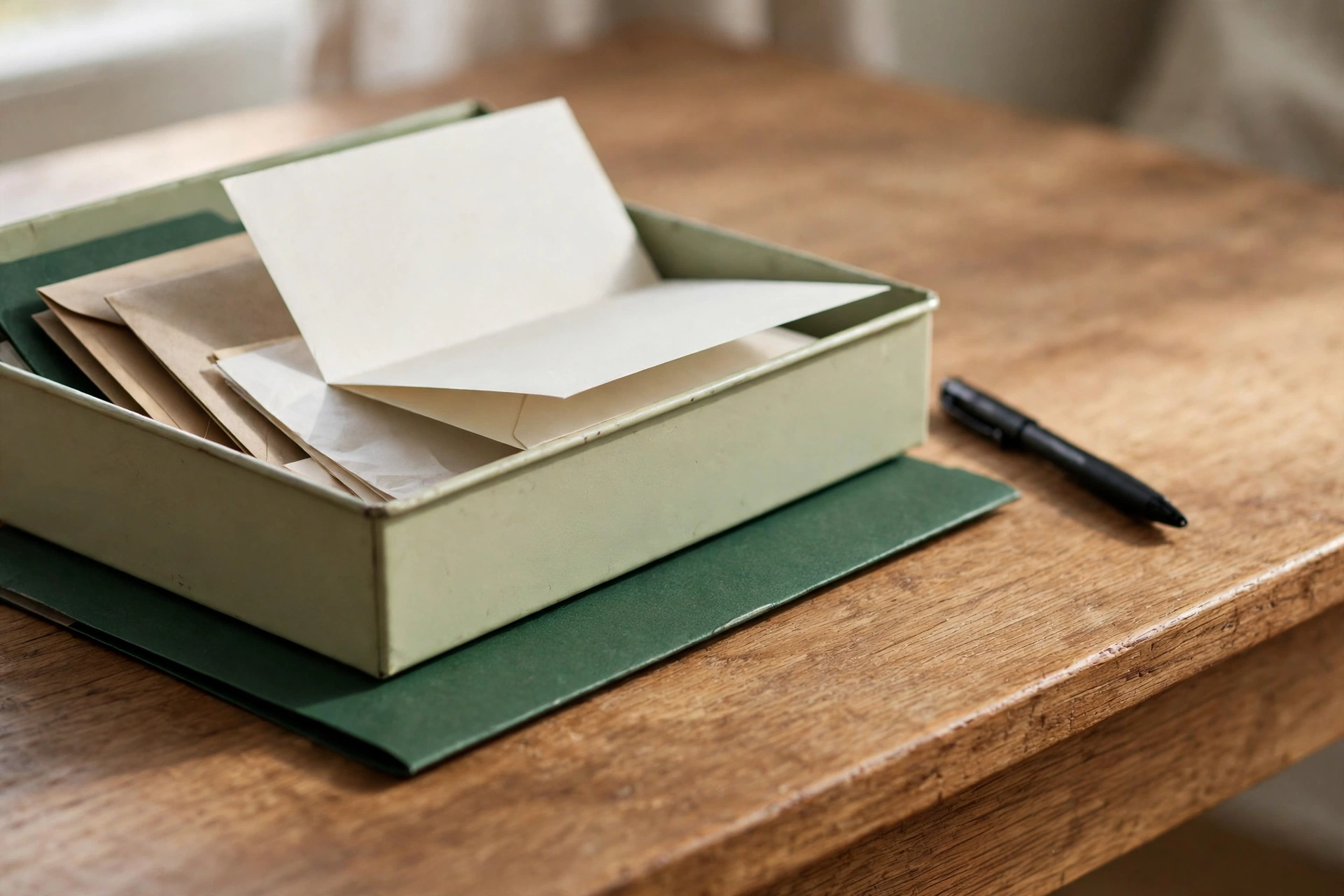
It gets its decision at the door, at the one landing place every sheet enters through, and it is never set down anywhere else “for now.” The landing place, the tray or slot the wider office system already assigns to incoming paper, is operated as an intake station: mail is opened standing at it, deliveries are unpacked beside it, and every sheet is given one of four fates on the spot or at the standing weekly processing (below), with no fifth option called later. Act: the sheet needs something done soon; it goes to the active stage, the in-tray or current folder, with its action as its reason for being there. File: it is already finished and kept; it goes straight to its reference folder. Scan and release: a copy serves; the original exits. Exit: recycle or shred bin, immediately, not via a maybe pile.
The discipline that makes this work is that the landing place is the only legal waiting room for undecided paper, and it is emptied completely on its rhythm, so nothing lives there longer than a week. Paper set down on the desk, the kitchen counter, or the stairs is paper that has left the system on its first day, and it will be joined by tomorrow’s arrivals wherever it landed. Piles are not formed by large volumes of paper. They are formed one “for now” at a time, and intake is where “for now” is refused.
What Filing Structure Works for a Small Home Office?
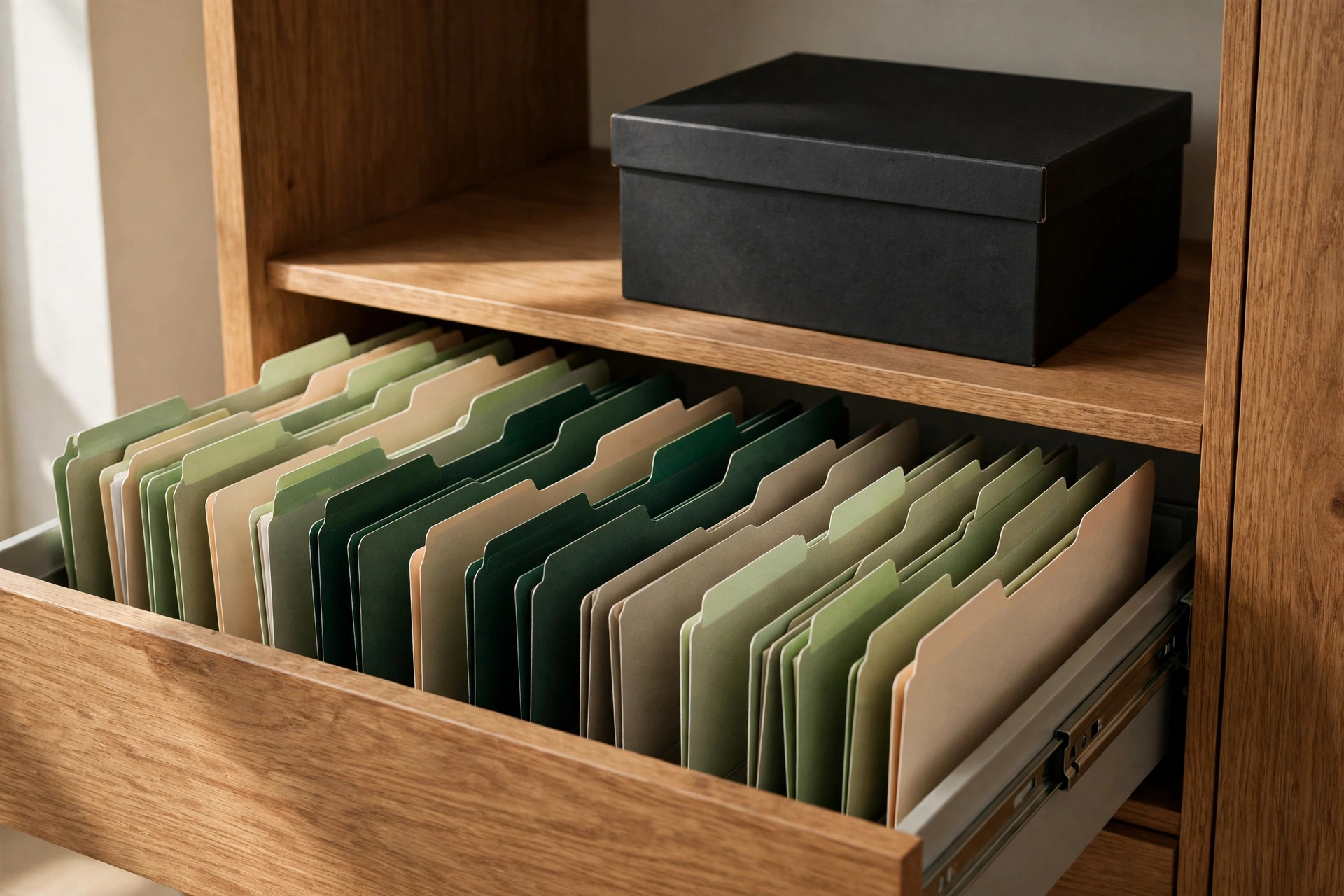
A shallow one: a single level of categories named for areas of responsibility, with one level of folders inside each, all of it fitting in one drawer, one file box, or one short run of binders. The pattern that fits most households runs to six or eight categories along the lines of money, home, health, work, identity and legal, projects, and people, adapted freely to the life actually being lived; a freelancer’s work category may split by client, a small household’s may not need projects at all. Inside each category, folders are named for the specific contents: the category says whose job it is, the folder says what it is. Two levels is the whole architecture. A third level, sub-folders inside folders, is where small systems go to become unsearchable, because no one remembers which branch they chose.
Containers follow the stages. Active paper lives flat and visible: the in-tray and one current folder, no filing furniture at all. Reference paper takes the real structure: hanging folders in a drawer or file box for most homes, since they hold categories upright, labeled, and flickable; binders earn their place for one bulky, sequential subject, a property’s documents, a long project’s record, where pages are read in order. Archive paper goes in a lidded box, labeled by category and year on the outside, because it is retrieved by the box, not by the sheet. Whatever the containers, the test of the structure is physical: the whole reference system should be openable, searchable, and closable with one hand and no rearrangement, or it will be bypassed by Friday.
How Should You Label Files So You Can Find Anything Fast?
Label for the person who will search in eight months, who is you, but with no memory of the filing day. The reliable pattern is category, then item, then year where time matters: “Money, Mortgage statements, 2026” retrieves itself; “Important stuff” retrieves nothing. Write labels in the words the searcher will think in when the document is needed, which are usually the words on the document itself: the issuer’s name, the policy’s subject, the project’s title, not your private shorthand for them. Consistency beats cleverness everywhere in this system: the same kind of document gets the same label shape every time, years file in the same direction, and new folders are named by the pattern, not by the mood.
The quality bar is a test, and it is worth running literally once the system is built: pick five documents at random, and time how long each takes to find using only its label logic. Under a minute each, the system works. Over a minute, the labels are describing the filing instead of the finding, and they get rewritten toward the searcher’s words. For the archive box, add one more aid: an index sheet on top inside the lid, or the first item in the box, listing what the box holds by category and year. Archive retrieval is rare enough that the box should explain itself, because nobody remembers a box they packed three years ago.
Where Should Each Kind of Paper Live?
At a distance matched to its stage, so the office’s valuable space is spent only on paper that earns it. Active paper lives at the desk: the in-tray on its edge and the current folder in the top drawer, inside the working surface’s orbit, because every day it is touched it should cost zero steps. Reference paper lives in the office but off the desk: the file drawer, the file box on the shelf, the binder run, reachable from the chair or with one stand, consulted without an expedition but never spread across the work field. Archive paper leaves the office’s working space altogether: the closet shelf, the storage cupboard, the top of the wardrobe in the other room, anywhere dry and findable-by-box, because a document touched once in three years has no claim on the room you work in daily.
The ladder is the system’s quiet engine. When archive paper sits in the desk drawer, it evicts reference paper to the shelf; the shelf evicts active paper to the surface; and the surface becomes the pile the whole system existed to prevent. Distance is not banishment, it is pricing: each stage pays for its space with its frequency, and the desk, the most expensive square footage in the office, is reserved for paper in play.
How Does the Filing System Keep Paper Off the Desk?
By leaving the desk nothing to hold. The desk’s own rule, from the desk-organization side of this cluster, is that paper in play is the only paper on the surface: the document being read, signed, or copied from, and nothing else. The filing system makes that rule easy to keep, because it removes every excuse paper uses to stay. Waiting paper has the landing place. Finished paper has a folder it can reach in seconds. Paper with no category has a diagnosis, not a pile: it means the structure is missing a category, and the fix is to add or rename one, five minutes at the weekly processing, rather than to tolerate a homeless stack that teaches every new arrival to join it.
This is the difference between a desk that is tidied and a desk that stays clear. Tidying moves the pile into a drawer and calls it done; the pile re-forms because its causes, undecided arrivals and homeless sheets, are untouched. In a working filing system the desk clears itself as a side effect: intake decides arrivals, stages house the kept, exits remove the rest, and the surface is left holding only the work, which was the point of having a desk.
How Do You Maintain the System Without It Decaying?
On two short rhythms, because filing systems decay by drift, not disaster, and drift is cheap to reverse weekly and expensive quarterly. Weekly, the processing appointment: ten to fifteen minutes at a standing time, emptying the landing place completely, every sheet acted on, filed, scanned, or exited; demoting last week’s finished active paper into reference; and fixing the one structural annoyance the week revealed, the folder that overflowed, the category that needs renaming. Seasonally or twice a year, the demotion pass: reference folders are flicked through for paper whose stage has expired, closed matters, superseded versions, documents whose issuers now keep them, and those move to archive or out; the archive gets the same test with a harder eye, because archive is where paper goes to be forgotten, and some of it deserves to be.
Two rules protect the structure during maintenance. A category that outgrows its folder splits by year or by sub-topic; it never spawns a miscellaneous folder, because “miscellaneous” is not a category but an admission that deciding has stopped, and a misc folder is a pile with a label. And the exits run at every rhythm, not just the big ones: a system that only releases paper twice a year spends the other fifty weeks accumulating, while one that recycles and shreds weekly stays the size it was designed to be. That is the whole maintenance doctrine, and it is deliberately boring: small, regular, and finished in minutes, which is exactly why it survives contact with real life, unlike the heroic annual purge it replaces. The office this paper flows through, the spot, the zones, and the nightly close that sweeps the last sheet home, is the wider system this workflow plugs into: the small home office system for renters.

Mike Maan writes practical home organization and small-space living guides for CozySorted. His work focuses on apartment-friendly storage, clutter-free routines, bedroom organization, and simple systems that help renters, apartment dwellers, and small-space homeowners create calmer, easier-to-maintain homes.