
A home office in a rental has to satisfy two landlords: the work, which wants a permanent, dedicated, fully equipped station, and the lease, which wants the property back exactly as it was. The renters who make working from home work are not the ones with the most gear. They are the ones running a system: claim a spot chosen by criteria rather than by whichever corner was empty, let a set of renter rules veto anything permanent before it is bought, organize what remains into four zones, control what an office accumulates, and shut the whole thing down at the end of the day so the rented room stays a home. None of it requires a spare room, and none of it leaves a mark.
Claim the Spot: Where a Rental Office Can Go
The spot decides more than the furniture does. Judge every candidate against the same five criteria, in this order, because a beautiful desk in the wrong place fails every workday.
- Light you can use. Daylight from the side is the prize: a window in front of the screen washes it out with glare, a window behind you puts your face in shadow on every call and reflects in the screen. Side light, or a spot where a curtain or blind can tame the window, wins.
- Power within reach. The spot needs an outlet close enough that one power strip serves the whole setup without a cable crossing a walkway. A spot that fails this test creates cable problems no organizer can fully fix later.
- A boundary for calls. A door that closes is ideal; a corner that faces a wall, so your background is a wall and not your bed or your kitchen, is the workable second. Video calls punish spots chosen without this in mind.
- The least damage to the host room. Every spot is borrowed from another use. The question is which room can lend space at the lowest cost to its real job: a living room corner costs less than half the bedroom in a studio, because the bedroom’s job includes sleep.
- Distance from the bed. If the office must live in the bedroom, put it as far from the bed as the room allows, ideally out of the direct line of sight from the pillow. Working where you sleep blurs both; physical distance and the shutdown routine later in this page are the renter’s two tools against it, since a separate room is not on offer.
Against those criteria, renters realistically have four spot types. A corner of the living room or bedroom is the most common and the most flexible: it takes a small desk, keeps a wall at your back, and can be visually closed off at night. The corner build itself, desk choice and layout in a few square feet, is its own topic in this cluster. A closet with its doors opened out, or removed and stored safely where the lease allows it, converts dead storage into the only spot with a true boundary, at the cost of the storage it held and any daylight at all; it suits call-heavy work and small footprints, and everything removed from it needs a home elsewhere first. A wall stretch in a hallway, landing, or the wide part of a kitchen takes a shallow desk or a wall-hugging table where no corner exists; it borrows circulation space, so it must stay shallow and shutdown-friendly. A shared table, usually the dining table, is the last resort and the most demanding: the office exists only while it is set up, so it lives or dies by the portability and shutdown rules below. The household side of that bargain, agreeing the office’s hours and edges with the people who share the room, is its own topic in this cluster. Choose the first type your floor plan offers that passes the five criteria; a corner that passes beats a closet that fails on light, and a shared table with a ruthless shutdown beats a corner that fails on power.
One condition changes the math: how many days a week you actually work there. A five-day office can justify a dedicated corner and permanent-feeling setup. A two-day hybrid office has to earn its footprint on the five days it is not used, which pushes toward the closet, the wall stretch, or the shared table, and toward furniture that folds, rolls, or doubles as something else. Decide this honestly before buying anything, because the wrong footprint is the one organizational failure no drawer divider can rescue.
The Renter Rules: Nothing Permanent, Everything Reversible
Every purchase and arrangement in the sections after this one gets filtered through four rules. They are the difference between an office that costs a deposit and one that does not.
Rule one: the default is no holes. No drilled shelves, no nailed rails, no screwed brackets, unless the lease explicitly allows them or the landlord agrees in writing. The good news is that almost every office function has a no-hole route: storage leans, stands, clamps to desk edges, hangs over doors, tensions between floor and ceiling or inside frames, or sticks. The sections below use those routes by default.
Rule two: know what the no-hole routes honestly hold. Adhesive strips and hooks are rated by their makers for specific loads on specific surfaces, and both the load rating and the clean-removal promise depend on the surface and on following the maker’s instructions; treat the printed rating as a ceiling, stay well under it, and never hang anything heavy, hot, or breakable over a workspace or a bed on adhesive alone. Leaning shelves and floor-standing units move the load to the floor, which is why they are the renter’s heavy storage. Clamp-on accessories grip a desk edge and hold monitors, lamps, and shelves with no wall contact at all. Tension poles and rods hold real weight between two solid surfaces. Each route is honest about its limit; the failure mode to avoid is asking one route to do another route’s job.
Rule three: protect the surfaces you touch. Felt or rubber pads under every furniture foot, a mat under a rolling chair on hard floors and under any chair on carpet, pads under clamp points, and nothing dragged. Floors and paint are where deposits actually go, and they are damaged by pressure and friction far more often than by holes.
Rule four: read the lease once, before the office, not at move-out. Rental agreements commonly have clauses about wall fixings, painting, and fixtures; what yours says decides whether rule one has any exceptions at all. This page cannot interpret your lease, and landlords vary; the organizational point is simply to check first, get any permission in writing, and keep the office inside what you find. If the lease is stricter than these rules, the lease wins, and the no-hole routes become the whole game.
Underneath all four sits one test, applied to every item the office acquires: could this be undone, packed, and gone in one afternoon, leaving the room as it was? If yes, it is renter furniture. If no, it is a renovation wearing an office costume, and it does not belong in this system.
Zone the Setup: Surface, Vertical, Storage, Tech
With the spot claimed and the rules set, organize the office as four zones. The zones are what stay organized when individual products change; a renter who zones can swap any single item without the whole setup sliding.
The surface zone is the desk itself, and its rule is earning: the surface holds only what the current work uses, the screen or laptop, the keyboard, the notebook or document in play, and one drink’s worth of space. Everything else lives in the other three zones and visits. A surface that stores is a surface that cannot work; the full discipline for the desktop itself, layouts for tiny desks and shared surfaces, belongs to the desk-organization end of this system, but the earning rule is what makes any layout possible.
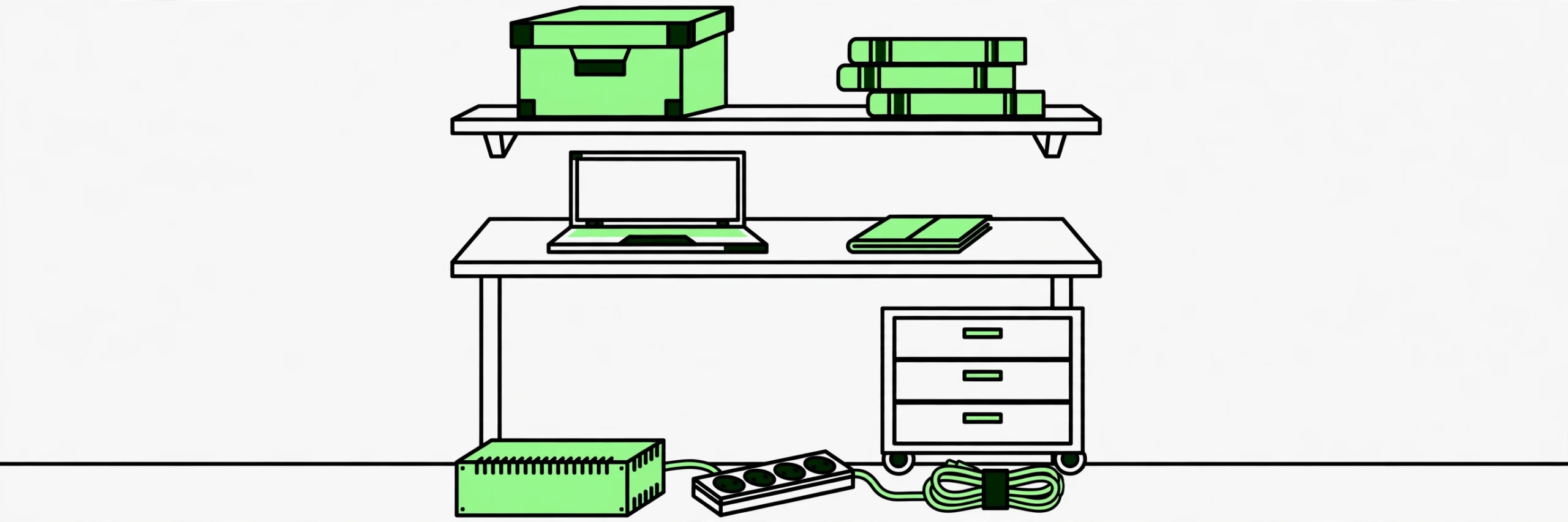
The vertical zone is the wall and airspace above and behind the desk, the most underused storage a renter has, because it feels like it belongs to the landlord. It does not, as long as nothing pierces it. A leaning shelf unit against the wall above desk height, a tension pole with shelves in the corner, clamp-on shelves at the desk’s back edge, and over-door storage on the room’s door all put reference books, the printer, and the weekly supplies in the vertical zone, off the surface and out of the floor plan. Vertical storage is also what keeps a tiny footprint viable: the smaller the desk, the more its office must live above it rather than beside it.
The storage zone holds everything the office needs within the week but not within the hour: supplies, paper and files, cables and accessories not in use. Its renter form is furniture, not fixtures: a small rolling cart, a lidded box or two on the vertical shelves, a file box that closes. Two properties matter more than capacity. It must close, because open storage in a borrowed room reads as clutter to everyone who lives with it, and it must move, because a renter’s office that cannot be rolled into a closet, another room, or a moving truck in minutes is a liability. The filing system inside the storage zone, how paper gets categorized and kept, is its own discipline; the zone’s job here is to give paper a closed, bounded, portable home so it never colonizes the surface.
The tech zone is the office’s power and cable layer, and it has one organizing idea: a single hub. One power strip, mounted under the desk with clamps or adhesive rated for the job, or sitting in a cable box on the floor, feeds everything; every cable runs from the hub to its device by the shortest tidy route, bundled where cables travel together. Chargers for things not in use live in the storage zone, not plugged in and wandering. The detailed cable methods, routing, labeling, and desk setups, are their own topic in this cluster; the system-level point is that cables are a zone with a hub and a boundary, not weather. An office whose cables have a zone can be shut down in minutes and moved in an hour. An office whose cables are everywhere can be neither.
Store What an Office Accumulates
An office generates four kinds of accumulation, and each needs a rule before it needs a container.
Supplies (pens, notebooks, printer paper, ink, sticky notes) creep because they are bought in packs and used one at a time. The rule: the working supply lives in the storage zone in one bounded container per category, and the surplus lives with the household’s other backstock, not in the office at all. One in, one out applies to the working container: it is full, so a new notebook enters when the current one is done, not when a prettier one appears.
Paper arrives daily and leaves slowly, which makes it the accumulation most likely to bury a small office. The zone rule is in-and-out: incoming paper lands in exactly one place, a tray or the front of the file box, never on the surface; it leaves that place on a short rhythm into the file box, the recycling, or the shredder pile. Any paper system deeper than that, the categories and retention logic, belongs to the filing end of this cluster; what cannot wait for that system is the one-landing-place rule, because paper that lands everywhere is filed nowhere.
Tech accessories (spare cables, adapters, drives, the charger for the thing you no longer own) accumulate silently in drawers. They live together in one closed container in the storage zone, and the container’s size is the discipline: when it is full, something leaves before something enters. Accessories stored loose join every zone at once, which is to say none.
Personal spillover is the category nobody plans: the mail, keys, packages, and household paper that land on the desk because it is the nearest flat surface. The office cannot organize the household, but it can refuse delivery: spillover that lands on the surface leaves with the shutdown, every day, to wherever the household keeps such things. The desk defends its boundary by the reset, not by willpower.
Shut It Down: The End-of-Day Reset
The shutdown is the renter’s signature move, because the office is usually squatting in a room with another job. A shutdown that takes five minutes and happens every workday does three things: it returns the room to the people who live in it, it protects the work boundary (a closed office stops leaking into the evening in a way an open one does not), and it is the daily enforcement of every rule above, since whatever crept gets evicted while the creep is small.
The sequence is short and fixed. First, the surface clears to the daily kit: screen or laptop closed or parked, work documents into the paper landing place or the file box, everything else back to its zone. Second, tech parks: laptop and chargers to their hub or their storage place, chair pushed in or rolled to its corner. Third, the office closes visually, by whichever means the spot offers: the closet doors, a curtain or screen across the corner, the cover over the cart, or simply the cleared surface and parked chair that let a shared table be a dining table again. Fourth, spillover leaves with you. That is the whole ritual; its power is that it is identical every day, so it survives tired evenings.
The failures diagnose the system. If the surface cannot clear, the surface zone is storing, and the fix is storage, not tidying. If cables prevent moving anything, the tech zone never got its hub. If paper reappears faster than the rhythm clears it, the landing place is missing or the file box is full. If the office never closes, the spot was wrong for a shared room, which is the claim-the-spot criteria asking to be re-run with the shutdown weighted higher. Each failure names its zone, and each zone names its fix, which is what makes this a system rather than a tidiness habit.
An office built this way is a tenant in good standing: it pays its rent in the room by shutting down, it keeps its footprint honest, and it can leave in an afternoon with the deposit intact. For the wider house it borrows from, the parent system is the home organization guide; for the specific case of the office that must share the bedroom, the bedroom’s own rules live in the small bedroom organization system for renters.

Mike Mann writes practical home organization and small-space living guides for CozySorted. His work focuses on apartment-friendly storage, clutter-free routines, bedroom organization, and simple systems that help renters, apartment dwellers, and small-space homeowners create calmer, easier-to-maintain homes.