The average American household throws away $1,500 worth of food every year [site: USDA, 2024]. Most of that waste starts inside the refrigerator. A disorganized fridge is not just messy. It spoils food faster, drives up energy bills, and forces you to buy things you already have buried in the back.
Fridge organization means assigning every food item a specific zone based on temperature, contamination risk, and how often you use it. This article covers the full system: food zones, FIFO rotation, freezer extension, odor control, and weekly maintenance. It is written for small families of 2 to 4 people and studio apartment dwellers working with compact or counter-depth refrigerators.
Follow this system and you will waste less food, free up more shelf space, keep food fresher longer, and lower your fridge’s energy draw.
Why Does a Small Fridge Always Feel Overcrowded No Matter How Often You Clean It?
A small fridge feels perpetually overcrowded because cleaning removes dirt, but it does not install a system. Without assigned zones for each food category, items pile up randomly after every grocery run. The real problem is the absence of structure, not the absence of space.
Most compact refrigerators hold between 10 and 18 cubic feet [site: Energy Star, 2024]. That is enough for a family of 2 to 4 if the space is divided intentionally. The moment you stop treating your fridge like a storage closet and start treating it like a zoned workspace, the overcrowding stops.
Food zones and FIFO rotation, which means rotating older food to the front so it gets used first, are the two core fixes. They work together. Zones tell you where each item lives. FIFO tells you in what order to use it. Without both, a clean fridge becomes a cluttered one within three days of restocking.
What Are the Most Common Fridge Organization Mistakes Small Families Make?
The most common fridge organization mistakes small families make involve placement errors, buying patterns, and container choices. 6 common fridge organization mistakes small families make are listed below.
- Storing raw meat on upper or middle shelves, where drips contaminate ready-to-eat food directly below.
- Ignoring FIFO rotation during restocking, so newer items get used first and older ones expire unnoticed.
- Overstuffing produce drawers with mixed fruits and vegetables, which releases ethylene gas and speeds up spoilage.
- Using mismatched containers of different shapes, which creates gaps, blocks airflow, and wastes shelf space.
- Placing milk and dairy on the door shelf, which is the warmest zone and causes faster spoilage.
- Leaving non-refrigerator items like bread, tomatoes, and onions inside the fridge, which wastes prime shelf space.
How Does Shelf Temperature Affect Where You Should Store Food in a Compact Fridge?
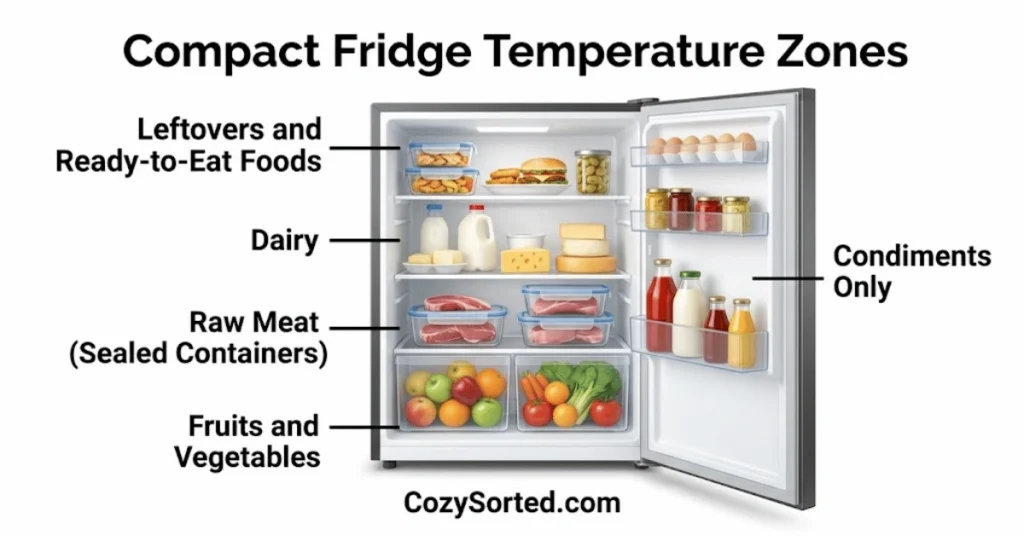
Shelf temperature in a compact fridge directly determines where each food type should be stored, because temperature varies by as much as 10°F (5.5°C) between the door and the bottom shelf [site: FDA Food Safety, 2024]. Placing food in the wrong temperature zone shortens its shelf life and raises contamination risk.
- Top shelf (37–40°F / 3–4°C): Store leftovers, drinks, ready-to-eat foods, and herbs in water. This zone is consistent but slightly warmer.
- Middle shelf (35–38°F / 2–3°C): Store dairy products like milk, yogurt, and cheese here. Temperature is stable and cool.
- Bottom shelf (32–35°F / 0–2°C): Store raw meat, poultry, and fish on a tray or in a sealed container. This is the coldest zone.
- Crisper drawers (high humidity drawer for vegetables, low humidity for fruits): Keep produce separated. Mixed humidity shortens shelf life of both.
- Door shelves (40–45°F / 4–7°C): Store condiments, juices, and butter only. This zone fluctuates the most with every opening.
How Do You Create an Effective Food Zone System in a Small Refrigerator?
An effective food zone system in a small refrigerator works by dividing every shelf and drawer into a fixed category, so every item always returns to the same spot. A zone system removes the daily guesswork of “where does this go?” and prevents the random pileup that makes compact fridges feel unmanageable.
Without zones, a fridge of any size becomes disorganized within days of a grocery run. With zones, restocking takes two minutes because every item has a home. The zones covered below include proteins, dairy, produce, leftovers, the door, and an optional kid-accessible snack section.
A zone-based system also reduces cross-contamination risk. Raw proteins stay on the bottom. Ready-to-eat food stays on top. These two categories never share a shelf, which is a food safety standard set by the FDA [site: FDA, 2024].
Where Should Meat, Dairy, Produce, and Leftovers Go on Each Shelf?
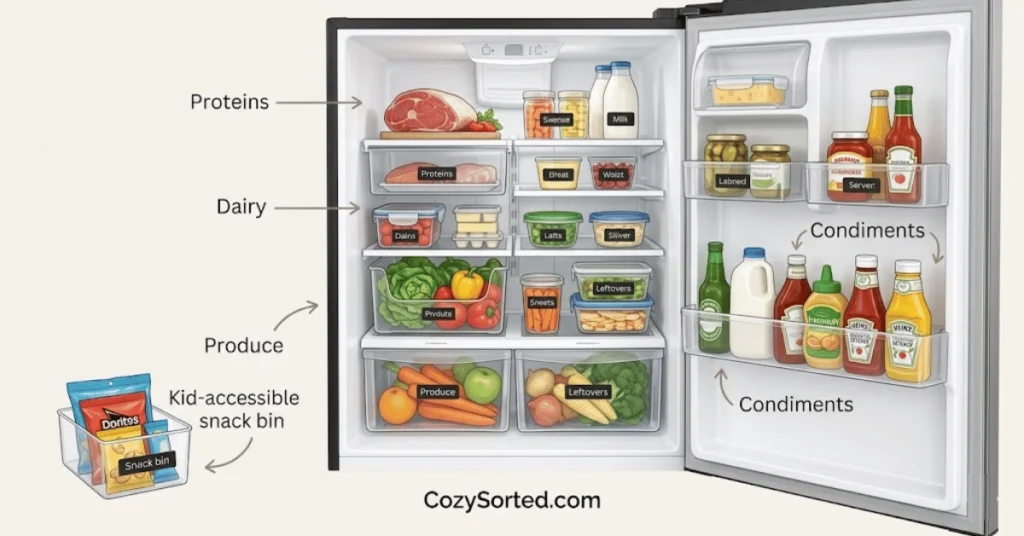
In a small refrigerator, meat, dairy, produce, and leftovers each belong on specific shelves based on temperature and contamination risk. The correct shelf placement for each food category is outlined below.
- Top shelf: Leftovers in labeled airtight containers, drinks, herbs in a glass of water, and ready-to-eat snacks.
- Middle shelf: Dairy products including milk, yogurt, hard cheese, and eggs. Temperature here is steady and cool.
- Bottom shelf: Raw meat, poultry, and seafood in sealed containers or on a tray to catch drips and prevent contamination.
- High-humidity crisper drawer: Leafy greens, broccoli, carrots, and herbs. High moisture keeps them from wilting.
- Low-humidity crisper drawer: Apples, grapes, pears, and stone fruits. Lower moisture prevents mold and skin breakdown.
- Door shelves: Condiments, salad dressings, juice, butter, and non-dairy creamers. Nothing that spoils quickly belongs here.
How Can You Build a Kid-Accessible Snack Zone Without Wasting Prime Shelf Space?
A kid-accessible snack zone in a compact fridge can be created without sacrificing prime shelf space by using one low, dedicated shelf section with a clear pull-out bin.
Place the snack bin at the front of the lowest full shelf, within easy reach for children. Stock it with pre-portioned items: cut fruit, string cheese, yogurt tubes, and small hummus cups. Pre-portioning matters because it prevents kids from rummaging through the entire fridge.
- Use a clear, labeled bin so children see exactly what is available without opening every container.
- Keep allergen-free snacks in a separate bin if the household has food allergy concerns.
- Restock the bin during your weekly FIFO rotation so nothing in it expires unnoticed.
What Is the Best Way to Organize the Fridge Door in a Studio Apartment?
The best way to organize the fridge door in a studio apartment is to treat it as a condiment-only zone and move everything else to an interior shelf. The door is the warmest part of the fridge, reaching 40 to 45°F with every opening, which makes it unsuitable for milk, eggs, or any perishable with a short window.
| What Belongs on the Door | What to Move Off the Door |
| Ketchup, mustard, hot sauce | Milk and dairy products |
| Salad dressings | Eggs |
| Juice boxes and bottled drinks | Deli meats |
| Butter and margarine | Opened canned goods |
| Non-dairy creamer | Leftovers |
| Tall bottles of soy sauce, vinegar | Soft cheeses |
Use the tallest door shelf for large bottles. Place the most-used condiments at eye level. Keep the bottom door shelf for butter and small jars.
What Are the Best Fridge Organization Tips for a Family of 2 to 4 People?
The best fridge organization tips for a family of 2 to 4 people focus on three pillars: FIFO food rotation, a dedicated meal prep zone, and the right containers. This is a system, not a one-time clean-up. A family fridge needs a repeatable structure that survives every weekly grocery run intact.
Families of this size typically cycle through a full fridge load every 5 to 7 days [site: USDA Economic Research Service, 2024]. That cycle creates a predictable rhythm. When you build your fridge system around that rhythm, organization becomes automatic instead of a chore you repeat every weekend.
FIFO handles food freshness. A meal prep shelf handles weekday efficiency. The right containers handle space. Together, they reduce food waste, cut the time spent staring into an open fridge, and keep the system working even when life gets busy.
How Do You Use the FIFO Method to Reduce Food Waste in a Small Fridge?
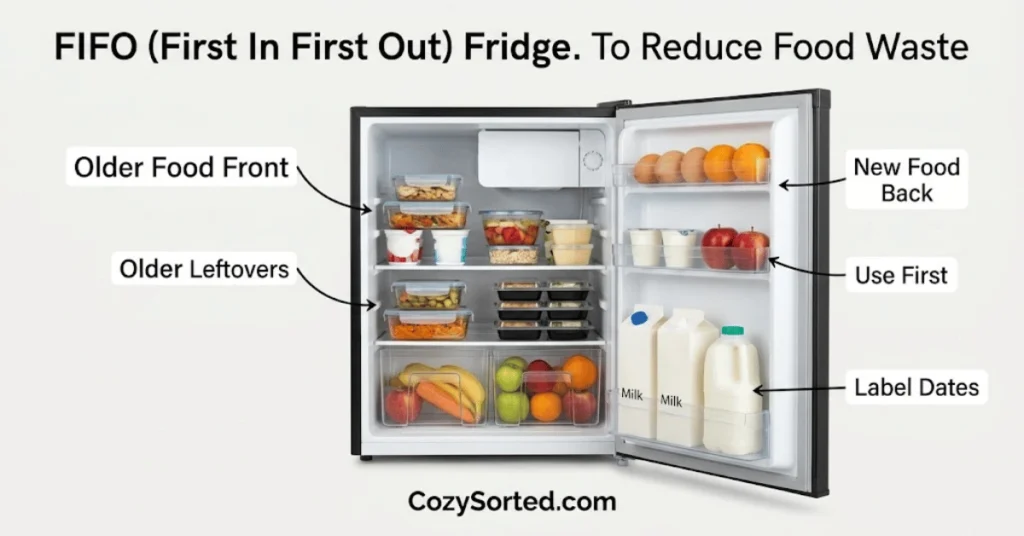
The FIFO (First In, First Out) method reduces food waste in a small fridge by ensuring older food always gets used before newer food. FIFO stands for First In, First Out, a rotation system used in professional kitchens and food storage facilities to eliminate spoilage. Steps to apply FIFO in your compact fridge are listed below.
- Before unpacking groceries, pull all existing items of the same category to the front of the shelf.
- Place the newly purchased items directly behind the older ones, never in front.
- Check expiry dates on both old and new items as you restock, and move anything expiring within 2 days to the front and center.
- Label any opened packages or leftovers with the date using a strip of tape and a marker.
- During your next restock, repeat the process so the oldest item always sits closest to the door.
How Should You Organize Meal Prep Containers and Weekly Batch-Cooked Food?
Organizing meal prep containers and weekly batch-cooked food in a small fridge works best when every container is the same shape and size. Uniform rectangular containers stack without wasted gaps, which is the single most effective way to reclaim shelf space in a compact refrigerator.
Dedicate one full shelf exclusively to meal prep. This shelf should sit at eye level so prepped food is the first thing you see when you open the door. Label every container with the contents and the day it was made, using masking tape and a marker.
- Use rectangular containers instead of round ones. Round containers leave corner gaps that waste space.
- Stack containers with the heaviest at the bottom and the lightest on top.
- Keep a maximum of 5 to 6 days of prep in the fridge. Move anything beyond that window to the freezer immediately.
Which Storage Containers Work Best for a Compact Refrigerator on a Budget?
The storage containers that work best for a compact refrigerator on a budget are clear, stackable, and rectangular. Budget-friendly storage containers recommended for compact refrigerators are listed below.
- Clear stackable rectangular bins (OXO, Amazon Basics): These fit most standard shelf depths and let you see contents without opening. Available on Amazon for $8 to $20 per set.
- Uniform food storage containers with locking lids (Rubbermaid, IKEA 365+): Stackable and airtight. A 10-piece set costs $12 to $25 at IKEA or Walmart.
- Produce keepers with ventilation (Prepworks, OXO GreenSaver): Extend leafy green freshness by 3 to 5 days. Available for $8 to $15 each.
- Lazy Susans (turntable organizers): Best for corner shelves and deep fridges. Spin to access items at the back. Available at Dollar Tree or IKEA for $2 to $8.
- Egg holders and can dispensers: Small-footprint tools that keep single-category items tidy without taking up full shelf space.
How Can You Maximize Freezer Space to Free Up More Fridge Room?
Maximizing freezer space to free up fridge room works by treating the freezer as an active extension of the refrigerator, not an overflow zone for forgotten food. A well-organized freezer reduces fridge overcrowding by 30 to 40% for families who batch cook weekly [site: Natural Resources Defense Council, 2023].
Most studio apartments and small households underuse their freezer. They either pack it randomly or avoid it because they do not know what is inside. Both habits push everything into the fridge and create the overcrowded feeling that no amount of cleaning fixes.
The fix is a two-part approach: move freezer-suitable foods out of the fridge, then organize the freezer by category so you always know what you have. The H3 sections below cover both steps.
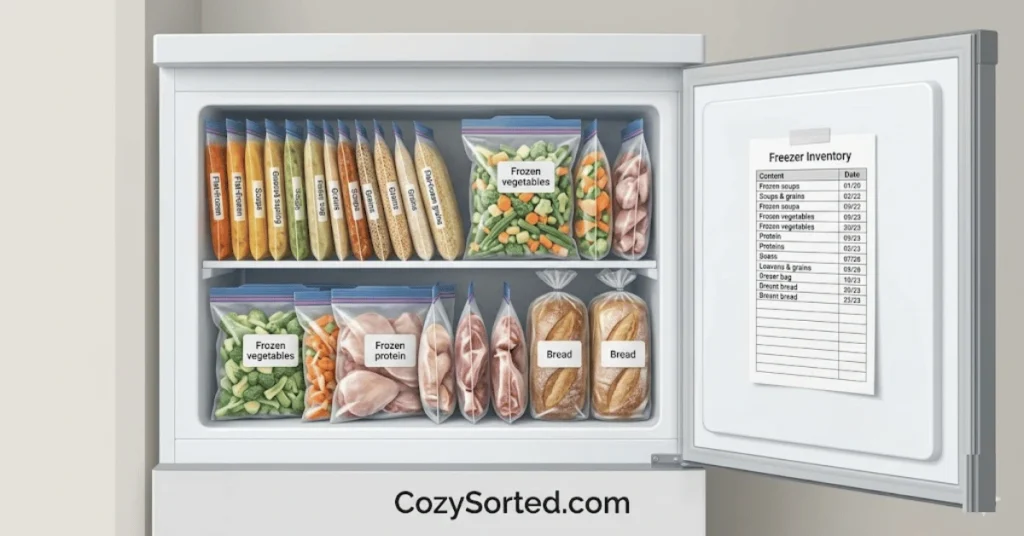
What Foods Should You Move to the Freezer to Reclaim Refrigerator Shelf Space?
Foods that can be moved to the freezer to reclaim refrigerator shelf space include proteins, starches, and batch-cooked items that are not needed within the next 3 days. Foods best moved to the freezer to free up fridge space are listed below.
- Bread and tortillas: Freeze after opening. Thaw at room temperature in 20 minutes or toast directly from frozen.
- Raw meat and poultry: Freeze any portion not being used within 2 days of purchase. Label with the freeze date.
- Batch-cooked grains (rice, quinoa, oats): Portion into silicone bags and freeze flat. Reheat in 90 seconds in the microwave.
- Legumes and beans: Cook a full pot and freeze in 1-cup portions. Eliminates the need for canned beans.
- Frozen produce (peas, corn, spinach, edamame): Store in the freezer by default. These do not belong in the fridge at all.
- Cheese blocks: Hard cheeses like cheddar and parmesan freeze well for up to 6 months. Grate before freezing for faster use.
- Butter: Freeze all extra sticks. Keep only what you will use in the next 2 weeks in the fridge.
How Do You Organize a Small Freezer for a Family That Batch Cooks Weekly?
Organizing a small freezer for a family that batch cooks weekly requires a zone system identical in logic to the fridge: one category per area, labeled, and rotated using FIFO. Steps to organize a small freezer for weekly batch cooking are given below.
- Empty the freezer completely and discard anything without a label or past 6 months old.
- Group remaining items by meal type: breakfast, lunch, dinner, snacks, and ingredients.
- Assign each group a physical zone: a shelf, a drawer, or a section of the same shelf.
- Store flat-frozen items (soups, grains in bags) standing upright like files, which saves space and speeds retrieval.
- Label every item with contents and freeze date using a permanent marker on freezer-safe tape.
- Keep a printed or phone-based freezer inventory list on the door so you know what you have without digging.
What Items Are Wasting Refrigerator Space That Belong on the Counter or in the Pantry?
Several items commonly stored in the refrigerator waste valuable space because they do not require refrigeration. Moving these items out immediately frees one to two full shelves in most compact fridges. This section covers four categories: fruits, condiments, baked goods, and vegetables.
Treat this as a quick audit you do today, not next weekend. Pull out every item in your fridge right now and check it against the list below. You will likely find 4 to 8 items that have been occupying cold space unnecessarily for weeks.
Removing non-refrigerator items also improves airflow inside the fridge, which directly affects energy use and food temperature consistency. A less-packed fridge keeps the remaining food colder with less effort.
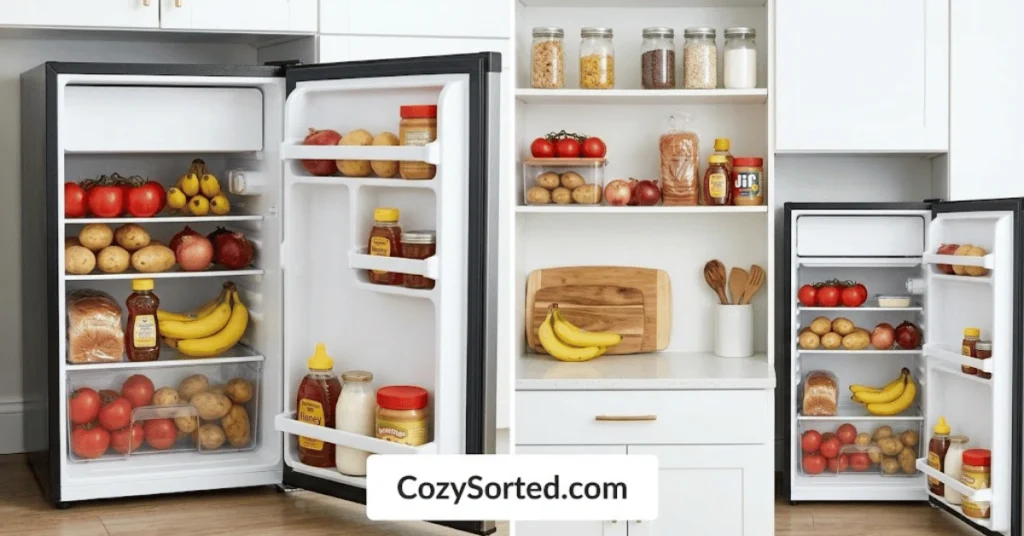
Which Common Foods Do Not Actually Need Refrigeration?
Common foods that do not actually need refrigeration and belong on the counter or pantry include produce, condiments, and baked goods that are stable at room temperature. Foods that do not require refrigeration are listed below.
- Tomatoes: Cold air breaks down their texture and kills flavor. Store at room temperature and use within 5 days.
- Potatoes and sweet potatoes: Refrigeration converts their starch to sugar. Store in a cool, dark pantry instead.
- Onions and garlic: These release moisture in the fridge and spoil faster. A mesh bag in a pantry keeps them fresh for weeks.
- Bread: Refrigeration dries bread out. Store at room temperature for up to 5 days or freeze for longer storage.
- Whole uncut avocados: Let them ripen on the counter first. Refrigerate only once ripe to extend by 1 to 2 days.
- Unopened hot sauce and soy sauce: Vinegar-based condiments are shelf-stable before opening. Move them to the pantry.
- Bananas, citrus, and pineapple: These fruits keep best at room temperature and suffer texture damage in the cold.
- Honey and peanut butter: Both are shelf-stable indefinitely at room temperature.
How Does Removing Non-Refrigerator Items Improve Energy Efficiency?
Removing non-refrigerator items from the fridge improves energy efficiency because an overpacked fridge blocks cold air circulation, forcing the compressor to work harder and longer to maintain the target temperature. The U.S. Department of Energy recommends keeping a fridge 75 to 85% full for ideal airflow [site: U.S. Department of Energy, 2024]. A fridge packed beyond that level uses up to 15% more electricity. Removing 4 to 6 misplaced items from a compact fridge often drops it into that optimal range immediately.
Should You Organize a Studio Apartment Fridge Differently Than a Small Family Fridge?
Whether a studio apartment fridge organization system should differ from a small family fridge depends on the number of users and the size of the appliance. Families need volume management and rotation. Solo renters need minimalism and flexible layout. A family of 4 runs a higher throughput of food, needs kid zones, and relies on batch cooking storage. A studio household of 1 to 2 people shops more frequently, stores less at once, and prioritizes fast access over volume. The zone logic stays the same. The scale changes.
What Fridge Organization System Works Best for a 1 to 2 Person Studio Household?
The fridge organization system that works best for a 1 to 2 person studio household is a minimalist one-shelf-per-category layout with the door reserved entirely for condiments and one drawer for produce. Unlike a family fridge, a studio fridge does not need a dedicated meal prep shelf every week or a kid-accessible zone.
Keep one shelf for proteins and leftovers. Keep one shelf for dairy and drinks. Use the produce drawer as intended. Buy groceries in smaller quantities every 4 to 5 days instead of one large weekly haul. This prevents overstocking, which is the primary cause of disorganization in single-person compact fridges.
| System Element | Family of 2–4 | Studio Household (1–2) |
| Grocery frequency | Weekly large haul | Every 4–5 days, small haul |
| Meal prep shelf | Dedicated full shelf | Shared with leftovers |
| Kid snack zone | Yes, low shelf bin | Not needed |
| FIFO rotation | Weekly during restock | At every grocery run |
| Freezer use | Heavy, batch cooking | Light, proteins and bread |
| Container type | Uniform sets, bulk | Small individual containers |
How Do Your Weekly Grocery Buying Habits Affect Organization in a Compact Fridge?
Weekly grocery buying habits directly shape how organized a compact fridge stays because over-buying is the primary driver of disorganization in single-person and small household refrigerators. Buying more than your fridge can absorb at its optimal 75 to 85% capacity forces overpacking. Overpacking blocks airflow, buries older food, and triggers a cycle of waste and clutter. Shop with a list tied to your actual fridge zones. Buy only what fills each zone by about two-thirds. A smaller, more intentional haul every 4 to 5 days keeps a studio fridge organized without effort.
What Are the Best Mini-Fridge and Counter-Depth Fridge Organization Strategies?
The best mini-fridge and counter-depth fridge organization strategies for studio apartments include working with the limited vertical and horizontal dimensions of these appliances rather than fighting them. Organization strategies for mini-fridges and counter-depth refrigerators are listed below.
- Use door-mounted spice racks or magnetic bins on the fridge exterior to move small items off interior shelves entirely.
- Stack containers vertically using an adjustable shelf riser, which doubles usable shelf space in mini-fridges with one fixed shelf.
- Store produce in reusable silicone bags instead of bulky produce keepers, reducing the footprint of this category by half.
- Keep a maximum of 3 to 4 condiments in the door at any time. Decant large bottles into smaller ones to save door shelf depth.
- Freeze proteins immediately after purchase if not cooking within 24 hours. Mini-fridges have almost no safe cold zone for raw meat storage beyond one day.
Recommended Video: Search YouTube for “mini fridge organization ideas studio apartment 2025” to watch a step-by-step visual guide on shelf layout and container placement.
How Can You Keep a Small Fridge Smelling Fresh and Odor-Free?
Keeping a small fridge smelling fresh and odor-free requires consistent use of odor absorbers and airtight containers, not just cleaning. Small fridges concentrate odors faster because their lower air volume saturates more quickly when food smells escape. A compact refrigerator with no odor management will develop a persistent smell within 7 to 10 days of storing pungent foods like onions, leftovers, or aged cheese. Baking soda, activated charcoal, airtight containers, and a regular wipe-down schedule are the four tools that keep a small fridge smelling neutral.
What Natural Odor Absorbers Work Best Inside a Compact Refrigerator?
The natural odor absorbers that work best inside a compact refrigerator are ones with high surface area and strong molecular absorption capacity. Natural odor absorbers for a compact fridge are listed below.
- Baking soda (sodium bicarbonate): Place an open box or shallow bowl on the middle shelf. Replace every 30 days. Absorbs acidic and basic odor compounds simultaneously.
- Activated charcoal: Place a small bag or open container on any shelf. Replace every 60 to 90 days. More effective than baking soda for strong persistent odors.
- Dry coffee grounds: Place in a small open container at the back of a shelf. Replace weekly. Works well for short-term odor bursts after cooking fish or cabbage.
- Vanilla extract on a cotton ball: Place on the top shelf. Replace every 5 to 7 days. Neutralizes odors and leaves a clean neutral scent.
How Often Should You Deep Clean and Re-Organize a Small Refrigerator?
A small refrigerator should be deep cleaned and re-organized on a monthly schedule, with a quick 5-minute wipe-down every week. Compact fridges require more frequent cleaning than large refrigerators because spills, condensation, and odors affect a smaller air volume faster. A large family fridge might tolerate 6 to 8 weeks between deep cleans. A compact or mini-fridge becomes visibly dirty and odorous within 3 to 4 weeks. The monthly deep clean resets the zone system, removes buildup from shelves and drawers, and gives you a clear picture of what needs restocking. The weekly wipe-down keeps the monthly task manageable.
What Is a Simple Weekly Fridge Maintenance Routine for Busy Families and Solo Renters?
A simple weekly fridge maintenance routine for busy families and solo renters involves five steps that take under 10 minutes total. Steps for a simple weekly fridge maintenance routine are given below.
- Check expiry dates on every item on each shelf. Move anything expiring within 2 days to the front and center of its zone.
- Wipe down all shelves and drawer edges with a damp cloth and a mild vinegar solution to remove spills and condensation.
- Restock groceries using FIFO: pull older items forward, place new items behind, and check that every zone is at 75 to 85% capacity.
- Check your odor absorber. Replace baking soda monthly. Refresh activated charcoal every 60 to 90 days. Swap coffee grounds or vanilla weekly.
- Update your freezer inventory list. Add anything new that went in and cross off anything you used. This step prevents the “mystery freezer” problem that forces you to keep extras in the fridge.

Mike Mann writes practical home organization and small-space living guides for CozySorted. His work focuses on apartment-friendly storage, clutter-free routines, bedroom organization, and simple systems that help renters, apartment dwellers, and small-space homeowners create calmer, easier-to-maintain homes.