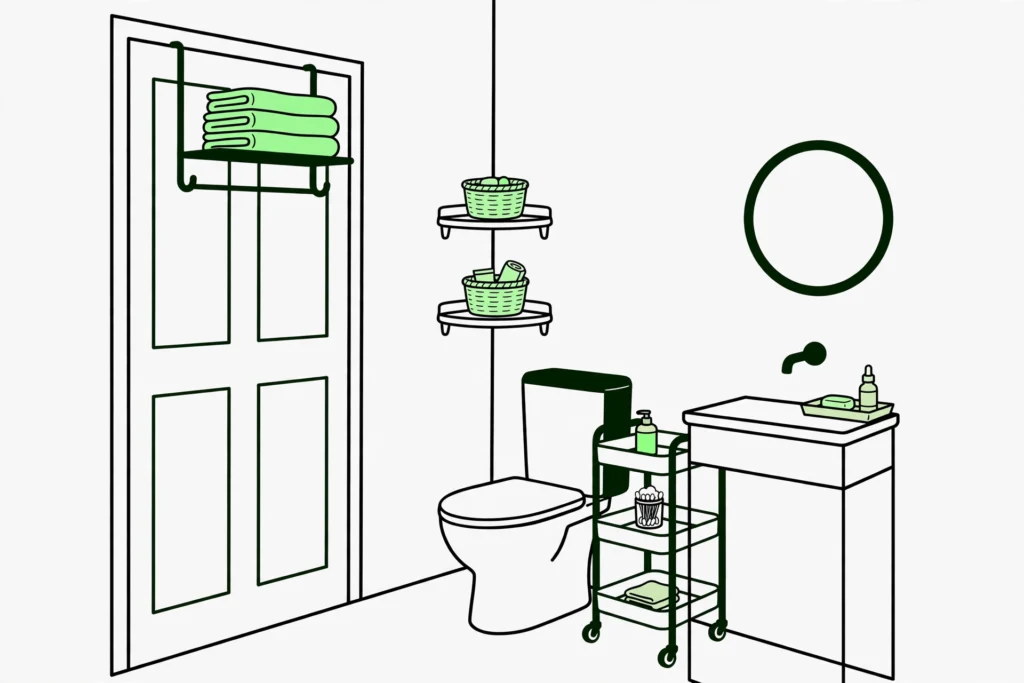
Makeup and skincare storage fails in a small bathroom for a predictable reason: the whole collection is treated as one pile, so everyday products, once-a-week products, and unopened backups compete for the same drawer and the same strip of counter. The system that holds is a sorting system first and a storage system second. Divide the collection into three tiers by how often each product is used. Give the daily tier, the only tier that earns prime space, one home chosen from the storage your bathroom actually has, arranged in the order you use it. Store the rest one step removed, or out of the bathroom entirely, where conditions suit products better anyway.
Sort Into Three Tiers: Daily, Weekly, Backstock
The daily tier is the products you reach for every day: your cleanser, moisturizer, SPF, and the handful of makeup items in your current rotation. It is deliberately small, because prime bathroom space is small, and a daily tier that holds twenty products is not a tier, it is the pile again. Membership is decided by the last two weeks, not by intentions: a product you have not touched in two weeks does not live in the daily tier, however virtuous it is.
The weekly tier is everything in genuine rotation that is not daily: treatment products used a few times a week, the mask, the occasion makeup, the alternate shades. It earns real storage, but one step removed from the point of use, because a product used twice a week does not need to be grabbed at the speed of toothpaste.
Backstock is the third tier and the one most collections refuse to admit exists: unopened duplicates, backups bought on sale, the second bottle of everything. Backstock is inventory, not routine, and inventory does not need bathroom space at all. It belongs wherever the household keeps spares, a bedroom drawer or a closet shelf, and it enters the bathroom one item at a time, when the open one runs out.
Sort makeup and skincare by the same three tiers, then, inside each tier, arrange products in routine order: cleanser before treatment, treatment before moisturizer, moisturizer before SPF; base before eyes, eyes before lips. Storage order that matches use order means the morning routine is a single pass along a shelf or across a drawer, with nothing picked up and put down twice while you hunt for the next step.
Place the Daily Set Where Your Bathroom Allows
The daily tier needs one home, and the right home is conditional: it depends on which storage your bathroom actually has. Work down this ladder and stop at the first rung your bathroom offers.
- If you have a drawer: the top drawer is the daily home, because it is the closest storage to the sink that stays dry and closed. Divide it by routine order, cleansers at one end and finishing products at the other, so the drawer reads left to right the way the routine runs. The weekly tier takes the drawer below or the back of the same drawer.
- If you have a medicine cabinet: daily skincare takes one shelf of it, in routine order, with the weekly tier on the shelf above. The cabinet itself, what belongs in it and what must be tossed, follows the medicine cabinet checklist system; this page only rents it a shelf.
- If the counter is your only storage: the daily tier lives on it, but as a tenant, inside the single containment boundary the counter system allows, arranged in routine order within that footprint. The surface rules themselves belong to the bathroom counter organization system; the point here is that only the daily tier gets tenancy, and the weekly tier has to find its step-removed home somewhere else, a shelf, a hook-mounted basket, the back of a cabinet door.
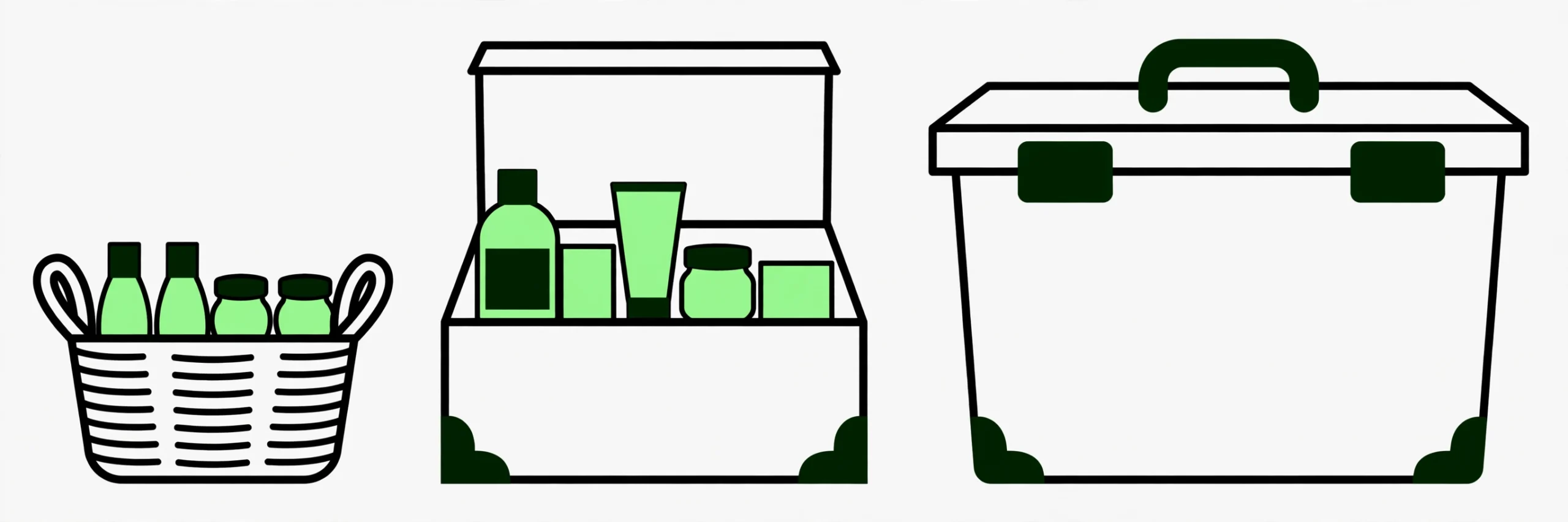
- If the bathroom has no storage at all: the daily tier lives in one portable caddy or pouch that hangs on a hook, sits on a small wall shelf, or travels in from the bedroom and back. One container, sized to the daily tier and no larger. A room with no storage needs the room system first; the full build is the bathroom with no storage system.
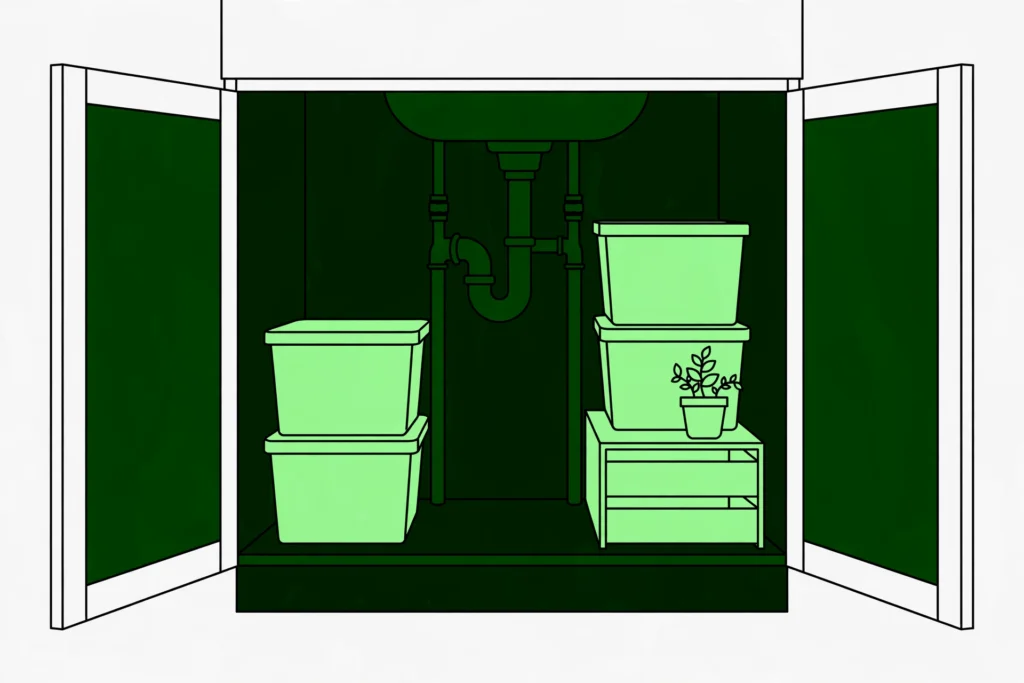
- Under the sink is not a daily home, whichever rung you landed on. The daily tier is grabbed twice a day, and the under-sink cabinet is the bathroom’s supply zone, deep, low, and built around plumbing; its own organization is the no-drill under-sink system. The one exception: sealed backstock, unopened products in a closed bin, may sit there if no other spare space exists.
Brushes and tools belong to the daily tier’s placement, with two conditions: upright, so bristles and tips are not crushed or resting in counter water, and out of the direct splash zone around the faucet. A small cup or holder at the back of the daily home, or inside the drawer standing in its own section, satisfies both.
Protect the Collection: Heat, Steam, Light, and Labels
A bathroom is where cosmetics are used, but it is not where they keep best. Most makeup and skincare products keep best in conditions the typical bathroom rarely offers: cool, dry, and out of direct sunlight. A small bathroom steams up with every shower and warms with every bath, which is one more reason the collection’s center of gravity should be small: the daily tier lives in the bathroom because access demands it, while the weekly tier and especially the backstock lose nothing, and often keep better, in a bedroom drawer or closet where the air stays dry and the temperature steady.
Two disciplines do most of the protecting. The first is label-first: when a product’s own packaging gives storage instructions, those outrank every general rule on this page, including this paragraph. The second is the period-after-opening check. Most cosmetics carry a small open-jar symbol on the packaging with a month count inside it, six, twelve, twenty-four: the maker’s guidance for how long the product is meant to be used after opening. That symbol, read off your own products, is the honest expiry system. Check it during the sort, and any time a product’s smell, color, or texture has changed, whatever the calendar says. Products past their mark leave the tiers entirely; what leaves is a small count in any sorted collection, because the tiers keep the stock visible and moving.
Hygiene is the quiet third discipline, and it is mostly about closure and dryness: lids and caps closed after use, pumps and droppers not left standing open in steamy air, brushes kept clean and allowed to dry fully where air reaches them rather than sealed damp in a pouch. None of this needs a schedule or a product. It needs the daily home to have a place where things can be put back closed and dry, which is what the placement section built.
Keep the System From Sliding Back
Collections regrow, and the guard is the same one the tiers started with: one in, one out of the daily tier. Prime space is a fixed size; a new daily product enters when the product it replaces leaves, to the weekly tier, to backstock if it is a spare, or out of the house. And before buying a replacement or a backup, check the backstock first. The forgotten duplicate, three unopened bottles of a cleanser you no longer use, is what backstock invisibility buys; a tier you can see at a glance ends it.
The failures diagnose themselves. Products spreading across the counter again means the daily tier has grown past its home, or the weekly tier has crept forward; shrink the tier, not the boundary. A drawer that avalanches means the tiers were never separated inside it, or routine order was lost; re-sort by the last two weeks and rebuild the order. Products repeatedly turning up past their open-jar mark means the check belongs in the sort rhythm, each time the tiers are rebuilt. A sorted collection is not a weekend project with a prettier drawer. It is a small system with a fixed daily core, and it holds because every product in the room can answer one question: which tier are you, and what are you doing here?

Mike Mann writes practical home organization and small-space living guides for CozySorted. His work focuses on apartment-friendly storage, clutter-free routines, bedroom organization, and simple systems that help renters, apartment dwellers, and small-space homeowners create calmer, easier-to-maintain homes.