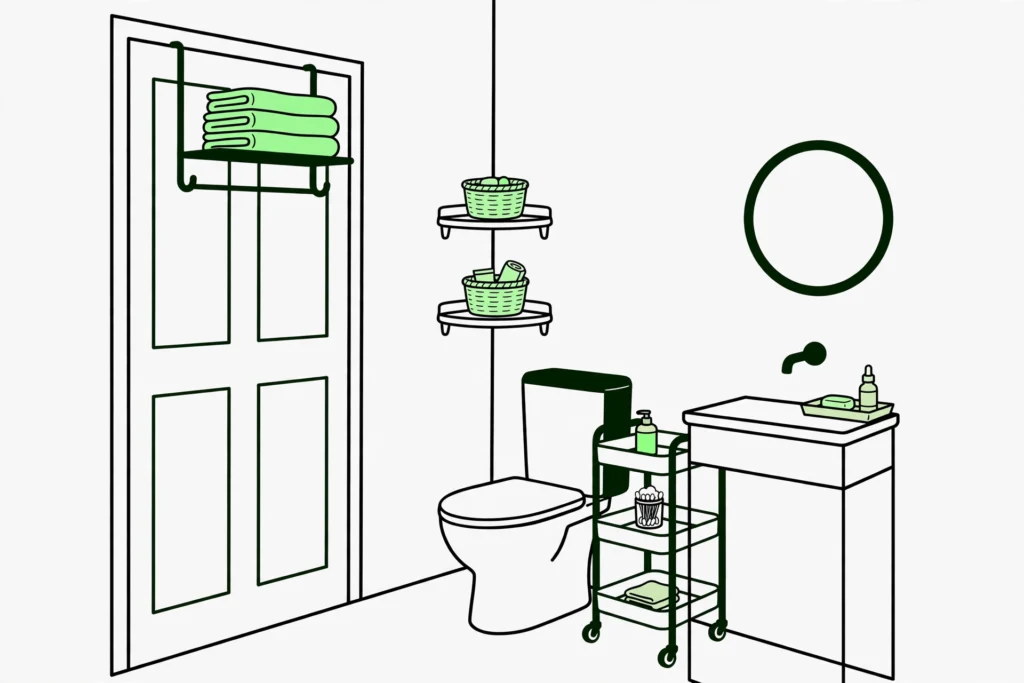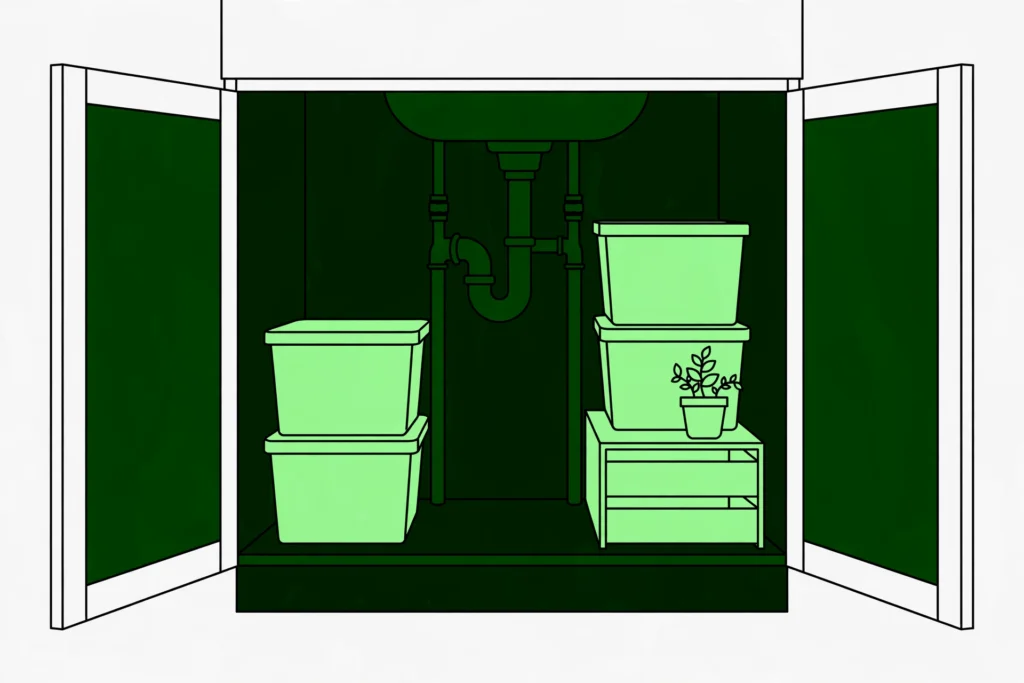
A small bathroom counter gets organized by subtraction, not by buying organizers. The system: only the daily set earns counter space, the whole set lives inside one bounded tray or caddy, what stays is zoned by water and reach, and a two-minute nightly reset keeps it that way. The deliverable is not a prettier arrangement of bottles. It is clear, dry working space in front of the faucet, every morning, without a daily negotiation with clutter. The counter is a work surface that a few items are allowed to park on, and everything below is about enforcing that distinction.
Decide What Earns Counter Space
Start by clearing the counter to zero. Everything off, onto a towel, including the items that live in the sink’s corners and the ones hiding behind the faucet. Then apply the daily-use test: an item earns counter space only if hands touch it every morning or every night. What passes is usually a short list: toothbrush and toothpaste, soap, a cleanser, a moisturizer, deodorant, daily makeup, and one or two daily treatments per person.
What fails the test leaves the surface, by category:
- Backstock and duplicates. The second shampoo, the unopened lotion, the spare of anything. Backstock belongs with the bulk storage, never on display at the sink.
- Weekly items. Nail tools, masks, the occasional treatment. Used weekly means stored somewhere else and fetched, not parked for six days to be used on the seventh.
- Cleaning supplies. They live with the cleaning caddy, low and separate, not beside the toothbrushes.
- Anything kept only because it looks nice. A counter this small cannot spend its scarcest resource on decoration that competes with the morning routine.
Where do the removed items go? The ones that are genuinely bathroom working stock move into the cabinet or the under-sink zones, and what earns a place in the cabinet at all is judged by the medicine cabinet checklist: in date, labeled, actually used. The rest leaves the bathroom or leaves the house. One exception to name: if your “counter” is only the narrow ledge of a pedestal sink, you are working with almost no surface at all, and your bathroom is the zero-storage case, which has its own full system.
Contain the Daily Set Inside One Boundary
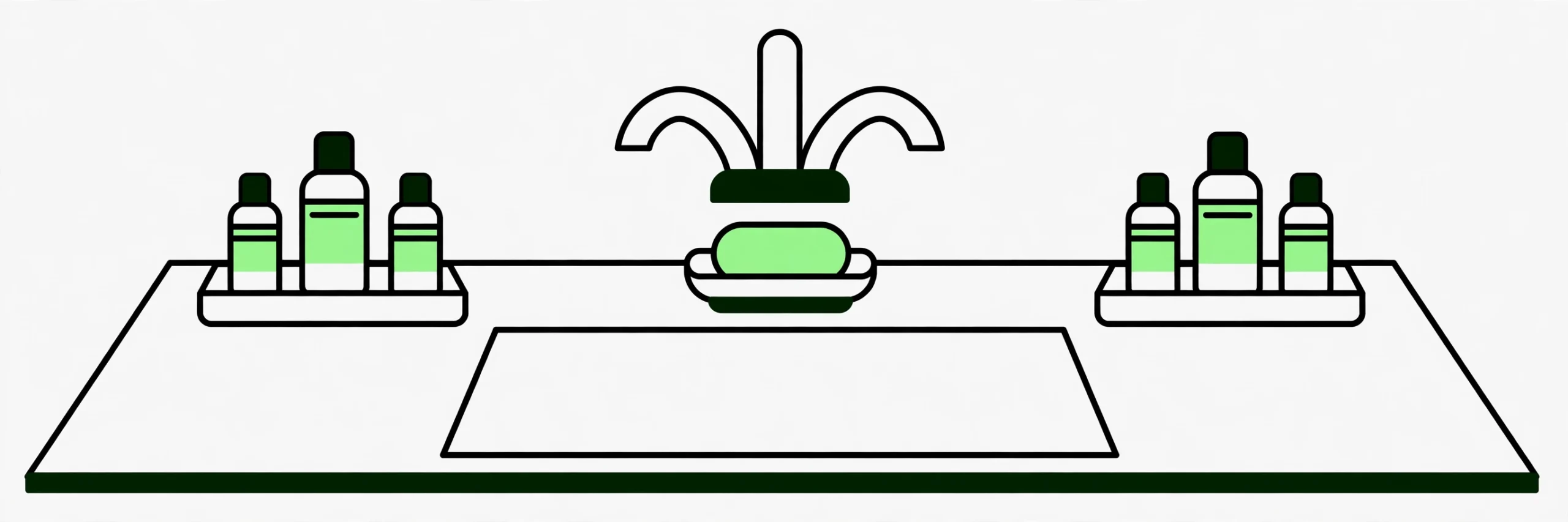
Whatever survives the audit gets one boundary: a single tray, caddy, or shallow divided organizer that holds the entire daily set in one footprint. The boundary is the whole mechanism. An item inside it is parked legitimately; an item outside it is clutter by definition, and it gets re-judged instead of shuffled. Without a boundary, “organized” means a neat row today and a scattered field next week, because nothing marks where the set ends.
Size the boundary to the counter, not to the collection. It should swallow the daily set and nothing more, sit against the back edge, and leave the front strip of the counter, the space between the tray and the sink rim where hands and elbows actually work, completely clear. Divided sections inside the tray matter for a practical reason: bottles that stand apart stay findable, while bottles pooled loose tip, hide each other, and migrate. Choose a tray material that tolerates standing water and wipes clean without fuss; the wet zone reaches everything near a faucet eventually, and porous materials parked there hold moisture and grime.
Zone by Water and Reach
Inside and around the boundary, place by two axes: how wet the item lives, and how the morning hand reaches for it.
- The wet zone, nearest the faucet. Soap on a dish that drains, the toothbrush holder, anything used with wet hands over the basin. Holders that drain and dry between uses beat holders that pool water at the bottom; that is the whole selection rule for this zone.
- The dry zone, at the back and sides. Daily bottles and jars, kept out of the splash path. Electric tools belong here at most, parked dry with cords off the wet surface, and in a small bathroom many counters honestly work better with electrics stored elsewhere and brought in.
- The back row. The tallest items stand against the wall or mirror, where they block nothing and can be seen over the short items in front. Short items in front, tall behind is not a styling preference; it is what makes every label visible at a glance.
- A riser or small tier, if one is used at all, has exactly one job: lifting the back row into view on a deep counter. It is not a second counter, and the moment it holds its own separate collection, the boundary rule has been quietly abandoned.
The test for the whole arrangement is the one-handed reach test: standing at the sink, half awake, you can run the full morning routine taking each item and returning it without moving another item out of the way. If two items have to shuffle for one to be reached, the set is too big for the surface, and the fix is the audit, not a bigger tray.
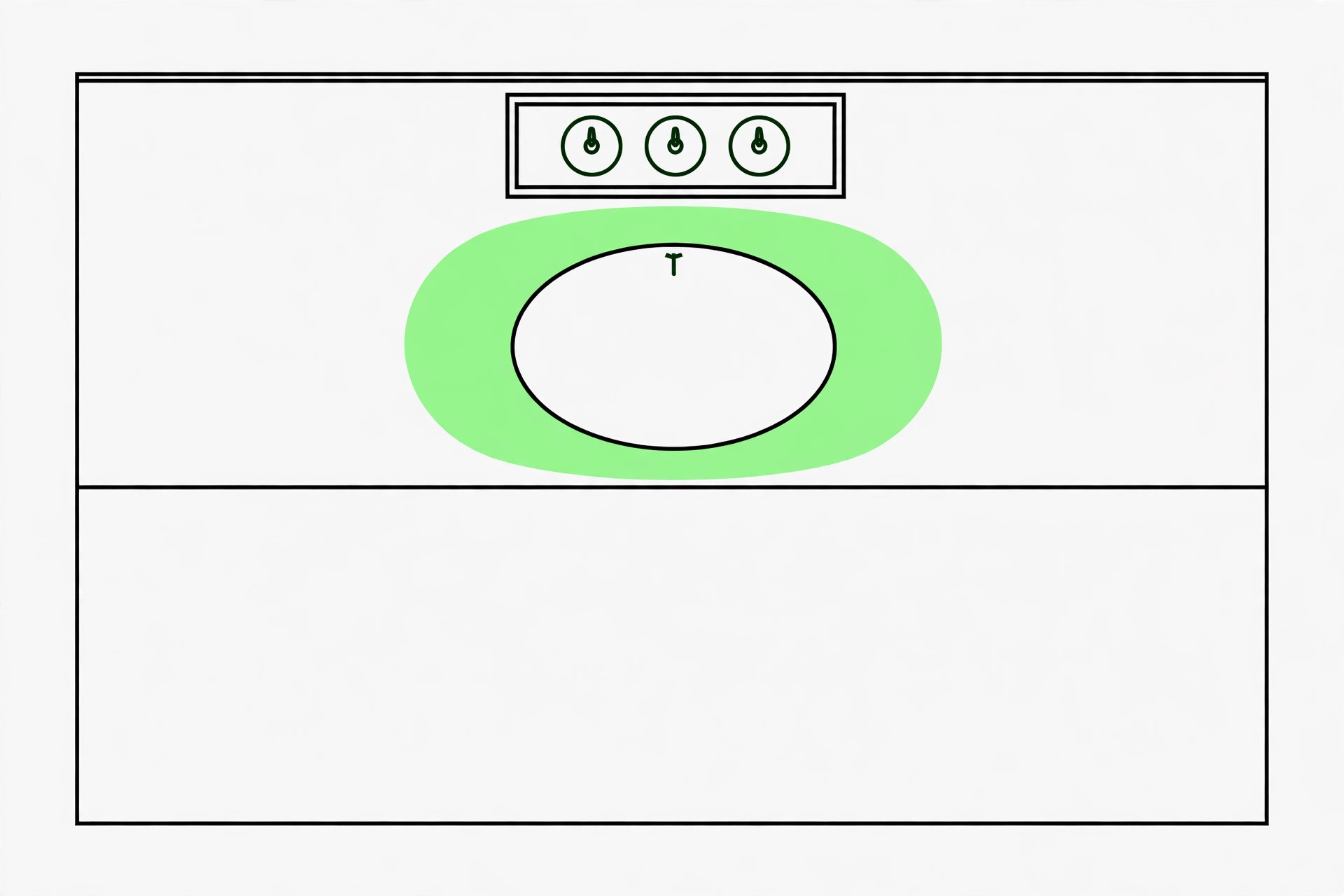
Sharing a Small Counter: One Boundary Each
A shared small counter fails in a specific way: not mess, exactly, but creep, as one person’s set slowly annexes the middle until the other person’s space is a sliver by the wall. The fix is to split the boundary, not the counter. Each person gets one tray or one defined half of a divided tray, sized to their own daily set. Shared items, the soap, the toothpaste if it is genuinely shared, live between the two boundaries in the wet zone. The rule that makes it hold: your items live inside your boundary or they do not live on the counter. There is no shared overflow strip, because an overflow strip is just tomorrow’s annexation.
Guests get surface, not storage. The clear front strip that the system protects anyway is the guest’s landing space for a toiletry bag, which is the real hospitality rule of a small bathroom: a visitor should find an empty place to set things down, not a museum of the hosts’ products to work around.
The Two-Minute Nightly Reset
The reset is what converts a one-time clear-out into a system. Nightly, in about two minutes: everything on the counter returns inside its boundary, anything that fails the daily-use test today leaves the surface for good, and the wet zone gets wiped while it is briefly empty of strays, because a counter wiped nightly never develops the ring of grime that makes a small bathroom feel dirty even when it is tidy. Once a week, add a single pass: finished or expired items out, and the boundary re-judged. Has the daily set quietly grown a weekly item? It moves.
The reset is also the diagnostic. If it regularly takes longer than two minutes, the problem is not discipline; the daily set has outgrown the boundary, and the answer is to run the earn audit again, not to buy a second tray. A small counter stays organized the way it got organized: fewer things, one boundary, zoned by water, reset nightly. The counter returns to being what it should have been all along, the bathroom’s work surface, with the storage happening everywhere else.

Mike Mann writes practical home organization and small-space living guides for CozySorted. His work focuses on apartment-friendly storage, clutter-free routines, bedroom organization, and simple systems that help renters, apartment dwellers, and small-space homeowners create calmer, easier-to-maintain homes.