Towel storage in a tiny bathroom works when you split the problem in two, because towels live two different lives. Towels in use need to dry, which means spread and airflow. Spare towels need to be compact, which means rolled or folded tight in whatever shelf, basket, or corner the room can spare. Most tiny bathrooms fail at towels by treating both lives the same, and by owning more towels than the room can rotate. So the order is: size the collection to the room first, give the in-use towels real drying space second, stash the spares third.
Start With the Count: How Many Towels This Room Can Hold
A working rotation is smaller than most people assume. Per person, the set that actually circulates is: the bath towel in use, one clean bath towel ready, and the one in the wash. Two to three bath towels per person, plus hand towels and washcloths on their own faster rhythm, is a complete system for most households. Everything beyond the rotation is backstock, and backstock does not live in a tiny bathroom. It lives where the rest of the household’s bulk lives, in a bedroom closet or a hall shelf, and visits the bathroom one towel at a time.
Count the categories separately, because they fail separately. Bath towels are the bulk problem. Hand towels are the placement problem: one by the sink, swapped often. Washcloths are small but numerous, and they multiply in the wash if nobody counts them. The honesty rule underneath all of it: the room’s storage decides how many towels the household keeps in rotation. A tiny bathroom that tries to hold a linen closet’s worth of towels does not have a storage problem. It has a count problem wearing a storage costume.
In-Use Towels: Storage That Has to Dry
A towel that cannot dry is a towel that starts to smell, and drying is a physics problem before it is a storage one. A towel dries when it hangs spread out with air reaching both sides. Bunched on a hook, folded over itself, or overlapped by a second towel, the middle stays damp for hours longer. Every option below is judged on that first: how well does it dry, and only then on how little room it takes.
- A bar or rail. The drying champion, because the towel hangs fully spread in one layer. On a tiny bathroom’s one free wall stretch, a single bar for the household’s main towels beats a decorative ladder purely on drying. The constraint is wall length, which is exactly what tiny bathrooms lack.
- Hooks, spaced honestly. One hook per towel is the right instinct, and it deepens into three rules: hang the towel by its short edge or loop so most of it hangs open rather than doubled into a bunch, space hooks so neighboring towels do not touch, and stagger heights on a narrow wall so two towels share the width without overlapping. Hooks dry towels slower than a bar does; spacing and hanging open are what close the gap.
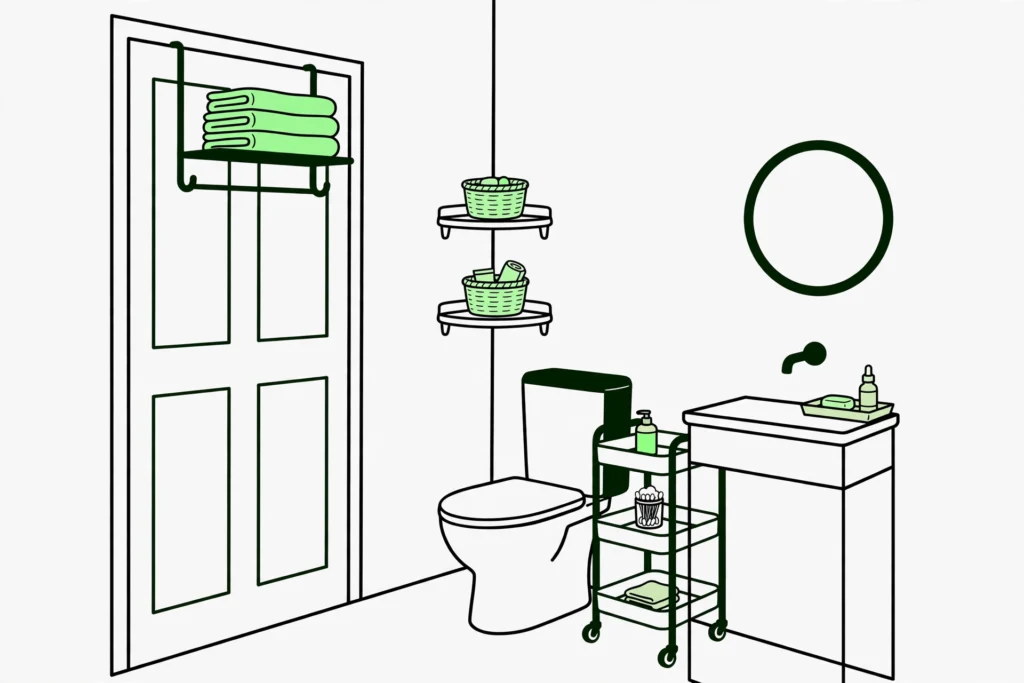
- An over-door rack. It spends no wall at all, which is why tiny bathrooms reach for it. Bars on the rack dry nearly as well as a wall bar if the towels hang in a single layer and the rack’s bars are staggered; a rack loaded two towels deep dries like a bunch. The door becomes the towel wall, and the rack earns it only if the layering stays honest.
- A ladder rack. Several bars in the footprint of a leaning ladder, good for a household whose towels outnumber its wall. Towels on the lower rungs dry slower, partly shadowed by the towels hanging above them, so the daily towels belong on the top rungs, and the ladder works best a small distance off the wall, where air can get behind it.
- Hand towels by the sink. A small ring, short rail, or single hook within reach of the basin, one towel, swapped on a rhythm of days rather than weeks. A hand towel wadded beside the sink never dries and is the most-used towel in the room; it deserves the same spread-and-air logic in miniature.

Spare Towels: Rolled, Stacked, and Out of the Steam
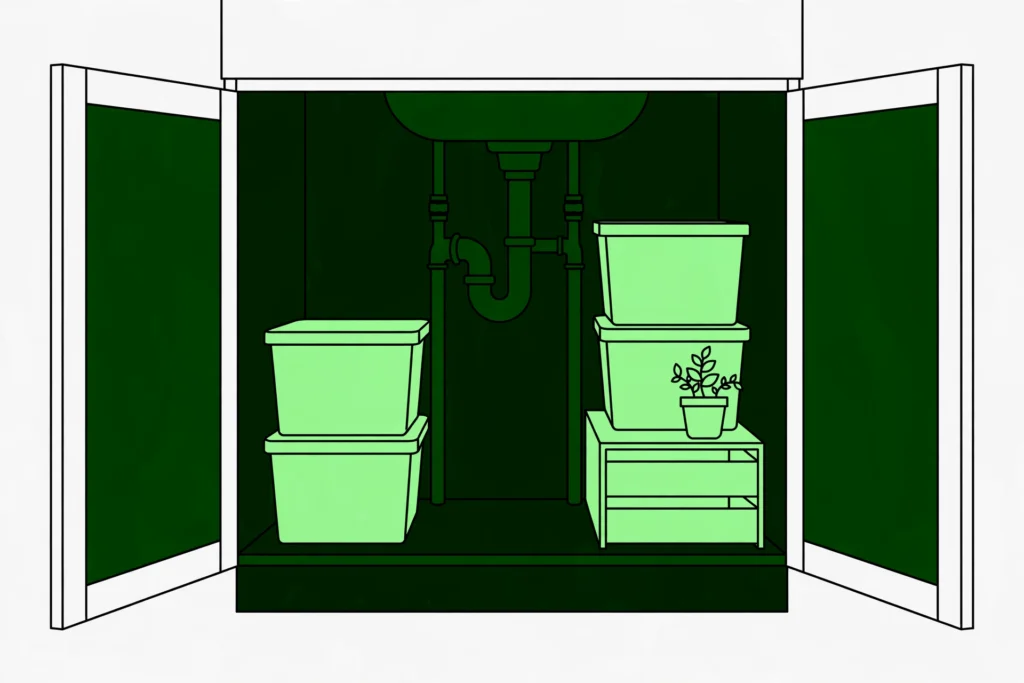
Spares want the opposite of the in-use set: no airflow requirement, maximum compactness, and protection from the room’s steam. The homes that work in a tiny bathroom are few and specific. Rolled spares line up well on an over-toilet shelf or a wall shelf above the door line, where their height is dead space anyway. A lidded basket on the floor or a shelf takes a rotation’s worth and keeps the visual field calm, which matters in a room where all storage is visible. And if the bathroom has even one closed spot, a vanity shelf or the top of a slim cabinet, spares belong behind that door first, because steam reaches open shelves every shower.
Roll or fold is a real decision, decided by how the towels come out. Roll towels stored where they are pulled from the front, like a basket or a deep shelf: a roll keeps its shape when its neighbor leaves, and the whole stock stays visible at a glance. Fold flat on shallow shelves and in short stacks, where rolling wastes the shelf’s precision. Either way, stack by category, bath towels with bath towels, so the rotation is visible: when the spare shelf holds one clean bath towel per person, the count from the first section is being kept; when it holds nine, it is not.
And the boundary that keeps a tiny bathroom honest: the room holds one rotation. The rest of the household’s towels, the beach towels, the extra sets, the inherited spares, live outside the bathroom with the backstock. A spare shelf in the bathroom is a working shelf, not an archive.

The Small Categories: Hand Towels, Washcloths, Guests
Hand towels live by the sink and rotate fastest, so their spare set is small and belongs with the bath spares, not in a separate system. Washcloths split in two: the ones in use belong to the shower zone, where their storage follows the no-drill shower organization system, and the clean spares fold small into the same basket or shelf as the hand towels. Guests get a defined answer rather than a permanent monument: one guest set, a bath towel and a hand towel, stored with the spares and brought out when needed. A tiny bathroom that keeps a guest set permanently deployed is spending its scarcest drying and shelf space on people who are not there.
Keep the Rotation Moving
The system holds together on rhythm, not hardware. Swap the in-use bath towels on a regular cycle and wash them before the damp smell sets the schedule for you. Hang every towel back spread after use, every time; the thirty seconds is the difference between the drying storage working and not. Buy towels one-in-one-out: a new towel enters the rotation when an old one leaves it, because the count was sized to the room and a fourth towel per person has nowhere true to go.
The diagnostic is visible from the doorway. Towels draped over the door, the tub rim, and the backs of chairs mean the in-use drying storage has failed, usually on count or on bunching, and the fix is drying capacity, not more spares. Towels stacked on the toilet tank and the counter mean the spare storage has failed, and the fix is the count and the out-of-the-room boundary. Name the failure correctly and it is a ten-minute fix. Treat every towel problem as a shopping problem and the tiny bathroom fills with racks that hold towels it never should have owned.
Towels are one system inside the bathroom’s wider one. For the room that has no storage to build any of this on, the full build is in the bathroom with no storage system, and the wider set of renter fixes is surveyed in the full rental-bathroom system.

Mike Mann writes practical home organization and small-space living guides for CozySorted. His work focuses on apartment-friendly storage, clutter-free routines, bedroom organization, and simple systems that help renters, apartment dwellers, and small-space homeowners create calmer, easier-to-maintain homes.