
The average small bedroom measures between 9.3 and 13.9 square meters (100 to 150 square feet), leaving the bedside table as one of the only dedicated personal storage surfaces in the entire room [site: U.S. Census Bureau, housing unit size data]. A disorganized nightstand consumes that surface entirely and forces books, notebooks, electronics, and toiletries onto the floor or bed. Smart nightstand organization reclaims both surface and drawer space without requiring a larger room or a new piece of furniture. This guide covers how to prioritize essentials, execute drawer and open-shelf systems, manage cords, and use vertical space and alternative furniture when the nightstand itself is the problem.
How Does Nightstand Organization Maximize Small Bedrooms?
Nightstand organization maximizes small bedrooms by consolidating bedside storage into defined zones that use vertical real estate instead of expanding across the floor. Every item within arm’s reach of the bed needs a specific home. Without one, the nightstand becomes a collection point for every clutter-y item that enters the room each evening. Reducing visual clutter on the bedside surface directly reduces the perceived size of the room, a principle supported by environmental psychology research on spatial perception [site: Journal of Environmental Psychology]. For more whole-room storage planning, see these small bedroom ideas for renters
Why Does Nightstand Organization Prevent Clutter in Small Bedrooms?
Nightstand organization prevents clutter in small bedrooms by assigning designated homes to every item before junk accumulation begins. A simple seasonal bedroom declutter checklist
5 reasons nightstand organization prevents clutter in small bedrooms are listed below.
- Item designation: Every object gets a fixed location. Without one, the surface collects whatever lands on it at the end of the day.
- Restricted surface rule: Organized nightstands operate on a three basic categories system: electronics, toiletries, and devotional materials or notebooks. Everything outside those categories leaves the surface.
- Drawer containment: Drawers hide items that create visual noise when left on top, reducing the cognitive load of a cluttered bedroom environment.
- Daily reset reinforcement: A quick organization plan that takes under two minutes works only when every item has somewhere to go. Organization systems make the reset automatic.
- Entry point control: A small nook or tray on the nightstand surface acts as an intentional landing zone, stopping random items from spreading across the table.

How Does Nightstand Organization Prioritize Essential Items?
5 steps to prioritize essential items during nightstand organization are given below.
- List every item you currently reach for within the first and last 15 minutes of your day, keeping only those within arm’s reach on the nightstand.
- Apply the rule of three basic categories: electronics like your phone and charger, toiletries like lip balm or teeth whitening strips, and devotional materials or notebooks for reading or journaling.
- Remove every single item that does not serve a nightly or morning function, including decorative objects that consume usable surface area.
- Assign the top drawer to the highest-frequency items: the ones you reach for in the dark without looking.
- Treat the nightstand surface as a zero-tolerance zone for items that belong in other rooms, including books you have finished, makeup remover wipes used once, and pampering items close to expiration.
How Do You Execute Nightstand Organization in Small Bedroom Drawers?
To execute nightstand organization in small bedroom drawers, you must sort items by frequency of use, assign each drawer a single category, and use physical dividers to prevent mixing. Drawers without structure become junk drawers within two weeks, regardless of the initial sort. The drawer organization process works from top to bottom, placing the most-accessed items in the top drawer and the least-accessed in the bottom. If your dresser drawers also feel crowded, this guide on folding clothes to maximize drawer space can help keep the rest of the bedroom storage system consistent.
5 steps to execute nightstand drawer organization are listed below.
- Empty all drawers and wipe them with a damp cloth before adding a pretty drawer liner for grip and cleanliness.
- Sort every removed item into three basic categories: electronics, toiletries, and books or notebooks.
- Place like items together using drawer dividers or small acrylic bins before returning anything to the drawer.
- Assign the top drawer to nightly essentials, the middle drawer to toiletries and pampering items, and the bottom drawer to books and large capacity storage items.
- Discard duplicates, expired products, and anything not used in the past 30 days before closing the drawers.
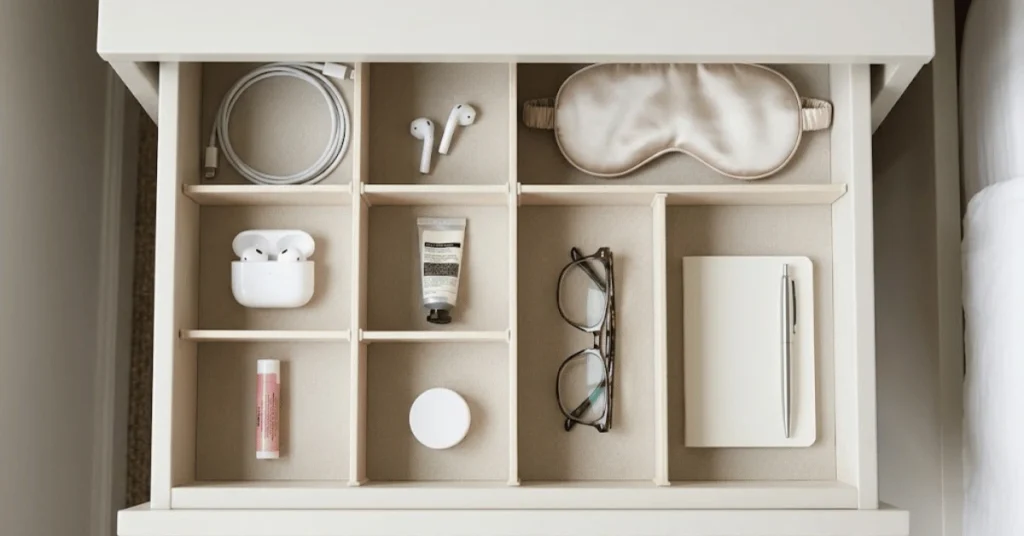
How Does Nightstand Organization Divide Top Drawer Essentials?
The top drawer handles the highest-priority items accessed daily without full attention.
4 ways nightstand organization divides top drawer essentials are outlined below.
- Tech section: Phone, earbuds, and a drawer charging station or short cable stay in a dedicated bin in the front-right corner for immediate access.
- Sleep section: Eye mask, earplugs, and any sleep-specific medications occupy a separate bin to the left, keeping them distinct from tech items.
- Personal care section: Lip balm, hand cream, and makeup remover wipes sit in a front-left compartment within arm’s reach without requiring the light to be on.
- Reading section: A single bookmark or reading glasses case fits at the back of the top drawer if the nightstand is long enough. A long rectangle nightstand accommodates this. A small narrow side table does not.
Why Does Nightstand Organization Utilize Drawer Dividers for Small Items?
Drawer dividers prevent the top drawer charging station area from merging with the toiletry section over time.
4 reasons nightstand organization utilizes drawer dividers for small items are given below.
- Separation maintenance: Acrylic organizers create fixed walls between categories. Without them, small items migrate and the drawer reverts to a junk state within days.
- Visual inventory: Dividers make every item visible at a glance from above, eliminating the need to remove unwanted items to find what you need.
- Size optimization: Expandable drawer dividers adjust from 20 to 45 cm (8 to 18 inches) to fit nightstands that are small enough to limit standard product sizing.
- Junk drawer prevention: A segmented drawer has no open space for random accumulation. Every compartment is already claimed by a category, blocking new clutter from entering.
How Does Nightstand Organization Adapt to Open Shelves?
Nightstand organization adapts to open shelves by replacing the concealment that drawers provide with containment tools like trays and lidded baskets. Open shelves on a ladder shelf nightstand or open-concept bedside table expose every item to full view. Visible clutter on open shelves reads as room-wide disorder, even when the rest of the bedroom is tidy. Containment and concealment are the two strategies that make open shelf organization work in small spaces.
Why Does Nightstand Organization Rely on Decorative Trays?
Decorative trays corral loose items on open nightstand shelves into a visually bounded zone.
4 reasons nightstand organization relies on decorative trays are listed below.
- Visual boundary creation: A tray signals where items belong. Anything outside the tray reads as out of place, which creates a natural pressure to keep the surface edited.
- Aesthetic coherence: A marble, wooden, or leather tray turns a collection of functional objects into a styled surface, which suits open shelves where everything remains visible.
- Portability for cleaning: A tray lifts as a single unit, making surface cleaning under the nightstand faster and more consistent.
- Item limit enforcement: The tray’s physical size caps how many items the surface holds. Once the tray is full, nothing else belongs on the shelf.
How Does Nightstand Organization Use Lidded Baskets to Conceal Clutter?
4 ways nightstand organization uses lidded baskets to conceal clutter are given below.
- Place a woven lidded basket on the lower open shelf to hold items used less frequently, such as pampering items close to expiration, extra cables, or devotional materials not in active use.
- Use a second, smaller basket on the upper shelf for bedtime toiletries like teeth whitening strips or hand cream, keeping the surface tray reserved for electronics only.
- Label each basket on the interior base so every single item returns to the correct container without deliberation during the nightly reset.
- Choose baskets sized to fit the shelf depth within 2 to 3 cm (1 inch) to prevent them from sliding forward and collect clutter-y items that fall behind.
How Do Nightstand Organization Hacks Manage Cords?
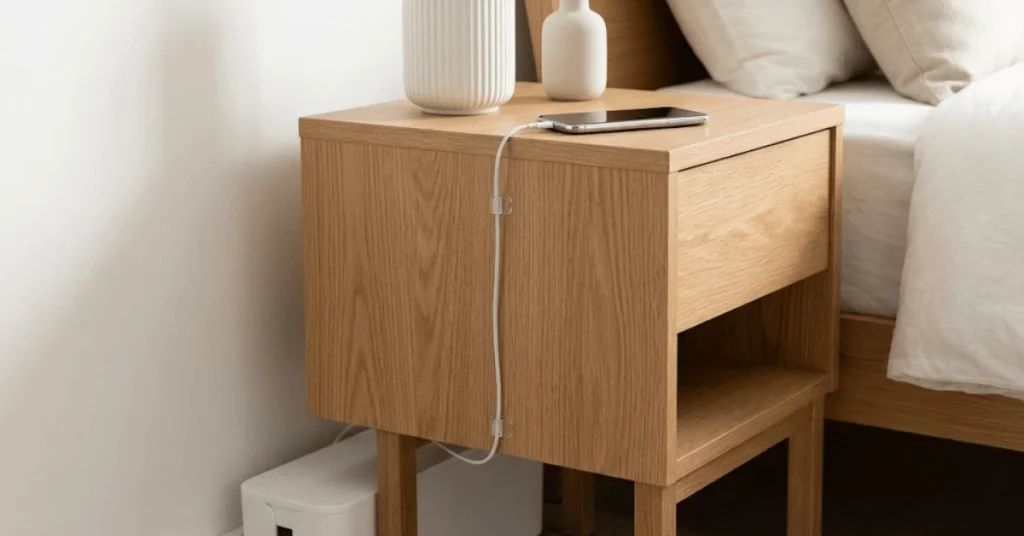
Nightstand organization hacks manage cords by routing, concealing, and anchoring charging cables so they do not occupy surface space or create visual noise in a small bedroom. Cord clutter is the fastest way to make a beautifully organized nightstand look chaotic. A single unmanaged cable draws the eye more than a cluttered tray. The primary cord control methods are adhesive clips, cable management boxes, and a DIY charging station built into or behind the nightstand itself.
Why Does Nightstand Organization Require Renter-Friendly Cord Control?
Renters face restrictions on wall modifications that eliminate most permanent cord management solutions.
4 reasons nightstand organization requires renter-friendly cord control are outlined below.
- No-drill requirement: Most rental agreements prohibit wall drilling, which eliminates recessed cable channels and mounted conduit systems as options.
- Adhesive clip performance: 3M Command adhesive cord clips hold up to 0.9 kg (2 lbs) per strip and remove without wall damage, making them the standard renter-friendly solution [site: 3M product specifications].
- Deposit protection: Permanent cord management solutions like wall-mounted cable raceways require patching on move-out, creating repair costs that exceed the organizational benefit.
- Flexibility on relocation: Adhesive and temporary solutions move with the renter. Permanent installations stay in the wall and provide no value after the tenancy ends.
How Do Cable Management Boxes Improve Nightstand Organization?
4 ways cable management boxes improve nightstand organization are listed below.
- A cable management box houses the power strip and all excess cable length inside a single enclosed unit, eliminating the tangled cord cluster that forms behind most nightstands.
- Place the box on the lower shelf or the floor behind the bed side table, routing only the necessary cable length through the box’s exit slot to the device on the surface.
- Use a box with ventilation slots to prevent heat buildup around the power strip inside, particularly when charging multiple devices simultaneously overnight.
- Select a box in a neutral finish, white, black, or wood grain, to match the nightstand and prevent the unit from becoming a visual focal point in the organized bedside table setup.
What Spatial Constraints Drive Small Bedroom Nightstand Organization?
Spatial constraints drive small bedroom nightstand organization because the floor plan dictates what type of bedside storage fits physically beside the bed. A narrow side table in a room under 10 square meters (107 square feet) occupies floor space that affects the walking path, door clearance, and overall room function. Small space storage decisions start with the floor plan, not the furniture catalog. When the traditional nightstand footprint exceeds what the room allows, alternative furniture and vertical solutions replace it entirely.
Should You Use Alternative Furniture for Small Bedroom Nightstand Organization?
You should use alternative furniture for small bedroom nightstand organization when the available floor space beside the bed measures less than 40 cm (16 inches) in width, or when the traditional nightstand height conflicts with the bed frame profile. C-tables and floating shelves eliminate the footprint problem entirely. They serve every function of a traditional nightstand without consuming floor space. Both options suit a nightstand small enough to create access or clearance problems in tight layouts.
Why Are Floating Shelves Chosen Over Traditional Small Bedroom Nightstand Organization?
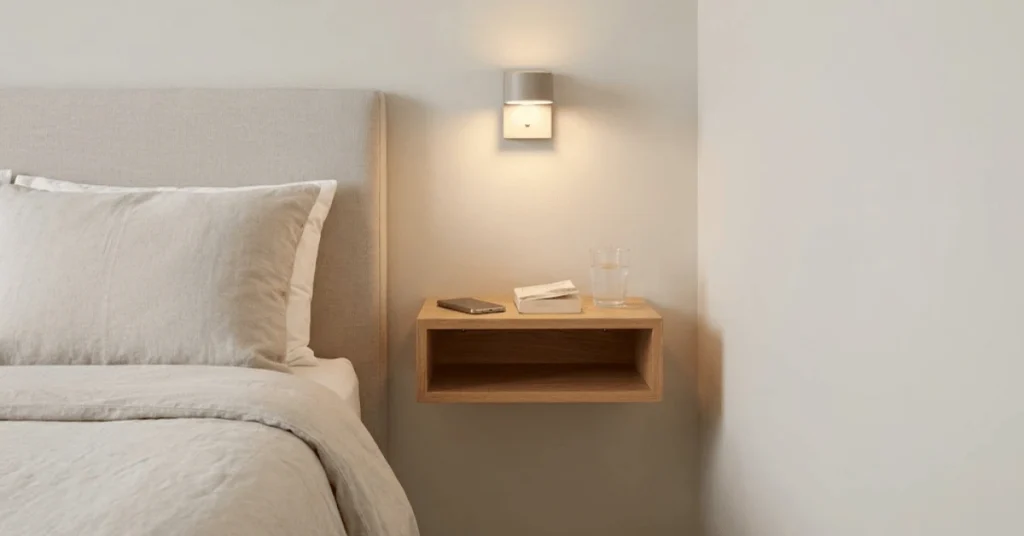
Floating shelves mount directly to the wall and use wall space behind the head of the bed that traditional furniture ignores. For more wall-based storage options, see these vertical storage ideas.
5 reasons floating shelves are chosen over traditional small bedroom nightstand organization are listed below.
- Zero floor footprint: Floating shelves use unused wall space completely, leaving the floor beside the bed open for movement or additional storage like fabric storage baskets or clothes storage bins.
- Adjustable height: Wall-mounted shelves install at any height above the mattress, accommodating varying bed frame profiles from platform beds to high box springs.
- Customizable depth: Shelves ranging from 15 to 30 cm (6 to 12 inches) deep provide sufficient surface area for nightly essentials without projecting into the walking path.
- Visual lightness: Open wall shelves make a small bedroom organized without adding the visual mass of a solid furniture piece beside the bed.
- Renter adaptation: Removable adhesive shelf systems like those from Command or Umbra support up to 4.5 kg (10 lbs) and install without drilling [site: product load rating specifications].
When Do C-Tables Provide Better Solutions Than Small Bedroom Nightstand Organization?
C-tables slide under the bed frame on a cantilevered base, positioning the surface above the mattress level without touching the floor beside the bed.
4 scenarios when C-tables provide better solutions than small bedroom nightstand organization are outlined below.
- Zero clearance beside the bed: When the wall-to-bed gap measures under 25 cm (10 inches), no traditional nightstand fits. A C-table slides under the frame from the foot of the bed instead.
- Adjustable height needs: C-tables adjust surface height from 55 to 80 cm (22 to 31 inches) on most models, accommodating different mattress depths without custom furniture.
- Mobile storage preference: C-tables roll on casters, making them easy to reposition without moving the bed, which suits small bedroom layouts that change configuration seasonally.
- Large capacity storage demand: C-tables with lower shelves hold large capacity storage bags or blanket storage bags beneath the surface, adding a storage tier that traditional nightstands in small rooms cannot match. For extra storage outside the nightstand, these under-bed storage ideas can help use the floor area below the bed more efficiently.
How Does Vertical Space Eliminate the Need for Small Bedroom Nightstand Organization?
Vertical space eliminates the need for small bedroom nightstand organization by shifting bedside storage from the floor and surface level up to the wall, freeing every square centimeter of floor area for movement or alternative use. Utilizing every space above the mattress line through wall sconces, mounted shelves, and over-bed storage removes the dependency on a physical nightstand surface altogether. This approach suits rooms where even a narrow side table creates a clearance problem.
Why Do Wall Sconces Reduce the Surface Demands of Small Bedroom Nightstand Organization?
A table lamp occupies 15 to 25 cm (6 to 10 inches) of nightstand surface radius. Wall sconces eliminate that footprint entirely.
4 reasons wall sconces reduce the surface demands of small bedroom nightstand organization are given below.
- Surface recovery: Removing the table lamp from the nightstand top returns the largest single area of bedside surface to functional storage use.
- Directed light control: Plug-in wall sconces with adjustable arms direct light to the reading zone without illuminating the entire room, which suits shared small bedrooms.
- No rewiring required: Plug-in sconces route along the wall to a standard outlet with adhesive cord clips, making them compatible with rental units without electrical modifications.
- Visual height creation: Wall-mounted lighting draws the eye upward, creating the perception of a taller, larger room, a consistent finding in interior design practice [site: interior design spatial perception research].
How Do Mounted Shelves Substitute a Small Bedroom Nightstand Organization?
5 ways mounted shelves substitute a small bedroom nightstand organization are listed below.
- Install a single wall shelf at mattress-plus-20 cm (8 inches) height beside the bed to position the surface within arm’s reach without requiring a freestanding table.
- Mount a second shelf 30 cm (12 inches) above the first to create a two-tier organized bedside table system that holds books on top and electronics below.
- Use the lower shelf as the primary surface for the drawer charging station setup, routing the cable down the wall with adhesive clips to the nearest outlet.
- Add a small hook beneath the lower shelf for headphones or a reading light cord to use every inch of the vertical space, including the underside of the shelf.
- Install shelves in a perfect small space configuration: no shelf wider than the bed headboard and no shelf projecting more than 20 cm (8 inches) from the wall to maintain safe clearance during sleep.

Mike Mann writes practical home organization and small-space living guides for CozySorted. His work focuses on apartment-friendly storage, clutter-free routines, bedroom organization, and simple systems that help renters, apartment dwellers, and small-space homeowners create calmer, easier-to-maintain homes.