
The average dresser drawer holds 30% to 50% more clothing when items stand upright instead of lying flat [site: professional organizer industry standards]. Most people stack clothes horizontally by habit, not by choice. File folding, the vertical storage method popularized by Marie Kondo, changes how much fits in a drawer and how fast you find what you need. This guide covers the folding technique itself, category-specific steps for t-shirts, pants, socks, and sweaters, tools that keep folds upright, and when rolling or hanging beats folding entirely. If you are trying to reduce clothing clutter before folding everything, this capsule wardrobe organization guide can help you decide which clothes deserve space in your drawers.
How Does Folding Clothes Maximize Drawer Space?
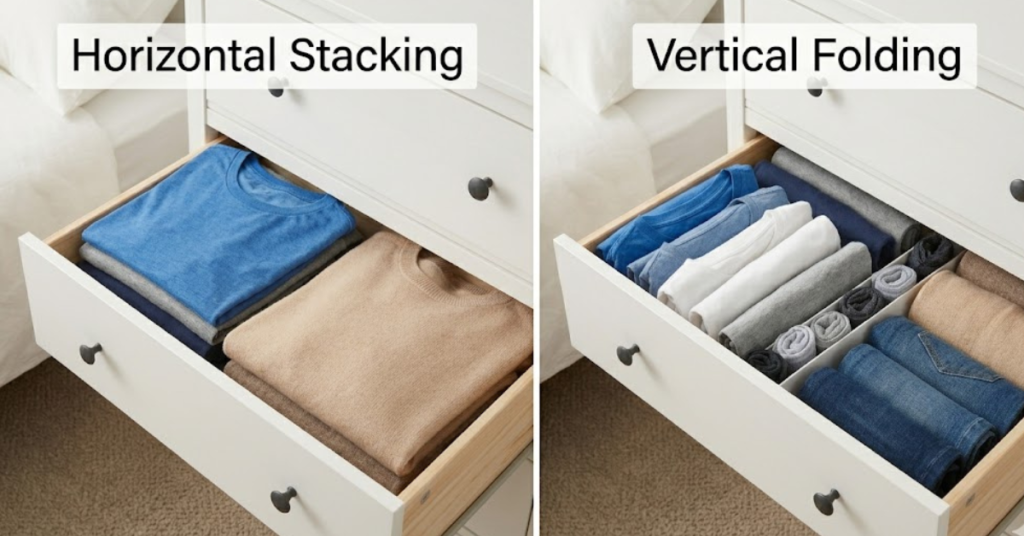
Folding clothes maximizes drawer space by replacing horizontal stacking with vertical file folding, which uses the full height of a drawer instead of only its floor space. Each item stands on its edge like a file in a cabinet. You see every item at once. Nothing gets buried. The file folding technique removes the top-to-bottom pressure that flattens stacked clothes and forces you to unpack the drawer to find one item.
What is the Difference Between Vertical Folding and Horizontal Stacking?
The difference between vertical folding and horizontal stacking lies in how each method uses drawer real estate. Vertical folding stands clothes upright so every item is visible from above. Horizontal stacking lays clothes flat so only the top item is visible and accessible.
3 key differences between vertical folding and horizontal stacking are listed below.
- Visibility: Vertical folding shows every item simultaneously. Horizontal stacking hides everything below the top layer.
- Capacity: Vertical folding fills the drawer height from bottom to top. Horizontal stacking uses only the floor of the drawer, leaving vertical space wasted.
- Stability: Horizontal stacking collapses when you remove a middle item. Vertical folding stays organized because each item supports the next.
Why Does File Folding Increase Drawer Capacity?
File folding increases drawer capacity by eliminating compression and dead vertical space. Flat stacking compresses lower items under the weight of everything above. Upright folding distributes each garment independently, removing that pressure entirely.
4 reasons file folding increases drawer capacity are outlined below.
- Height utilization: Drawers are typically 15 cm to 25 cm (6 to 10 inches) deep. Vertical folding fills that depth with individual items instead of one compressed pile.
- Item independence: Each folded piece stands alone. Removing one item does not disturb the others.
- Clothing compression prevention: Upright folding maintains the structure of each garment, particularly knit fabrics that flatten and stretch under stacked weight.
- Consistent fold size: The KonMari method standardizes each item to a uniform rectangle, which allows tighter, more predictable packing across similar colored shirts and mixed categories.
How Do You Fold Clothes to Maximize Drawer Space?
To file fold clothes to maximize drawer space, you fold each item into a compact, self-supporting rectangle that stands upright on its longest edge. The fold must be firm enough to hold its shape without external support. A folding board accelerates the process and creates consistent sizes across every garment type.
5 general steps to fold clothes are listed below.
- Lay the garment flat on a smooth surface with the front side facing down.
- Fold both sides toward the center, overlapping slightly to create a long vertical strip.
- Fold the strip in half lengthwise if the item is still wider than your drawer allows.
- Fold from the bottom up in thirds or quarters until the item forms a compact rectangle.
- Stand the folded rectangle upright in the drawer with the folded edge facing up.
How Do You Fold T-Shirts Vertically for Drawer Space?
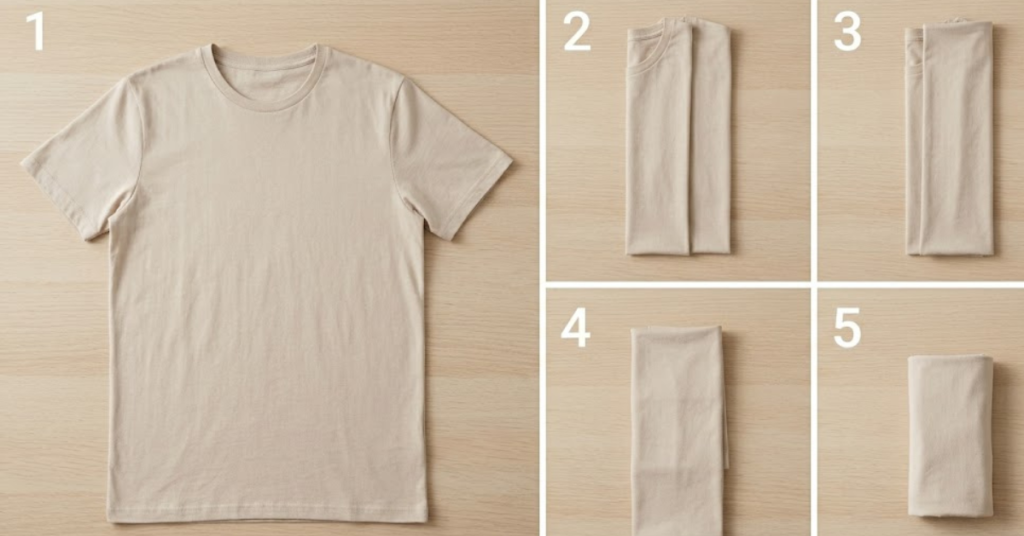
6 steps to fold t-shirts vertically for drawer space are given below.
- Lay the t-shirt flat with the front side facing down on a smooth surface.
- Fold the left third of the shirt toward the center, including the sleeve.
- Fold the right third toward the center the same way, overlapping the left side slightly.
- You now have a long rectangle. Fold the bottom hem up to meet the collar.
- Fold this panel in half again so the shirt forms a short, thick rectangle.
- Stand the rectangle upright in the drawer with the folded edge facing upward so you see the long-sleeved shirt or short-sleeved edge clearly.
How Do You Fold Pants and Jeans for Maximum Drawer Space?
6 steps to fold pants and jeans for maximum drawer space are listed below.
- Lay pants flat with the front facing down and legs aligned on top of each other.
- Fold one leg over the other so both legs overlap completely.
- Fold the waistband down to the hem, creating a long, narrow strip.
- Fold that strip in half, bringing the hem up to the waistband.
- Fold in half one final time to create a compact square or rectangle.
- Stand the folded jeans upright in the drawer with the fold facing up.
How Do You Fold Underwear and Socks to Save Drawer Space?
6 steps to fold underwear and socks to save drawer space are given below.
- For underwear, lay the item flat and fold both sides toward the center to create a long rectangle.
- Fold the rectangle in thirds from the bottom up until the underwear forms a compact square. Fold bras and even bralettes by tucking one cup inside the other without folding the straps.
- Stand each underwear square upright in a drawer box or bin.
- For socks, lay one sock on top of the other, perfectly aligned at the toe and heel.
- Roll both socks together tightly from the toe toward the cuff.
- Stand each rolled pair upright in a dedicated section or use IKEA SKUBB boxes to keep them separated.
How Do You Fold Bulky Sweaters to Maximize Drawer Space?
Folding bulky sweaters requires a wider fold to accommodate fabric thickness without distorting the shape.
5 steps to fold bulky sweaters to maximize drawer space are outlined below.
- Lay the sweater face down and fold both arms across the back of the body.
- Fold one side to the center, then fold the other side on top, creating a wide rectangle.
- Fold the bottom third up toward the collar, keeping folds loose enough to avoid crushing the fabric.
- Fold once more in half, stopping before the garment becomes too thick to stand upright.
- Place sweaters upright in the drawer with the folded edge facing up. Do not hang sweaters; hanger storage stretches the shoulders of knit fabric permanently.
How Do You Keep Folded Clothes Upright in Drawer Space?
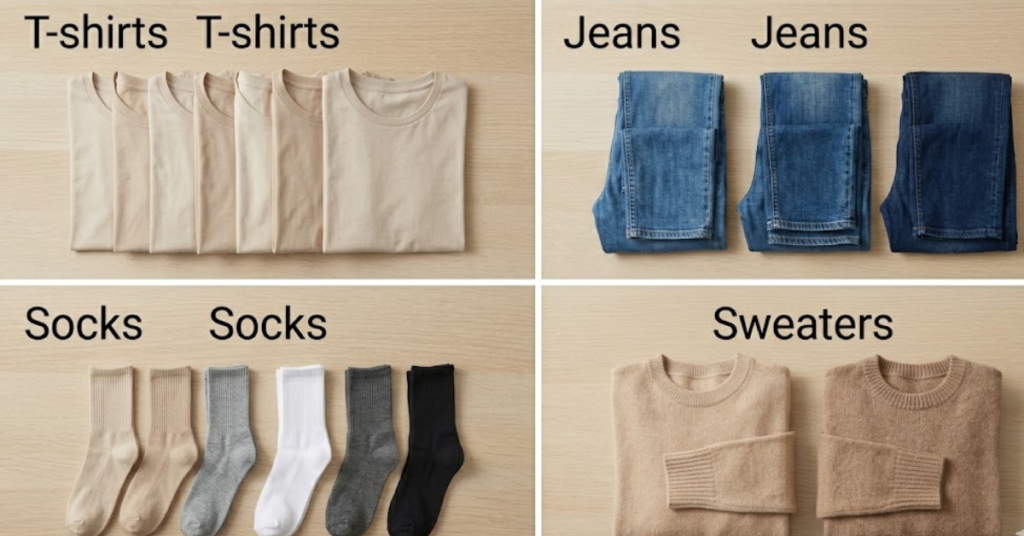
Keeping folded clothes upright in drawer space requires structural support on all four sides of each item. A half-empty drawer is the main cause of collapsed folds. Clothes standing upright with no lateral support tip over the moment you remove one item. The solution is to fill each section fully or add physical dividers that substitute for the missing garments. If your drawer setup is part of a compact bedroom, these small bedroom organization ideas for renters can help you keep clothing organized without permanent changes.
Why Do Drawer Dividers Support Folded Clothes?
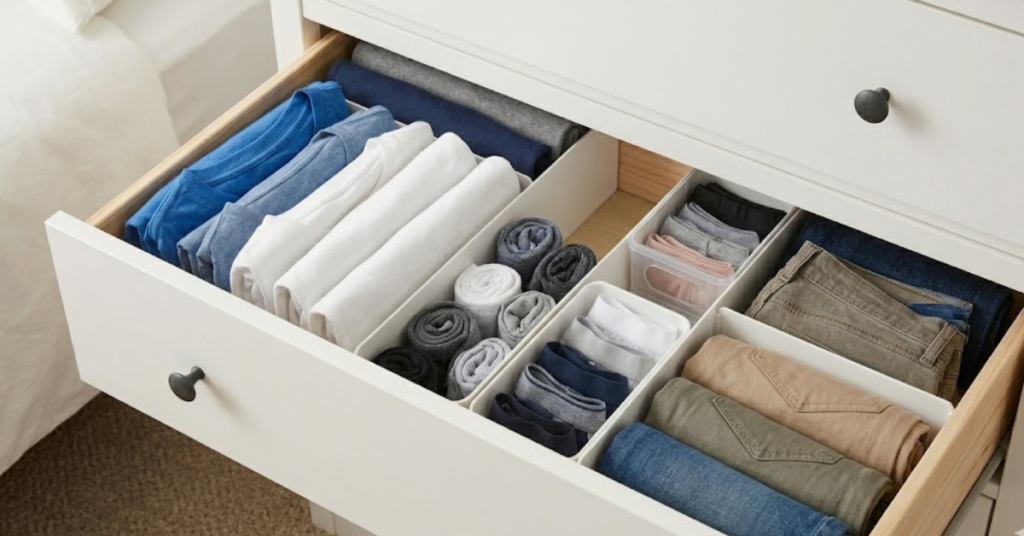
Drawer dividers support folded clothes by creating fixed compartments that eliminate the lateral movement that causes items to fall.
4 reasons drawer dividers support folded clothes are listed below.
- Fixed wall structure: Expandable drawer dividers create rigid boundaries that hold each section of clothing firmly, regardless of how full or empty it is.
- Category separation: Dividers keep similar colored shirts, pants, and underwear in dedicated zones so mixing does not disrupt adjacent folds.
- Adjustable fit: Expandable dividers adjust from 25 cm to 65 cm (10 to 26 inches) to fit any dresser configuration without cutting or modifying the drawer.
- Reduced refolding: When clothes stay upright between uses, you spend less time refolding after each laundry cycle.
How Do Organizing Bins Stabilize Vertically Folded Clothes?
4 ways to organize bins, stabilize vertically folded clothes are given below.
- Container walls replace drawer walls: Acrylic drawer organizers and drawer bins act as individual containers. Each bin holds one category of clothing tightly, preventing lateral shift.
- Portability during laundry: Bins lift out of the drawer as a unit. You refill them on a flat surface and return them to the drawer without disturbing adjacent sections.
- Deep dresser drawer management: Deep dresser drawers create the most instability for vertical folds. Bins reduce the effective depth to a manageable 10 cm to 15 cm (4 to 6 inches) per section.
- Visibility by category: Clear acrylic bins show contents from above and from the front. Storage space improves when you see exactly what each bin holds before opening the drawer.
How Does Clothing Storage Dictate Folding Methods?
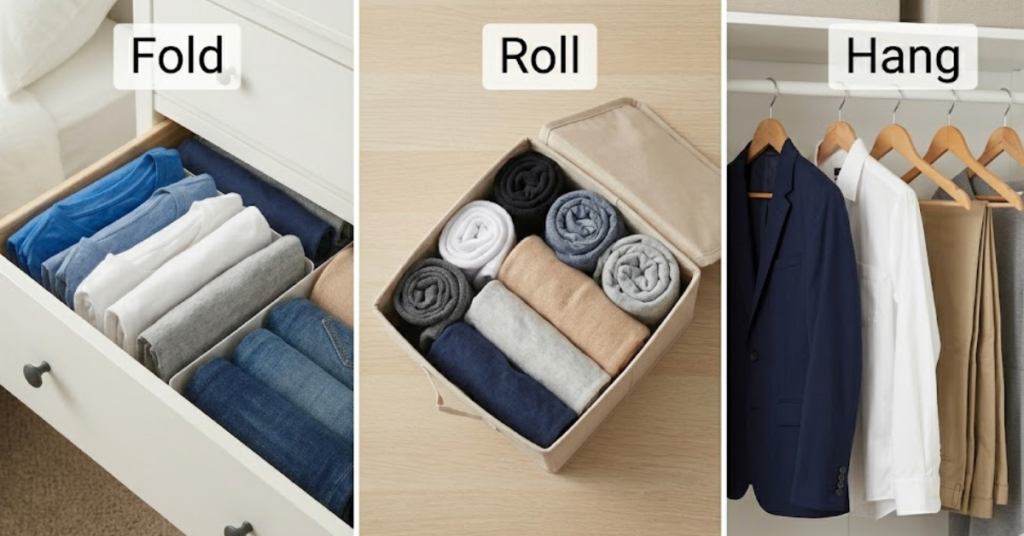
Clothing storage dictates folding methods because the type of storage space, drawer depth, closet rod length, and shelf height determine which technique maintains garment integrity and uses available space efficiently. Drawers suit file-folding essentials like t-shirts and jeans. Closets suit hanging for structured and wrinkle-prone items. Suitcases suit rolling for compression and speed. No single method works across every storage context. Proper folding techniques depend on where the clothing lives, not just on the garment type. For a bigger small-space system beyond drawers, this home organization and budget decor guide can help connect clothing storage with the rest of the room.
When Should Hanging Clothes Replace Drawer Space?
Hanging clothes should replace drawer space when the garment wrinkles under folding pressure or when its structure requires vertical support to maintain shape. Blazers, dress shirts, and trousers develop permanent creases when folded and stored flat. Hanging preserves the silhouette in a way no folding method replicates. Closet space becomes more efficient when each hanger holds a garment that genuinely needs it, freeing drawers for items that fold cleanly. If you do not have enough dresser space, learning how to organize a small closet without a dresser can help you decide what belongs on hangers, shelves, bins, or drawers.
What Clothing Materials Require Hangers Over Folding?
Clothing materials that require hangers over folding are listed below.
- Linen clothing wrinkles within hours of folding. It requires a wide hanger and open air circulation to stay presentable.
- Silk and chiffon crush under drawer pressure. Padded hangers prevent distortion of the fabric grain.
- Structured garments like blazers and suit jackets lose their shoulder shape when folded. Suit hangers with wide shoulders maintain the correct silhouette.
- Wool trousers crease at the knee when folded. Clamping hangers hold them at the waistband and let gravity remove wrinkles.
- Formal dresses and gowns require full-length hanging to prevent hem distortion and seam stress from compression.
Should You Roll Clothes Instead of Folding Them for Drawer Space?
You should roll clothes instead of folding them for drawer space when the garment is casual, lightweight, and used frequently for travel or stored in a small drawer. Rolling and file folding both stand clothes upright, but tightly rolled clothes compress more than flat-folded rectangles in narrow spaces. The Lennia Carter method and the Kaitlyn Strother method, both widely shared as TikTok folding hacks, demonstrate rolling variations that reduce individual item width by up to 40% compared to standard file folding [site: closet organization expert demonstrations].
When Does Rolling Clothes Save More Space Than Folding?
4 scenarios when rolling clothes saves more space than folding are outlined below.
- Small drawer spaces: Rolled items fit into drawers under 20 cm (8 inches) wide more efficiently than folded rectangles, which require a minimum flat width to hold their shape.
- Casual knit fabrics: T-shirts, tank tops, and lightweight knits roll without creasing. They do not need the structured fold that woven fabrics require to stay wrinkle-free.
- Travel packing: Rolling fills irregular suitcase corners that folded items leave empty. It also allows visual identification of each item when packing cubes are open.
- Prioritizing folding essentials: Rolling works for secondary items like gym clothes and beach wear. Master space saving by reserving file folding for daily-wear items like t-shirts and jeans where outfit visibility matters most.
How Does Suitcase Space Benefit from Folded Clothes?
Suitcase space benefits from folded clothes by applying the same vertical organization principles used in dresser drawers to a compressed, mobile format. File folding and rolling translate directly to travel organization when combined with packing cubes, which act as portable drawer bins inside luggage. The result is compact packing that maintains category separation and reduces the time spent unpacking at a destination.
Why Does File Folding Optimize Packing Cube Space?
5 reasons file folding optimizes packing cube space are given below.
- Uniform rectangle sizes: File folded items stack predictably inside packing cubes, eliminating the irregular shapes that waste cube capacity.
- Category containment: One cube holds t-shirts. Another holds jeans. This modular folding system mirrors drawer organization and speeds up both packing and unpacking.
- Compression compatibility: File folded items compress further under the zip of a compression packing cube without losing their fold structure, unlike loosely rolled items.
- Visibility during travel: Standing items upright inside an open packing cube shows every garment at once, the same benefit file folding delivers in a dresser drawer.
- Reduced wrinkle transfer: Folded edges face upward in packing cubes, keeping fabric surfaces from pressing directly against each other during transit, which maintains garment integrity across long flights.

Mike Mann writes practical home organization and small-space living guides for CozySorted. His work focuses on apartment-friendly storage, clutter-free routines, bedroom organization, and simple systems that help renters, apartment dwellers, and small-space homeowners create calmer, easier-to-maintain homes.