
A standard queen mattress measures 60 by 80 inches (152 by 203 cm), which creates a 4,800-square-inch footprint before the bed frame is counted [site: Better Sleep Council mattress size guide]. With 6 to 10 inches (15 to 25 cm) of clearance, that same footprint can hold about 16.7 to 27.8 cubic feet of hidden storage.
Under-bed storage in a small bedroom means using low-profile bins, vacuum bags, drawers, or a storage bed frame to turn unused bed clearance into organized storage. The right setup depends on clearance height, pull-out space, and what you need to store.
The best under-bed storage ideas for small bedrooms are simple: store seasonal clothing, bedding, shoes, and low-use items under the bed instead of adding another dresser. Use rolling bins for regular access, vacuum bags for bulky fabrics, and storage beds when you need more built-in capacity.
This guide shows what fits under low beds, how to choose the right storage bin size, when storage beds make sense, what to store, what to avoid, and how to keep the space clean, dry, and easy to use.
What are common types of under-bed storage options available?
Common types of under-bed storage options include rolling bins, vacuum bags, fabric organizers, drawers, shoe organizers, storage bed frames, and flat archive boxes.
Under-bed storage works best when the container matches the item. Hard bins protect heavy items. Soft bags compress fabrics. Drawers reduce friction for daily use.
The main under-bed storage types are compared below:
| Type | Best for | Clearance needed |
|---|---|---|
| Rolling storage bins | Clothing, shoes, accessories, and items accessed every few days | 7+ inches (18+ cm) |
| Flat vacuum bags | Comforters, spare blankets, winter coats, and seasonal clothing | Under 5 inches (12 cm) |
| Zip-up fabric organizers | Linens, soft accessories, and lightweight clothing | 5+ inches (12+ cm) |
| Under-bed drawers | Daily clothing, kids’ rooms, and studio apartments with no dresser | 8+ inches (20+ cm) |
| Shoe organizers | Keeping pairs flat, visible, and separated under low-clearance beds | 5+ inches (12+ cm) |
| Storage bed frames | Replacing a dresser or adding hidden storage without extra furniture | Built-in (no clearance needed) |
| Flat archive boxes | Papers, photos, and seasonal decor in dry, low-humidity rooms | 4+ inches (10+ cm) |
Plastic bins from Sterilite and IRIS USA, fabric cases from IKEA SKUBB, and vacuum bags like Ziploc Space Bag all solve different storage problems. Check product height, lid style, and pull-out clearance before buying.
What makes under-bed storage different in a tiny bedroom?
Under-bed storage in a tiny bedroom creates unique challenges because the floor space needed to pull bins out often does not exist in the same room as the bed itself.
In a standard-sized bedroom, you slide a bin out, crouch beside it, and access the contents with room to maneuver. In a tiny bedroom, the bin extends into door swing zones, furniture legs, or open floor space that serves as the primary walkway. Retrieval constraints change everything about which products work and which fail immediately.
The bed frame type, clearance height, and aisle width all determine what is actually usable. A product rated for under-bed use in a standard room becomes impractical in a space where pulling it halfway out blocks the only path to the door.
What are the best under-bed storage ideas for small bedrooms?
The best under-bed storage ideas for small bedrooms are rolling bins, vacuum bags, fabric organizers, drawer units, shoe organizers, and storage beds. These options use the bed footprint without adding another dresser, shelf, or floor unit.
The right storage type depends on access frequency. Daily items need drawers or rolling bins. Seasonal items work better in vacuum bags, sealed fabric organizers, or labeled flat boxes.
Use these ideas based on the item category:
- Use rolling bins for clothes, accessories, hobby supplies, and items accessed every week.
- Use vacuum bags for comforters, blankets, winter coats, and seasonal fabrics.
- Use zip-up fabric organizers for soft items that need dust protection.
- Use under-bed drawers for daily clothing, kids’ toys, shoes, and studio apartment storage.
- Use shoe organizers for sandals, flats, sneakers, and off-season footwear.
- Use storage beds when the bedroom lacks space for a dresser or extra cabinet.
- Use flat document boxes for archived papers in dry rooms only.
Keep the fastest-access bins on the open side of the bed. Store off-season items against the wall side or deepest part of the frame.
How does limited floor space change what you can realistically store and access?
Limited floor space in a tiny bedroom directly restricts bin size, retrieval angle, and how frequently you access stored items without disrupting the room.
Four factors that limit under-bed storage access in a tiny bedroom are listed below.
- Bin length: bins longer than 60 cm (24 in) require open floor depth equal to the bin length plus body clearance, typically 90 cm (36 in) total, which most tiny bedrooms lack beside or at the foot of the bed
- Retrieval angle: standard rectangular rooms with beds pushed against walls allow access from only one or two sides, eliminating full slide-out access for bins positioned deep against the wall
- Door swing radius: interior bedroom doors swing through 60 to 90 cm of floor space, blocking the retrieval zone for any bin stored at the foot of the bed near the entry
- Furniture leg proximity: nightstands, dressers, and chairs positioned beside the bed reduce the usable pull-out width, often forcing bins to be accessed at an angle rather than straight-out
Access frequency determines the real cost of these constraints. Items accessed weekly need easy retrieval. Items accessed twice yearly tolerate a harder pull-out process.
Why do most general under-bed storage tips fail in very small rooms?
General under-bed storage advice fails in tiny bedrooms because it assumes floor space that does not exist in rooms under 70 square feet.
Standard recommendations include large 66-liter clear plastic bins, full-width under-bed drawers spanning the entire frame, and zippered fabric organizers requiring two-handed access from a kneeling position. Each of these requires 90 cm or more of open floor beside the bed for practical use. Tiny bedrooms rarely have that aisle width consistently available on any side of the bed.
Frame incompatibility creates a second failure point. Platform beds with solid bases, beds with decorative skirting, and low-profile frames under 15 cm clearance block access entirely. The most common mistake is buying a product before measuring clearance and retrieval space.
What should you measure before buying any under-bed storage?
Before buying any under-bed storage, you need three measurements: clearance height, usable floor width for retrieval, and the internal bed frame dimensions if you are considering a storage frame.
Three measurements to take before buying under-bed storage are listed below.
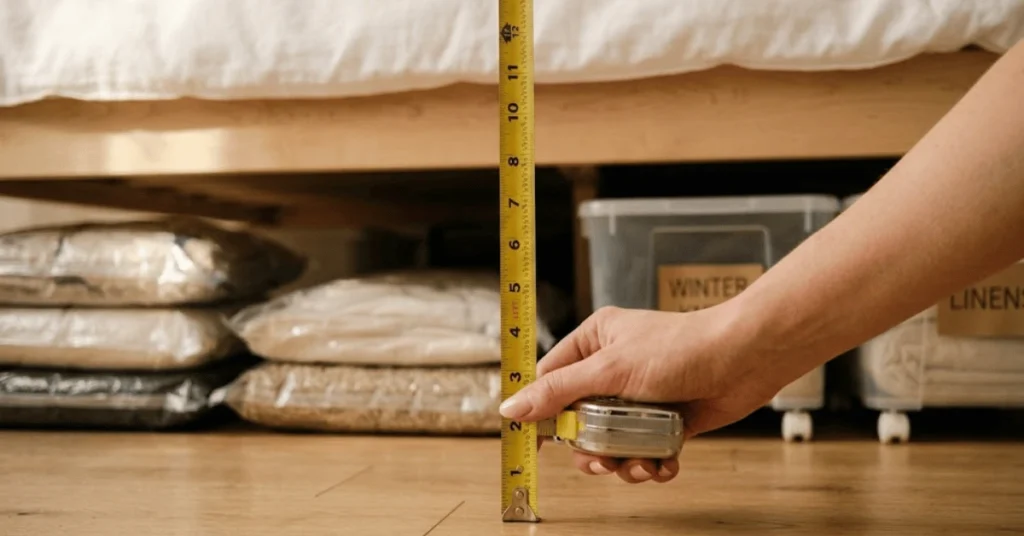
- Clearance height: measure from the floor surface to the lowest point of the bed frame or slats at the center point of the bed, not just at the edges where the frame may sit higher
- Retrieval width: measure the open floor space on each accessible side of the bed from the bed frame edge to the nearest obstruction (wall, furniture, door swing endpoint)
- Bed frame interior span: for storage bed frames, measure the interior cavity width and depth from inside the frame rails to confirm bin or drawer compatibility before purchase
These three numbers determine which product categories are physically possible before any style or cost decision.
How do you measure bed clearance height and why does it determine everything?
Clearance height determines everything because it sets a hard physical ceiling on which container types fit, and no organizational system overrides a product that does not slide under the frame.
Steps to measure bed clearance height are listed below.
- Remove all items from under the bed and place the bed on a flat floor surface without rugs or mats that add height variation
- Use a rigid tape measure or a flat ruler and measure from the floor to the lowest structural point of the bed frame at the center, not the edge
- Record this measurement in both inches and centimeters and note whether the frame has a center support rail that creates a lower obstruction point than the outer frame
- Compare your measurement to these three threshold ranges: under 18 cm (7 in) limits you to flat vacuum bags and ultra-low-profile bins only; 18 to 30 cm (7 to 12 in) opens rolling drawers and standard low-profile bins; 30 cm (12 in) and above accommodates most standard under-bed storage products including wheeled bins with lids
Measure in at least three spots: center, left side, and right side. Frame sag and floor unevenness create variations of 1 to 3 cm that matter when selecting products with tight clearance tolerances.
What under-bed storage works best for low beds?
Under-bed storage for low beds works best when the container is flat, flexible, and shorter than the measured clearance. Vacuum bags, soft fabric organizers, and ultra-low-profile bins are the safest choices.
Low beds need storage with extra clearance tolerance. A bin that matches the exact bed height will scrape, jam, or damage the frame. Leave at least 0.5 to 1 inch (1.3 to 2.5 cm) of free space.
Use this clearance guide before buying:
- Under 5 inches (12 cm): Use flat vacuum bags only.
- 5 to 6 inches (12 to 15 cm): Use thin fabric organizers or lightly packed vacuum bags.
- 6 to 7 inches (15 to 18 cm): Use ultra-slim plastic bins without tall lids.
- 7 to 10 inches (18 to 25 cm): Use low-profile rolling bins or shallow drawers.
- Over 10 inches (25 cm): Use standard under-bed bins, drawers, or shoe organizers.
Avoid domed lids, oversized wheels, and thick handles under low beds. Those features add height without adding useful storage capacity.
For beds with a center support rail, measure the lowest point under the rail, not only the open edge. That single rail can reduce usable clearance by 1 to 3 inches (2.5 to 7.6 cm).
Which bed frame types block under-bed storage completely?
Bed frame types that block under-bed storage are listed below.
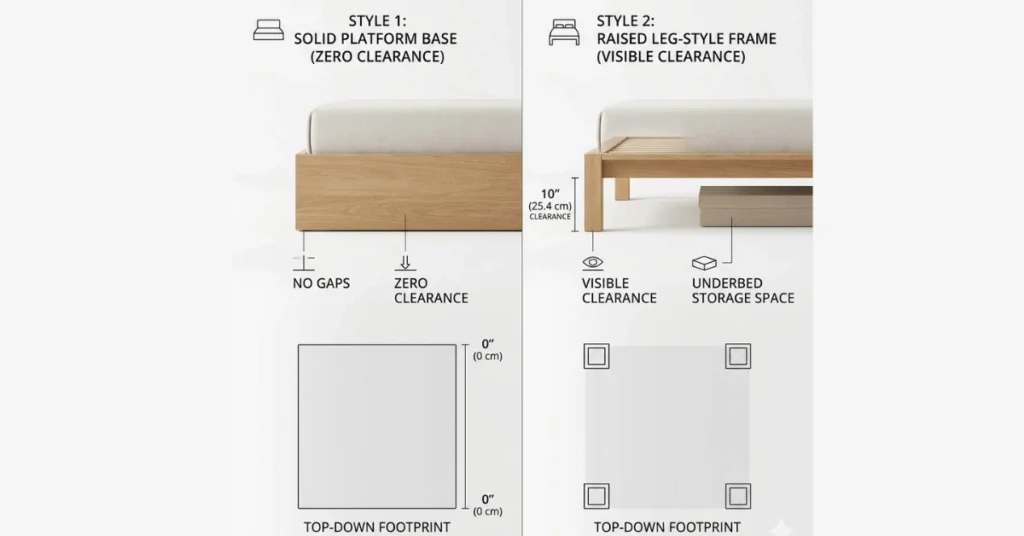
- Solid platform bases with enclosed sides: frames with full-panel sides and no open undercarriage leave zero clearance and zero access regardless of frame height
- Divan bases: the upholstered box base common in UK and European divan beds eliminates all under-frame space unless the divan includes factory-built drawers
- Murphy beds and wall beds: when deployed, these frames rest flush against the floor, eliminating clearance entirely during sleeping position
- Slatted platform frames under 12 cm total height: frames where the sleeping surface sits 12 cm or less from the floor leave insufficient clearance for any rigid bin and restrict even flat vacuum bags
- Waterbeds and adjustable air beds: the base structure on most waterbed and air bed frames sits directly on the floor, leaving no usable under-frame cavity
If your frame appears on this list, the practical options are either adding bed risers or replacing the frame with a storage-compatible alternative.
How much open floor space do you need to pull bins out in a small room?
Pulling a storage bin from under a bed safely requires open floor space equal to the bin’s full length plus a minimum 30 cm (12 in) of body clearance beyond the bin’s leading edge.
For a standard 60 cm (24 in) deep bin, that means 90 cm (35 in) of clear floor space measured from the bed frame edge outward. A 75 cm (30 in) deep bin requires 105 cm (41 in). In a tiny bedroom where total room width may be only 200 to 240 cm, those retrieval requirements consume 40 to 50% of the available floor area on the accessible side.
Door swing compounds this. A standard 80 cm interior door swings through 80 cm of floor space. If the door is within 120 cm of the bed’s foot end, retrieval from that direction blocks the door during access. Measure the door swing radius and subtract it from your usable retrieval zone before selecting bin depth.
How do you choose the right size under-bed storage bin?
You choose the right size under-bed storage bin by measuring clearance height, pull-out space, bin depth, and the item category before buying. The bin must fit the bed and the room, not only the product listing.
The best bin is shorter than the bed clearance. Choose a container at least 0.5 to 1 inch (1.3 to 2.5 cm) below your lowest clearance point. This prevents scraping, sticking, and lid damage.
Follow this process:
- Measure height: Measure from the floor to the lowest bed frame point.
- Measure width: Measure the open side where the bin will slide out.
- Measure depth: Check how far the bin can pull out before hitting furniture.
- Check the lid: Avoid domed lids because they add hidden height.
- Check the wheels: Include wheel height in the total product height.
- Match the item: Use wider bins for bedding and narrower bins for shoes.
- Leave space: Keep 1 inch (2.5 cm) of movement clearance above the bin.
A 24-inch-deep bin needs about 36 inches (91 cm) of open floor space for easy retrieval. That includes the bin length plus body clearance while crouching.
What low-profile rolling bins work for beds with minimal clearance?
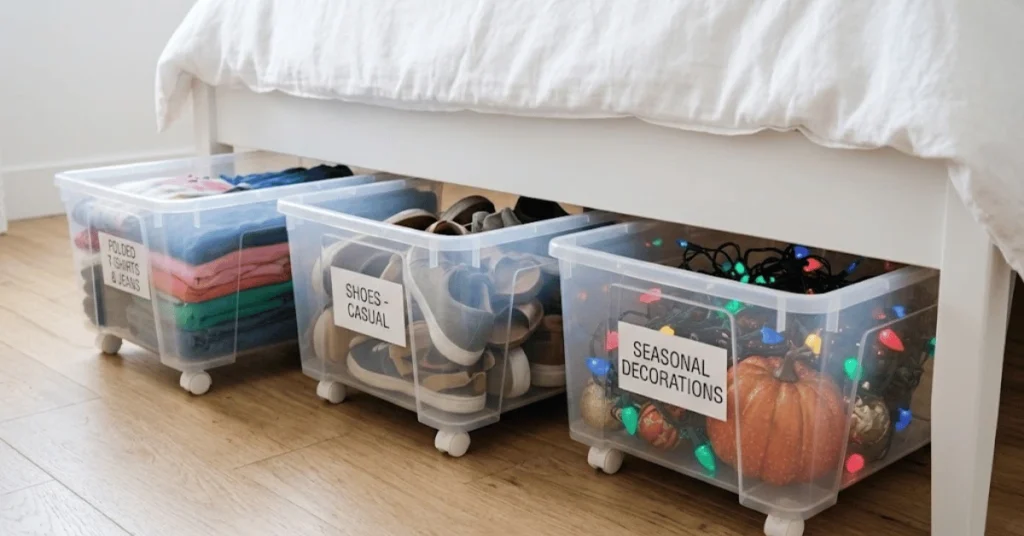
Low-profile rolling bins are the most practical solution when clearance is under 25 cm (10 in) and daily or weekly retrieval is required without disrupting the room.
Low-profile means a container body height between 12 and 18 cm (5 to 7 in), excluding wheel height where applicable. The combined product height including wheels must fall within your measured clearance with at least 1 cm of tolerance for floor variation.
Features to look for in low-profile rolling bins are listed below.
- Wheel type: smooth-rolling casters with a locked swivel mechanism allow straight-line pull-out and prevent bin drift on hardwood and laminate floors
- Lid style: snap-fit or hinged lids that sit flush with the container rim keep total height within the low-profile measurement; domed lids add 2 to 4 cm and disqualify the bin in tight clearances
- Handle placement: recessed handles or grip cutouts at the short end of the bin allow straight retrieval from a kneeling position without requiring the user to reach under the frame
- Base rigidity: a solid, flat base without flex distributes load evenly across wheels and prevents bin bowing under weight that would cause the bin to catch on floor irregularities
- Clear sides: clear bins allow you to see what is inside without opening the container or pulling it fully out from under the frame, reducing retrieval disruption in a tiny bedroom
Sterilite, IRIS USA, and Ziploc WeatherShield produce low-profile bins with wheel attachments in this height range, typically priced between $12 and $28 per unit.
When do flat vacuum-seal bags outperform rigid containers under a bed?
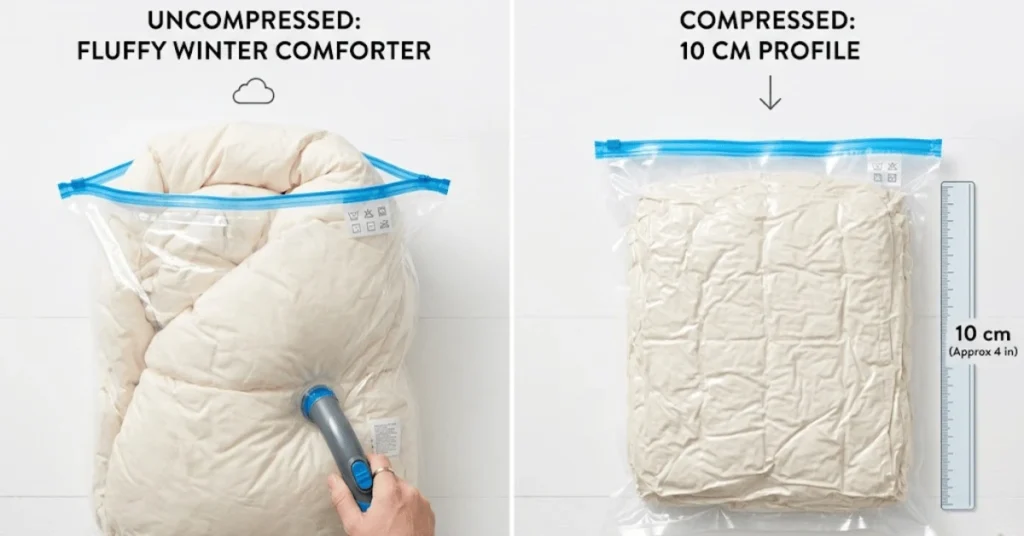
Flat vacuum-seal bags outperform rigid containers when clearance falls below 15 cm (6 in), when items are bulky and compressible, and when access frequency is seasonal rather than weekly.
Vacuum storage bags compress soft goods like comforters, blankets, winter jackets, and spare linens to 50 to 70% of original volume by removing air through a one-way valve using a standard vacuum cleaner nozzle. [site: Space Bag product specifications] That compression converts a 30 cm thick stack of bedding into a 10 to 12 cm flat profile that slides under frames with almost no clearance.
The limitations are specific. Vacuum bags require a vacuum cleaner each time you reseal them after access, making them impractical for weekly-use items. They also damage down-filled products, structured wool garments, and leather items through sustained compression. For seasonal clothing swaps done twice yearly, flat vacuum storage is the most space-efficient option available for beds with minimal clearance.
What under-bed drawers and slide-out cabinets work best for daily-access items?
Under-bed drawers work best for daily-access items when clearance reaches at least 20 cm (8 in) and retrieval happens from the same side of the bed each day.
Situations where under-bed drawers outperform open bins are listed below.
- Daily clothing access: drawers with smooth glide rails allow one-handed retrieval without crouching or kneeling, unlike bins requiring both hands to lift a lid
- Children’s bedrooms: low-pull-force drawers with no lid latches allow independent child access without adult assistance, reducing morning routine friction
- Studio apartments with no dresser: drawers tucked underneath the bed replace dresser function entirely when floor space prohibits a separate furniture piece, which is an ideal strategy when you need to organize a small closet with no dresser.
- Shoe storage: clean-lined drawers sized for footwear keep pairs sorted and protect finishes better than open bins where shoes stack and scuff
- Hobby supplies: rolling drawers with divided interior sections organize small items like craft supplies, cables, or accessories in a way that open bins cannot
Roller drawer units from brands like SONGMICS and Whitmor range from $25 to $60 for sets of two to four drawers in heights between 15 and 22 cm.
Are storage beds a good option for small bedrooms?
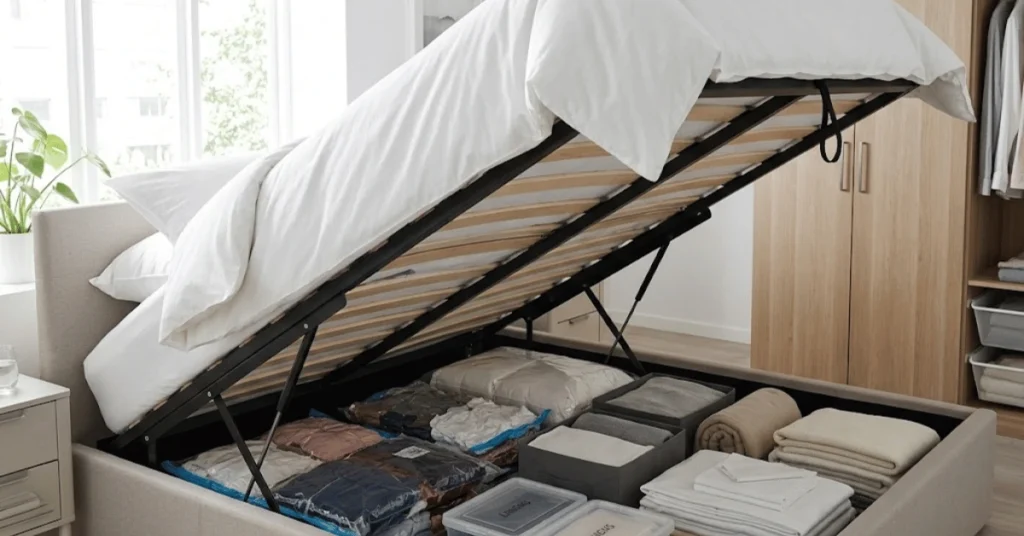
Yes, storage beds are a good option for small bedrooms when the room lacks space for a dresser, cabinet, or extra shelving. They turn the largest furniture footprint in the room into hidden storage.
Storage beds work best for high-volume storage. They hold bedding, seasonal clothing, shoes, and low-use items without adding another piece of furniture. Drawer models are better for tight walkways than lift-up hydraulic frames.
Storage beds make sense when:
- You need dresser replacement: Built-in drawers can hold folded clothes and bedding.
- You rent long term: Freestanding storage beds add capacity without drilling walls.
- You lack closet space: Bed storage can hold seasonal clothes and extra linens.
- You want visual calm: Hidden storage keeps the bedroom floor clear.
- You access items monthly: Storage beds work best for low-to-medium access items.
Avoid lift-up storage beds in rooms with low ceilings or tight side clearance. These frames need open space around the bed and enough lift height above the mattress.
Drawer storage beds suit small bedrooms better when the bed has at least one open side. Lift-up beds suit rooms where the foot or side area stays clear during access.
Which storage bed frames offer the most usable space in a small bedroom?
Lift-up hydraulic storage bed frames and integrated drawer frames represent the two primary storage bed frame categories, each with distinct capacity, accessibility, and floor space tradeoffs.
Factors to compare when choosing a storage bed frame are listed below.
- Total storage volume: lift-up hydraulic frames provide a single large cavity of 200 to 500 liters depending on mattress size; drawer frames provide 4 to 8 individual drawers holding 20 to 60 liters each
- Retrieval method: hydraulic lift frames require 30 to 45 cm of vertical clearance above the mattress to open fully and work best in rooms with ceiling height above 220 cm; drawer frames require only the standard aisle width beside the bed
- Floor space impact: hydraulic frames require you to stand at the side or foot to lift the platform, consuming 60 to 90 cm of floor space during access; drawer frames pull out horizontally from the bed sides within a smaller footprint
- Renter suitability: both types are freestanding and require no wall modification; neither creates deposit risk at move-out
- Price range: hydraulic storage bed frames range from $300 to $900; drawer bed frames range from $150 to $450 [site: IKEA, Zinus, DHP product listings 2024]
In a tiny bedroom with limited aisle width, drawer frames outperform hydraulic frames on access practicality. Hydraulic frames deliver superior total volume when the room allows the lift clearance.
How do zip-up fabric organizers compare to rigid bins under a bed?
Zip-up fabric organizers require 12 to 18 cm of clearance, cost $8 to $20 per unit, and suit moderate-access items that need dust protection without the weight capacity of a rigid bin.
Rigid bins handle heavier loads, typically 15 to 30 lbs per container, and protect contents from compression, moisture, and pests more reliably than fabric. Fabric organizers weigh less, collapse flat for storage when empty, and conform to irregular clearance gaps that rigid bins cannot fit. For storing accessories, folded clothes, and linens, fabric zippered bags perform comparably to rigid bins. For shoes, books, or items that need structural support, rigid bins with solid bases are the only appropriate choice. Fabric organizers become messy quickly when overfilled, as the sides lack the rigidity to maintain shape under weight.
What under-bed shoe organizers fit the tightest clearance spaces?
Under-bed shoe organizers designed for minimal clearance use a flat, multi-pocket layout that keeps each pair sorted at a profile height between 10 and 15 cm (4 to 6 in).
Features that make an under-bed shoe organizer work in tight clearances are listed below.
- Flat grid or pocket design: individual fabric or plastic pockets hold one pair each in a side-by-side flat layout, eliminating the stacked arrangement that adds height
- Breathable top panel: mesh or perforated fabric on the top surface prevents moisture buildup inside shoe pockets, which reduces odor in sealed under-bed environments
- Pull-out handle or strap: a fabric strap or handle at the short end allows straight retrieval from a kneeling position without requiring the user to reach to the back of the organizer
- Adjustable dividers: accordion-style dividers that widen to accommodate boots or narrow for flat shoes prevent pairs from shifting during retrieval
- Non-slip base: a rubberized bottom surface prevents the organizer from sliding on hardwood or tile floors when partially pulled out
These organizers free up valuable closet space by relocating extra shoes to the under-bed zone without consuming any additional floor footprint.
How do you choose the right under-bed storage for your specific situation?
Choosing the right under-bed storage depends on three situational factors: who accesses it, how often they access it, and whether the bed frame can be modified.
Four situational factors that determine the right under-bed storage choice are listed below.
- Renter status and frame modification restrictions
- User age and physical accessibility needs
- Room type and primary storage demand (studio vs. dedicated bedroom)
- Budget range per storage unit
What are the best no-modification options for renters who cannot alter the bed frame?
No-modification under-bed storage options for renters are listed below.
- Low-profile rolling bins: freestanding containers that slide under the existing frame without attachment, drilling, or alteration of any component
- Flat vacuum storage bags: require no frame contact and leave no marks, making them fully deposit-safe in any rental unit
- Zip-up fabric organizers: slide under the frame with no attachment points and remove completely at move-out without residue
- Freestanding under-bed drawer units: standalone roller drawers that sit on the floor and slide under the frame without connecting to it
- Under-bed shoe organizers: flat fabric units with no attachment mechanism that store and retrieve independently of the frame
All five options qualify as renter safe storage systems. None requires drilling, adhesive contact with the frame, or any modification that a landlord could assess as damage at move-out.
How should under-bed storage work in a kids’ room where children access it independently?
Under-bed storage in a kids’ room works best when the system prioritizes low pull force, visible labeling, and no latch mechanisms that require adult assistance.
Features to look for in child-accessible under-bed storage are listed below.
- Low-profile drawers with recessed handles: drawers with integrated grip cutouts allow a child to pull without grabbing a separate handle that requires hand strength to squeeze
- Clear bins or mesh panels: clear low-profile bins allow children to see exactly what is inside without opening the container, reducing the need to pull everything out during retrieval
- No lid latches: snap-fit lids with locking tabs require adult strength; lidless bins or drawers with simple friction-fit covers allow independent child access
- Color-coded labels or picture labels: adhesive labels with both color coding and images let pre-readers identify toy storage, book storage, and clothing zones without text literacy
- Rubber-footed containers: bins with rubber base pads prevent sliding on hardwood and tile floors when a child pulls at an angle rather than straight out
This kind of kid-friendly storage promotes positive habits by making cleanup faster and easier to do without asking for help.
What under-bed storage solutions work best in a studio apartment?
In a studio apartment, under-bed storage functions as primary storage rather than supplementary storage, which requires solutions that handle multiple item categories and maintain visual calm.
The bed in a studio represents the largest furniture footprint in the room. The space beneath it is the highest-density hidden storage zone available. Lift-up hydraulic storage bed frames deliver the most total volume, 200 to 500 liters depending on mattress size, and suit studio living where the under-bed cavity needs to hold seasonal clothing, extra linens, spare bedding, and archived items simultaneously. For studios where a hydraulic frame is not feasible, a combination of four to six low-profile rolling bins organized by category achieves comparable capacity.
Visual calm matters in studio apartments because the living and sleeping zones share the same space. Lidded clear bins that keep stored items clean and hidden beneath the bed frame maintain a clutter-free floor and make daily routines easier without exposing storage to the room’s sightlines.
Which under-bed storage products perform well for under $30?
Under-bed storage types that perform well under $30 are listed below.
- Flat vacuum storage bags (3-pack), $10 to $18: compress seasonal clothing and extra blankets to a fraction of original volume, work for beds with any clearance above 8 cm, and store winter jackets and summer clothes reliably when resealed correctly
- Low-profile clear plastic bins without wheels, $8 to $15 each: provide solid structure, allow you to see what is inside without opening, and fit clearances from 14 cm upward depending on the specific product
- Zip-up fabric under-bed organizers, $8 to $20: store clothing, linens, and accessories in a flat, dustproof format for clearances from 12 cm and deliver reliable hidden storage without exceeding a tight budget
- Under-bed shoe organizers, $12 to $22: flat multi-pocket designs keep pairs sorted and free up closet space at a fraction of the cost of a dedicated shoe rack
- Cardboard under-bed storage boxes with lids, $6 to $12: a short-term option suited for archived documents, seasonal decor, and infrequently accessed items in dry rooms only
What should you store under a bed and what should you never put there?
What you store under a bed matters as much as how you store it, because the wrong item category creates moisture damage, pest attraction, or fire hazard regardless of container quality.
Item categories well-suited for under-bed storage are listed below. Item categories you should never store under a bed are listed below.
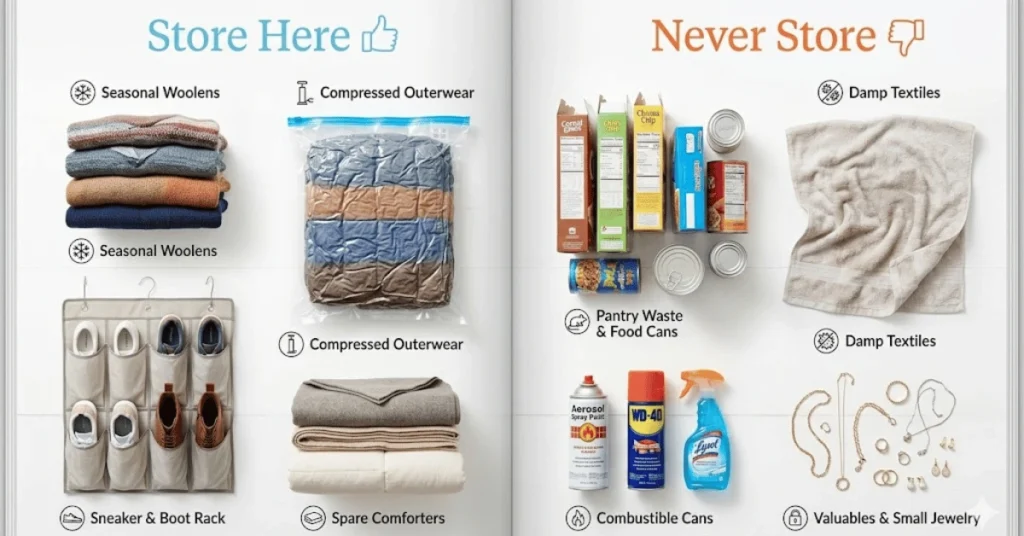
Suitable items:
- Seasonal clothing like winter jackets and summer clothes stored in sealed containers that block moisture and dust
- Store comforters, blankets, and extra linens in vacuum-sealed bags or zippered fabric organizers that compress bulk
- Shoes and extra footwear in flat organizers that keep pairs sorted and protect finishes
- Archived documents in rigid lidded bins that protect against floor moisture and physical compression
- Seasonal decor in labeled plastic boxes that stack flat and seal tightly
Prohibited items:
- Food of any kind, including packaged snacks, as it attracts insects and rodents to a difficult-to-inspect location
- Flammable materials including aerosol cans, cleaning chemicals, and paper in large quantities near electrical outlets or heated bed frames
- Electronics not in use for extended periods, as trapped heat and low airflow accelerate component degradation
- Wet or damp items including recently washed clothing or towels, which create the humidity conditions that cause musty odors and mold growth
- Valuables and medications, not for damage reasons but because under-bed storage is the first location searched during a break-in
What are the best bedding storage ideas for small spaces?
The best bedding storage ideas for small spaces use flat, sealed, and labeled containers that compress bulk without damaging fabric. Under-bed storage works well for sheets, blankets, comforters, and guest bedding.
Bedding needs dry, breathable storage. Sheets can go in zippered fabric organizers. Bulky comforters fit better in vacuum bags, unless the fill material loses loft under compression.
Use these bedding storage ideas:
- Store sheet sets inside one pillowcase before placing them in a labeled bag.
- Store comforters in vacuum bags when the material tolerates compression.
- Store guest bedding in one clear bin so the full set stays together.
- Store blankets in zip-up fabric organizers with a moisture absorber.
- Store seasonal bedding in the far under-bed zone until rotation season.
Do not store damp bedding under the bed. A fabric that feels slightly cool after washing still contains moisture, and sealed storage can trap that moisture inside.
For ground-floor rooms, basement bedrooms, and humid climates, use airtight plastic bins with silica gel packets. Indoor relative humidity above 60% increases moisture risk for stored fabrics [site: EPA indoor air quality guidance].
What categories of items are best suited for under-bed storage in a tiny bedroom?
Item categories best suited for under-bed storage are listed below.
- Seasonal clothing: out-of-season items like winter jackets and summer clothes stored in sealed bins or vacuum bags leave the primary closet free for active wardrobe items
- Extra bedding: store comforters, blankets, guest sheets, and spare pillowcases in vacuum-sealed bags, which compress bulky fabrics to a fraction of their original size for flat under-bed storage
- Shoes: seasonal swap bins for footwear keep pairs sorted and free up closet space without adding a freestanding shoe rack to the already limited floor area
- Archived documents: paper files, tax records, and reference materials in rigid lidded bins protect against floor moisture while staying accessible without requiring closet or shelf space
- Hobby supplies: items like craft supplies, rolling drawers with divided compartments, and project materials store well under-bed when the hobby is seasonal or infrequent
What items should never go under a bed regardless of container type?
Item types you should never store under a bed are listed below.
- Food and snacks: organic material under a bed attracts insects and rodents into a zone that receives minimal daily inspection, allowing infestations to develop undetected
- Flammable materials: aerosols, solvents, and large quantities of paper create fire risk adjacent to mattress materials and electrical components near bed frames with USB charging ports
- Wet or damp textiles: storing things just slightly damp creates the exact humidity conditions that produce mold, mildew, and musty smells that penetrate bedding and clothing stored nearby
- Active medications: accessibility under a bed is low; medications requiring regular access belong in a fixed, labeled location, and those requiring temperature stability cannot tolerate floor-level temperature fluctuations
- High-value items: jewelry, cash, and electronics stored under a bed are the first items removed in a break-in, making this the lowest-security storage location in any bedroom
How do you decide between under-bed storage and other small bedroom storage options?
Under-bed storage outperforms wall shelving, over-door organizers, and closet systems for bulky, seasonal, or infrequently accessed items, but loses to those alternatives for items requiring daily visibility or vertical display.
Use under-bed storage when the item is seasonal, bulky, or accessed less than once per week, and when the bed frame offers at least 15 cm of clearance. Use wall shelving or adhesive-mounted floating shelves when items need to be visible daily, require easy one-handed access, or are too heavy for low-clearance containers. Use over-door organizers for small, frequently accessed items like accessories, shoes, or toiletries that benefit from vertical hanging storage without consuming floor area. Use a closet system for active wardrobe items rotated daily or weekly. The storage hierarchy for a tiny bedroom places under-bed space as the primary zone for volume storage and closet space as the primary zone for active use items.
How do you build an under-bed organization system that stays organized?
An under-bed organization system that stays organized requires three things: consistent labeling, a seasonal rotation schedule, and a twice-yearly audit.
Three components of an under-bed organization system are described below.
- Labeling and categorization: assigning every bin a fixed item category and visible label
- Seasonal rotation: a calendar-based swap system that keeps active-season items accessible
- Periodic audit: a structured purge process that prevents accumulation of forgotten items
How should you label and categorize bins so items are findable without pulling everything out?
Labeling practices for under-bed bins are listed below.
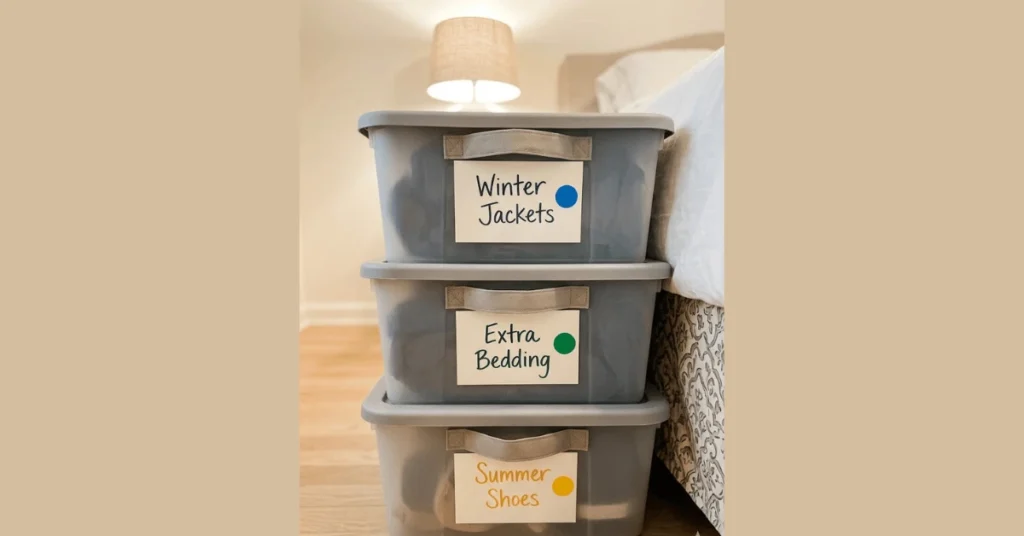
- Place labels on the short end of every bin, facing outward toward the retrieval side of the bed, so you read the label while crouching rather than after pulling the bin fully out
- Use a two-part label system: a broad category name (Bedding, Shoes, Winter Clothes) printed large, and a contents summary written smaller below it listing 3 to 5 specific items inside
- Apply color-coded tags by item type using colored adhesive labels, one color per category across all bins, so the correct bin is identifiable from across the room at floor level
- Photograph the contents of every sealed bin immediately after packing and store the photo in a labeled folder on your phone, creating a visual inventory that eliminates the need to open bins during searching
- Reassign labels every time a bin changes contents; a bin labeled “Summer Clothes” holding winter gear creates retrieval errors that make the system feel unreliable and break the habit of using it
How do you set up a seasonal rotation system using under-bed space?
Steps to set up a seasonal under-bed rotation system are listed below.
- Divide your under-bed space into two zones: the near zone (easily accessible from the primary retrieval side) and the far zone (against the wall, requiring full extension to reach)
- Assign the current season’s backup items (extra pieces of the active wardrobe type, summer clothes or winter jackets depending on the month) to the near zone for quick access
- Assign the off-season archive (the clothing type you will not touch for 4 to 6 months) to the far zone, packed in vacuum-sealed bags to maximize density
- Set a calendar reminder for the first weekend of each new season (March, June, September, December) as the rotation date, treating it as a fixed annual task rather than an optional one
- During rotation, swap near-zone and far-zone contents, repack vacuum bags, update labels, and photograph the new bin contents before pushing bins back under the frame
How often should you audit and purge under-bed storage in a small bedroom?
Audit under-bed storage twice per year, timed to coincide with seasonal rotation, to prevent the space from becoming a long-term holding area for items that no longer belong in the home.
Signs it is time to audit your under-bed storage are listed below.
- Bins are full at the start of rotation: if adding new-season items requires removing current bins to create space, the total volume exceeds capacity and a purge is overdue
- You cannot identify bin contents from the label alone: forgotten contents indicate that items have not been accessed long enough that their category no longer reflects what is actually inside
- Retrieval takes more than two pull attempts: if bins are no longer sliding out cleanly, the space has accumulated overflow items or misplaced objects that block bin movement
- The space smells musty or dusty: odor development in a sealed storage zone signals either moisture infiltration or items packed without full drying, both requiring immediate audit and repacking
Purge decision rule: any item not accessed in 12 months and not tied to a confirmed future use date leaves the under-bed zone.
How do dust, moisture, and floor damage affect under-bed storage?
Dust, moisture, and floor damage are the three most overlooked risks of under-bed storage, and each degrades both stored items and the bedroom environment regardless of which container type you select.
Dust accumulates at floor level faster than at any other height in a bedroom because foot traffic, air currents, and settling particles concentrate near the floor surface. Moisture migrates from below, especially on ground-floor and basement-level units, and enters containers through small gaps in lids or fabric seams. Floor damage from rolling bins compounds over time on hardwood and laminate surfaces when wheels lack protective coatings. Every product selection and maintenance decision in this section applies regardless of which storage solution type you chose above.
How do you prevent dust buildup on items stored under the bed?
Strategies to prevent dust buildup on under-bed storage are listed below.
- Use lidded bins with snap-fit or airtight seals: open bins and lidless containers collect floor-level dust inside within 2 to 4 weeks in an average bedroom, contaminating textiles and clothing stored inside
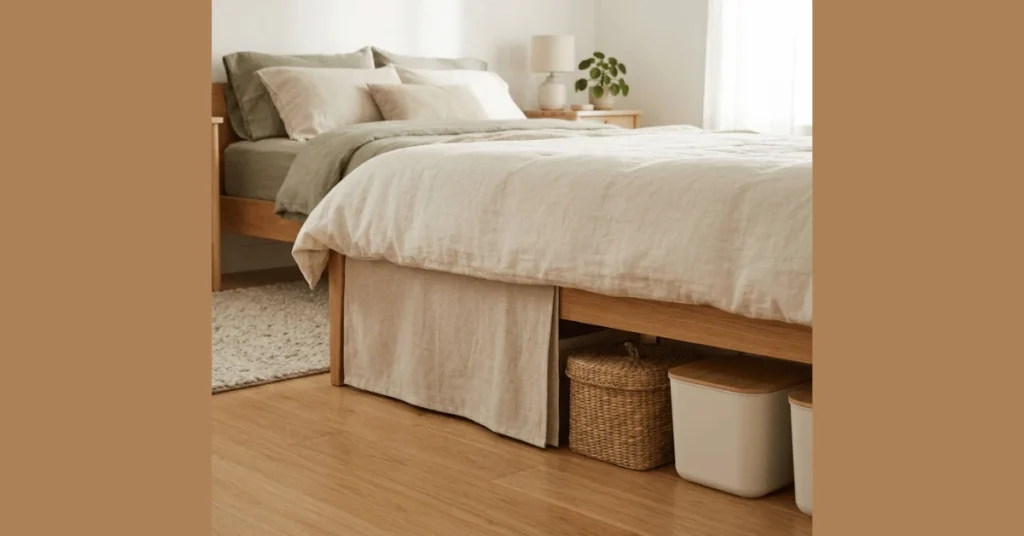
- Add a bed skirt or valance: a fitted bed skirt that reaches the floor reduces airflow beneath the bed, cutting the rate of dust settlement on bin surfaces by blocking the primary air current channel
- Use zippered fabric organizers for textile storage: fully enclosed fabric bags with zipper closures block dust from reaching clothing, linens, and seasonal items inside more effectively than snap-fit bin lids in high-traffic rooms
- Clean the under-bed zone during each seasonal rotation: vacuuming the floor surface and wiping bin exteriors twice per year prevents dust accumulation from building into a layer that transfers onto bin contents during retrieval
- Avoid carpet in the under-bed zone where possible: low-pile or bare floor under the bed accumulates less dust than deep carpet and allows bins to slide without resistance that deposits carpet fibers onto container surfaces
When does humidity make under-bed storage risky and what should you use instead?
Humidity makes under-bed storage risky when the bedroom sits on a ground floor, a basement level, or in a coastal climate where ambient relative humidity regularly exceeds 60%. [site: EPA indoor air quality guidelines]
At those humidity levels, moisture migrates through the floor surface and rises into the under-bed zone. Even sealed rigid bins accumulate condensation on their inner surfaces over weeks, creating conditions that produce mold on fabric items and paper. The risk is highest in summer months when temperature differentials between the floor and the room air cause condensation to form on the cold underside of containers.
In high-humidity rooms, relocate textile and paper storage to higher shelves, over-door organizers, or top-of-wardrobe positions where air circulation reduces moisture exposure. If under-bed storage is the only available option in a humid room, use silica gel desiccant packets inside every container and replace them every 60 to 90 days. Rigid airtight bins outperform fabric organizers and vacuum bags in these conditions because fabric seams allow moisture vapor to enter over time.
How do you protect hardwood and laminate floors from heavy rolling bins?
Ways to protect floors from under-bed rolling bins are listed below.
- Select bins with rubber-coated wheels or soft casters: hard plastic casters on hardwood floors leave linear scratches with each retrieval; rubber-coated or polyurethane casters distribute weight without surface abrasion
- Apply felt floor protector sheets beneath non-wheeled bins: self-adhesive felt pads applied to the base of rigid bins allow sliding without scratching and cost under $5 for a set that covers 4 to 6 bins
- Use a low-pile rug or runner beneath the bin storage zone: a thin runner placed under the bed across the full storage area protects the floor from all bin contact while also reducing dust migration from the floor surface
- Distribute weight across multiple smaller bins: a single heavy bin concentrates load on 4 wheel points; splitting the same weight across two or three bins reduces load per contact point and floor stress
- Inspect wheels and bases every 6 months: cracked or flattened casters create sharp contact edges that damage floors; replacing casters before they crack costs less than refinishing scratched hardwood
Should you raise your bed height to create more under-bed storage space?
Raising your bed with risers is one way to add under-bed clearance, but it comes with real tradeoffs in a tiny bedroom where bed height, room proportions, and user mobility all interact.
Risers solve clearance problems. They do not solve retrieval problems or aisle width limitations. The next three sections cover what risers actually add in measurable terms, what risks they introduce in a small room context, and when buying a storage bed frame is a better long-term decision than stacking risers under an existing frame.
What are bed risers and how much clearance do they realistically add?
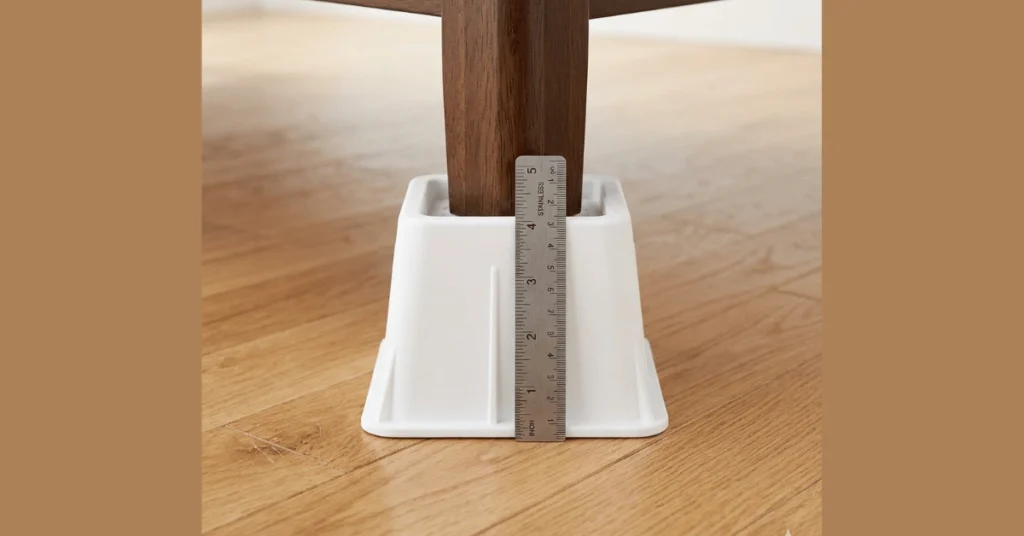
Bed risers are stackable supports placed under bed legs to increase floor-to-frame clearance, available in heights of 7.5 cm (3 in), 15 cm (6 in), and 20 cm (8 in) per unit.
Clearance added equals the riser height minus any riser body width that the riser itself occupies at the leg contact point, typically 1 to 2 cm less than the nominal height per side. A 15 cm riser raises the bed 13 to 14 cm in net usable clearance terms. Standard sets of four risers hold 1,200 to 2,000 lbs total load and suit most standard bed frames. Steel-reinforced risers rated to 4,000 lbs handle heavier platform and storage frames. Risers do not add retrieval space; they only change the vertical dimension.
What risks come with raising a bed in a tiny bedroom?
Risks of using bed risers in a tiny bedroom are listed below.
- Stability on a small frame footprint: narrow bed frames with leg spacing under 50 cm become top-heavy with risers above 15 cm, increasing tip risk during movement or if a person sits on the edge with force
- Getting in and out of bed: every 5 cm of added bed height increases the physical effort required to mount and dismount the bed, which affects children, shorter adults, and anyone with limited mobility
- Visual room height effect: raising the bed raises the visual center of the largest object in a tiny room, making the ceiling feel lower and the room feel more compressed, particularly in bedrooms under 220 cm ceiling height
- Frame compatibility: not all bed frames have legs compatible with standard riser cup diameters; platform frames with flat-panel bases or legs under 3 cm diameter do not seat securely in standard risers
When does raising bed height make sense versus choosing a storage bed frame?
Bed risers make sense when you rent a furnished unit with a fixed bed frame, when your budget is under $30, or when you need a quick short-term storage solution without replacing furniture.
A storage bed frame makes sense when you plan to stay in the same unit for 12 months or more, when the total storage volume you need exceeds what bins under a raised standard frame provide, or when you want integrated drawers that eliminate the need for separate rolling bins. Storage frames cost $150 to $900 compared to $15 to $40 for a riser set, but they deliver 2 to 10 times the organized storage capacity. [site: IKEA, Zinus product specifications 2024] For renters in furnished apartments, risers remain the only practical option. For renters in unfurnished units committing to a longer lease, a storage frame delivers better total value than risers combined with multiple bins over the same period.
How does under-bed storage fit into a complete tiny bedroom organization system?
Under-bed storage works best as one layer of a complete tiny bedroom organization system, not as a standalone fix for a bedroom that needs multiple storage zones to function. It should seamlessly integrate into your broader home organization strategy.
A tiny bedroom with under-bed space, a closet, and limited floor area has three storage zones to work with. Assigning the right item categories to each zone prevents any single zone from becoming overcrowded, which is the condition that makes stored items feel permanently inaccessible and staying organized feel impossible. The two sections below address how renters layer no-damage methods alongside under-bed storage and how to prioritize which items go into which zone.
How do renters maximize under-bed space alongside other no-damage storage methods?
No-damage storage methods that complement under-bed storage for renters are listed below.
- Over-door hanging organizers: flat pocket units that hang on standard door frames without drilling add vertical storage for accessories, shoes, and small items that would otherwise occupy under-bed space or closet shelves
- Freestanding vertical shelving units: floor-standing bookshelves and cube units positioned against walls capture height without wall contact, freeing under-bed space for bulkier, less visible items
- Tension rod closet doubler systems: tension rods installed inside closet openings double hanging capacity for short garments, reducing the number of items needing relocation to under-bed storage
- Adhesive Command hook systems: lightweight hooks mounted with Command strips hold bags, belts, and accessories on wall surfaces adjacent to the bed, removing these items from closet and under-bed competition
- Bedside caddies and over-mattress organizers: pocket organizers that hang from the mattress edge or bed frame hold daily-access small items at arm’s reach, eliminating the need to open under-bed storage for frequently used objects
What storage hierarchy works best when a tiny bedroom has under-bed space, a closet, and limited floor area?
Rules for assigning items to the right storage zone in a tiny bedroom are listed below.
- Assign the closet to active wardrobe items only: clothing worn in the current season, accessed 3 or more times per week, takes priority for closet hanging and shelf space because retrieval speed matters most for these items
- Assign under-bed space to seasonal and bulk items: out-of-season clothing, extra linens, shoes, and archived items belong under the bed because low retrieval frequency makes the pull-out process acceptable
- Assign floor area storage (freestanding units, rolling carts) to hobby supplies, books, and daily-use items requiring visible, open access that under-bed and closet storage cannot provide without containers
- Never use under-bed space for items accessed more than once per week unless the retrieval system (rolling drawers with easy-glide rails) reduces friction to under 10 seconds per access
- Review zone assignments at each seasonal rotation and reassign items that have shifted in access frequency since the last audit
Frequently asked questions about under-bed storage for tiny bedrooms
This section answers the most common reader questions on clearance thresholds, platform bed compatibility, odor prevention, storage value alongside a closet, and container selection for heavy items.
What is the minimum clearance height needed for under-bed storage bins?
The minimum clearance height for any rigid under-bed storage bin is 12 cm (5 in). At this threshold, ultra-low-profile flat bins from brands like IRIS USA or Sterilite fit without contact friction on most flat floors. Below 12 cm, only flat vacuum-sealed bags (8 to 10 cm profile when packed) remain viable. Clearance between 18 and 25 cm opens standard low-profile bins with wheels. Above 30 cm, the full range of under-bed storage products including taller rolling drawers and slide-out cabinets becomes accessible.
Can under-bed storage be used on a platform bed?
Yes, with conditions. Platform beds vary in clearance from near-zero to 30 cm or more depending on the frame design. Low-profile platform frames with a floor-to-base measurement under 12 cm block all rigid storage and limit options to flat vacuum bags only. Platform beds with legs or raised bases measuring 18 cm or above accommodate low-profile rolling bins and flat fabric organizers. Measure from the floor to the underside of the platform base at the center point before selecting any product. Solid-base platform beds with enclosed side panels block under-bed access entirely regardless of height.
How do you keep under-bed storage from smelling musty?
Ways to prevent musty smell in under-bed storage are listed below.
- Pack only fully dry items: any moisture in clothing, bedding, or shoes at the time of packing creates the anaerobic conditions that produce musty odor inside sealed containers within 2 to 4 weeks
- Place silica gel desiccant packets inside every sealed bin: one to two packets per bin absorb ambient moisture vapor and extend the period before odor develops, replacing packets every 60 to 90 days in humid climates
- Use airtight containers rather than open bins or lidless drawers: airtight seals prevent the slow humidity exchange that causes mustiness in containers left sealed for months in ground-floor rooms
- Air out the under-bed zone during seasonal rotation: removing all bins and vacuuming the floor before repacking allows accumulated moisture and stale air to dissipate before items return to the space
Is under-bed storage worth using if the bedroom already has a closet?
Yes, under-bed storage adds value alongside a closet when the closet holds active wardrobe items and the under-bed zone handles everything else.
A closet optimized for active clothing access functions better when it is not also holding seasonal swap bins, extra linens, spare blankets, and archived shoes. Under-bed storage absorbs these bulk categories, freeing the closet for what it does best: keeping daily-wear items visible, accessible, and unwrinkled. The combination of both zones creates a functional clutter-free space that a closet alone cannot deliver in a tiny bedroom.
What is the best under-bed storage container for heavy items like books?
Hard-sided rigid bins with a solid flat base and a reinforced snap-fit lid are the correct choice for heavy items like books, with a weight capacity of at least 30 lbs per container. [site: Sterilite, IRIS USA product weight specifications]
Soft-sided fabric organizers and vacuum bags lack the structural rigidity to support stacked heavy items and collapse under load, which also damages the items inside. Wheeled bins rated for 30 lbs or more distribute the weight across casters and allow retrieval without lifting the full load. Keep individual bin weight below 15 kg (33 lbs) to allow safe floor-level retrieval without a second person.
Are Storage Beds a Good Option for Small Bedrooms?
Yes, storage beds are a good option for small bedrooms when there is no dresser space. Built-in drawer beds give easy daily access to folded clothes, while hydraulic lift-up beds offer maximum volume for seasonal items. Before buying, measure your clearance and check that the bed fits your room layout, including door swing and walking space.

Mike Mann writes practical home organization and small-space living guides for CozySorted. His work focuses on apartment-friendly storage, clutter-free routines, bedroom organization, and simple systems that help renters, apartment dwellers, and small-space homeowners create calmer, easier-to-maintain homes.