
The average person wears only 20% of their clothes 80% of the time [site: Journal of Consumer Psychology]. The other 80% of items crowd your closet, waste your mornings, and quietly drain your budget. A well-organized capsule wardrobe fixes all three problems at once. This guide walks you through defining your style, auditing your clothes, selecting pieces, organizing your closet physically, rotating seasonally, and sustaining the system long-term.
What is a Capsule Wardrobe?
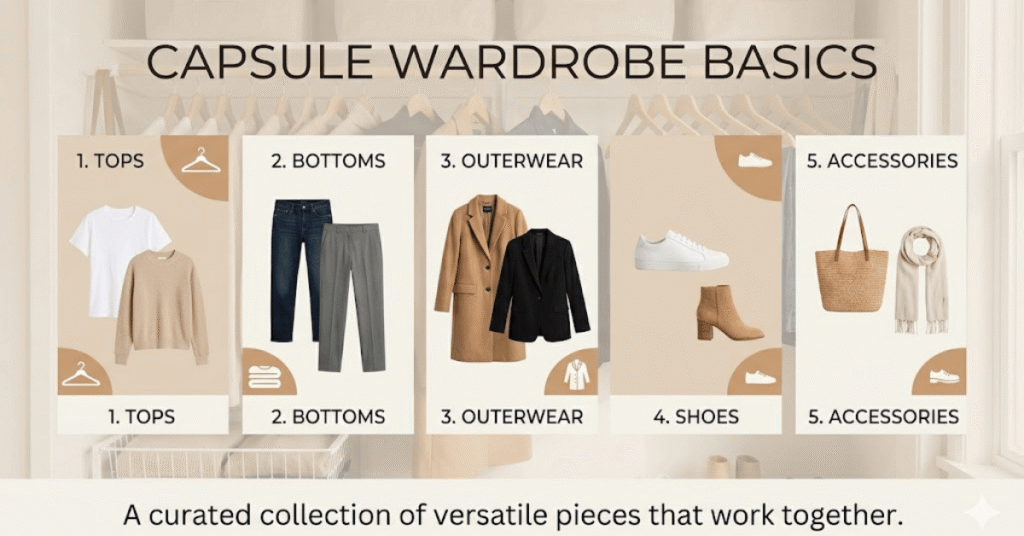
A capsule wardrobe is a small, curated collection of essential, interchangeable clothing items that work together to create a wide range of outfits. The concept was introduced by London boutique owner Susie Faux in the 1970s and later popularized by designer Donna Karan. Every piece earns its place because it fits well, matches other items, and serves a clear purpose in your daily wardrobe.
Why Start a Capsule Wardrobe?
You should start a capsule wardrobe because it reduces decision fatigue, saves money, and reclaims closet space. Research from Columbia University shows that too many choices actively impairs decision quality [site: Columbia University, Sheena Iyengar]. Fewer, better clothes means faster mornings and less mental load.
Key benefits of a capsule wardrobe include:
- Saving money by shopping less often and buying quality clothing that lasts
- Eliminating decision stress so you put together outfits without much thought
- Freeing up storage space in your home
- Supporting sustainable living by reducing overconsumption
- Making interchangeable outfits easy to build daily
What are the Core Rules of a Capsule Wardrobe?
The core rules center on a limited item count, a cohesive color palette, and verified fit. Most frameworks suggest 25 to 50 total pieces per season. Rules flex based on your lifestyle. A person with an active social calendar needs more variety than someone who works from home five days a week.
How Do You Start a Capsule Wardrobe?
You start a capsule wardrobe by auditing what you own, defining your style, decluttering ruthlessly, and identifying gaps. The process is sequential. Skipping steps, especially buying new items before decluttering, creates a newly curated capsule that is just as cluttered as before.
The steps to start a capsule wardrobe are listed below.
- Define your personal style
- Audit your current wardrobe
- Declutter using a proven method
- Select pieces based on clear criteria
- Identify wardrobe gaps
- Shop intentionally for missing essentials
How Do You Define Your Personal Style?
Define your personal style by analyzing your lifestyle first, then matching an aesthetic to it. A capsule wardrobe planner works best when it reflects how you actually live, not how you wish you lived. Scroll Pinterest or save outfits you wear repeatedly. Look for patterns in color, silhouette, and occasion across those saves. Align every choice to your daily activities: work, office meetings, daily errands, and dressy formal events like concerts or date nights.
How Do You Audit Your Current Wardrobe?
Audit your current wardrobe by emptying your entire closet and assessing every item individually. Pull everything out. Lay it flat. Try on anything you have not worn in the past three months. A wardrobe review using an inventory checklist helps you assess fit, comfort, and current condition systematically. Clothing assessment at this stage is not about sentiment. It is about function.

What is the Best Method for Decluttering Clothes?
The best methods for decluttering clothes are the KonMari method and the reverse hanger trick. KonMari, developed by Marie Kondo, asks you to keep only items that spark joy. The backwards hanger method involves turning all coat hangers backwards at the start of a season. After three months, check which worn items you returned to their forward position. Anything still reversed goes to the donate pile. Both methods create two separate piles: keep or donate. Items that need repair go into a mend pile. Sell or donate one item for every new item you bring in afterward.
How Do You Select Pieces for a Capsule Wardrobe?
You select pieces for a capsule wardrobe by evaluating each item against versatility, fit, color compatibility, and lifestyle relevance. Selection is not about finding the cheapest option or the trendiest piece. Quality loved clothing pieces worn repeatedly outperform cheaper items replaced constantly.
Factors for selecting capsule pieces include:
- Fit: the item must fit your body now, not a future version of it
- Versatility: it must work across at least three outfit combinations
- Color coordination: it must pair with your chosen base neutral colours
- Lifestyle alignment: it must serve your actual life best right now
- Quality: construction and fabric must withstand frequent wear
How Do You Choose a Cohesive Color Palette?
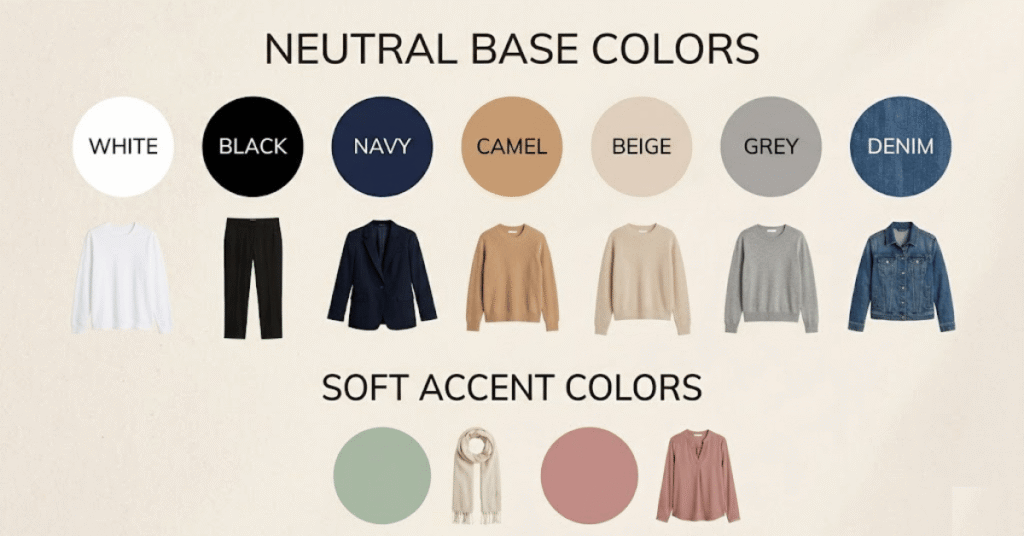
Choose a cohesive color palette by selecting two to three base neutral colors first, then adding a couple of coordinating accent colors. Neutrals anchor the system. Black, white, navy, camel, and grey are the most common bases. A color scheme where all tops match all bottoms eliminates the problem of color combos that create dead-end outfits. Limit accent colors to two. This keeps outfit creation fast and removes decision stress.
How Many Items Should be in a Capsule Wardrobe?
A capsule wardrobe typically contains 33 to 50 total pieces per season, though the number is secondary to functionality. Project 333, created by minimalist Courtney Carver, sets the capsule wardrobe limit at 33 items including clothes, shoes, and accessories for a 3 month season. Some frameworks use 37 items. Others allow up to 50 total pieces across primary outfit categories: work and office meetings, dressy formal events, fun restaurants and date nights, and daily groceries and errands. The right number serves your lifestyle right now.
How Do You Identify Wardrobe Gaps?
Identify wardrobe gaps by building outfits from your kept items and noting what is missing. If you cannot complete a functional work outfit without reaching for an item you discarded, that item belongs on your shopping list. Missing key pieces, like a tailored blazer or a versatile flat shoe, signal genuine wardrobe gaps. Write a specific list before you shop. Do not buy anything not on it.
How Do You Organize a Capsule Wardrobe Physically?
You organize a capsule wardrobe physically by categorizing clothes logically, using uniform storage tools, and keeping everything visible. Best practices for organizing your closet prioritize visibility over volume. When you see everything, you wear everything. If your bedroom is compact or rental-friendly, these small bedroom organization ideas for renters can help you keep your wardrobe visible without damaging walls.
Best practices for organizing your closet include:
- Group clothes by category: tops, bottoms, outerwear, and dresses
- Use matching hangers throughout the entire rod
- Apply file folding in every drawer for vertical visibility
- Store accessories where you can see them at a glance
- Keep daily outfit categories at eye level

How Do You Categorize Clothes in a Closet?
Categorize clothes by grouping them into zones: tops, bottoms, outerwear, and occasion-specific items. This closet layout creates a visual organization system that speeds up getting dressed. Some people prefer arranging clothes by outfit instead of category. Both approaches work. The test is whether you reach for the right item without searching. Zone-based category grouping tends to be faster for capsule wardrobes because every piece already coordinates. If your room has limited built-in storage, learning how to organize a bedroom with no closet can make this zoning system much easier to apply.
Why Use Matching Hangers for Organization?
Matching hangers create a uniform look that eliminates visual clutter and makes a closet feel intentional. Velvet hangers save the most space per rod, fitting up to 50% more items than plastic hangers in the same length [site: closet organization industry standard measurements]. Wood hangers add weight and work well for heavy outerwear. Pick one type and use it across your entire hanging section. The closet aesthetic shift alone changes how you interact with your clothes.
What is the File Folding Technique for Drawers?
File folding is a vertical folding method developed by Marie Kondo that stores clothes standing upright in a drawer rather than stacked flat. Every item becomes visible at once. This eliminates the buried-item problem where the same five t-shirts get worn because they sit on top. KonMari fold technique for a standard t-shirt reduces it to a compact rectangle roughly 10 cm wide. Drawer organization using this method increases visible capacity by up to 30% compared to flat stacking [site: KonMari documented method]. If you do not have enough drawer space, you can still organize a small closet without a dresser using bins, shelves, and folded clothing zones.
How Do You Organize Accessories in a Capsule Wardrobe?
Organize accessories by keeping them visible and category-specific. Use a wall-mounted jewelry display or a tray on your dresser for daily items. A belt organizer hung inside a closet door keeps belts untangled and accessible. Bag storage works best on a high shelf with bags upright, not stacked. Shoe organization on an angled shelf or clear boxes makes selection fast. Accessories you see are accessories you wear. Hidden storage kills variety. For accessories like bags, belts, and scarves, bedroom vertical storage ideas to maximize every inch can keep items visible without overcrowding your closet rod.
How Does a Capsule Wardrobe Handle Seasonal Changes?
A capsule wardrobe handles seasonal changes by rotating active and off-season items on a structured schedule. Each 3 month season gets its own reviewed set of pieces. Summer and winter capsule wardrobes share core neutrals but swap out temperature-specific layers. Transition pieces, like lightweight trench coats or medium-weight knits, bridge the gap between seasons and extend the life of each rotation. The system works only when you commit to the swap on schedule.
Steps for seasonal transition include:
- Review your current capsule four to six weeks before the season changes
- Pull out off-season items and assess condition before storing
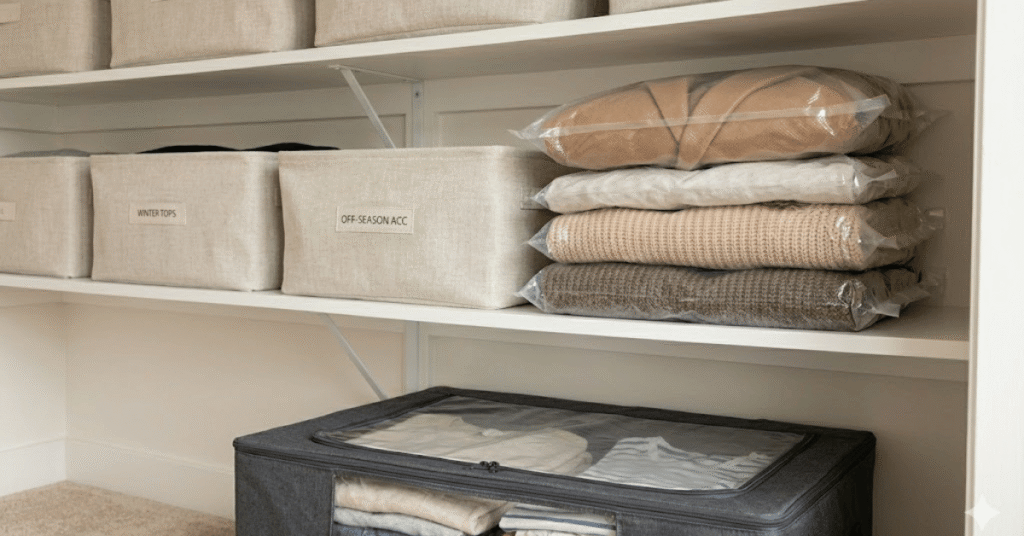
- Store summer items or fall items using vacuum bags or labeled storage bins
- Retrieve the next season’s clothes from under-bed storage or high shelves
- Identify gaps in the incoming seasonal set before they become a problem
When Should You Rotate Your Capsule Wardrobe?
Rotate your capsule wardrobe every three months, aligned with meteorological seasons rather than calendar dates. Weather triggers matter more than the date. When daytime temperatures drop consistently below 15°C (59°F), rotate to the fall wardrobe. When they rise above 20°C (68°F) for a sustained week, pull the summer capsule wardrobe. A quarterly rotation keeps the system fresh and gives you a built-in moment to edit pieces that no longer fit your life.
Where Do You Store Off-Season Clothes?
Store off-season clothes in labeled storage bins under the bed, in vacuum bags on high closet shelves, or in a dedicated storage area outside the bedroom. Vacuum bags compress bulky winter items by up to 75% [site: space-saving storage product standards]. Labeling every bin with the season and category eliminates digging. Clear bins add visibility without unpacking. Under-bed storage works best for flat, soft items. Keep off-season storage clean and accessible so the next rotation takes under an hour. When under-bed space is limited, bedroom vertical storage ideas can help you use high shelves, hooks, and wall-safe storage zones more effectively.
How Does Maintenance Affect a Capsule Wardrobe?
Maintenance affects a capsule wardrobe by determining how long the system stays functional and how long individual items last. A capsule only works if every piece remains in wearable condition. Clothing care directly extends garment life: washing in cold water, air-drying delicates, and storing knits folded rather than hung prevents stretching and fabric breakdown. Without consistent upkeep, quality pieces degrade faster than cheap ones replaced often, defeating the core purpose of long-term organization. Habit formation around daily and weekly maintenance is what separates a wardrobe that lasts years from one that collapses in a season.
What Mistakes Should You Avoid With a Capsule Wardrobe?
The mistakes you should avoid with a capsule wardrobe are buying new clothes before decluttering, setting rules too strict for your lifestyle, ignoring fit, and shopping without a list. These pitfalls are the primary reasons people abandon the system within three months.
Common capsule wardrobe mistakes include:
- Buying new items before completing a wardrobe audit
- Setting a capsule wardrobe limit that ignores your actual lifestyle needs
- Keeping items that do not fit the body you have now
- Shopping impulsively and bringing clutter back into a cleared closet
- Building a palette with no color combos that work across categories
- Treating the item count as a strict rule rather than a guideline
Why Do People Fail at Maintaining a Capsule Wardrobe?
People fail at maintaining a capsule wardrobe because of lifestyle mismatch and rigid rules. A system built around a nine-to-five office job fails the moment someone switches to freelance work. Strict rules that prohibit any new purchase create boredom and a shopping backlog. Sustainability issues also emerge when the budget does not support quality pieces upfront. Flexibility prevents abandonment. Review the system every season and adjust it to your life as it is now, not as it was when you started.
Should You Buy New Clothes Before Decluttering?
You should not buy new clothes before decluttering because doing so adds unnecessary purchases on top of an unassessed inventory. New items fill gaps you think exist. A closet clean out almost always reveals that several of those gaps are already filled. Shop your closet first. Impulse control at this stage keeps the new system clean. Inventory assessment before buying is the single habit that stops people from recreating the overcrowded closet they just cleared.
How Do You Shop Intentionally for a Capsule Wardrobe?
Shop intentionally by buying only items on your wardrobe gaps list. Every purchase should address a missing key piece confirmed during the audit. Prioritize quality and versatility above price. One well-made item worn 200 times costs less per wear than three cheaper versions replaced annually. Intentional shopping tied to lifestyle needs makes things easier, creates less work over time, and stops impulse buying at the point of decision.
How Do You Sustain a Capsule Wardrobe Long-Term?
You sustain a capsule wardrobe long-term by building consistent habits, editing seasonally, and shopping only against confirmed gaps. Long-term style depends on the system staying lean. A budget creates less work over time because it forces prioritization before purchase.
Tips for long-term sustainability include:
- Return every item to its designated place after each wear
- Plan outfits weekly to identify gaps before they become urgent
- Edit the wardrobe 1 to 2 times per year at minimum
- Apply a one-in-one-out rule for every new item added
- Prioritize timeless fashion over trend-driven pieces
- Spend less time shopping by maintaining an updated gap list year-round
What Habits Keep a Capsule Wardrobe Organized?
Daily habits keep a capsule wardrobe organized better than any single reorganization session. Return clothes to their exact place after wearing. Do a weekly reset every Sunday: check for items needing repair, restock the outfit planning rotation, and verify that nothing has drifted out of its zone. Outfit planning the night before removes the morning pressure that leads to chaotic closet searching. Tidy closet conditions are maintained in minutes daily, not hours weekly. If two people share the same room or closet area, bedroom organization for couples sharing a small space can help keep separate zones clear and easy to maintain.
How Often Should You Edit Your Capsule Wardrobe?
Edit your capsule wardrobe at least twice per year, ideally aligned with the spring-to-fall and fall-to-spring seasonal transitions. An annual declutter catches items that have degraded in quality or no longer fit your current lifestyle. Seasonal reviews catch gaps before the weather makes them urgent. A regular review process prevents the slow accumulation of items that do not serve you, which is exactly how a lean capsule wardrobe turns back into an overcrowded one.

Mike Mann writes practical home organization and small-space living guides for CozySorted. His work focuses on apartment-friendly storage, clutter-free routines, bedroom organization, and simple systems that help renters, apartment dwellers, and small-space homeowners create calmer, easier-to-maintain homes.