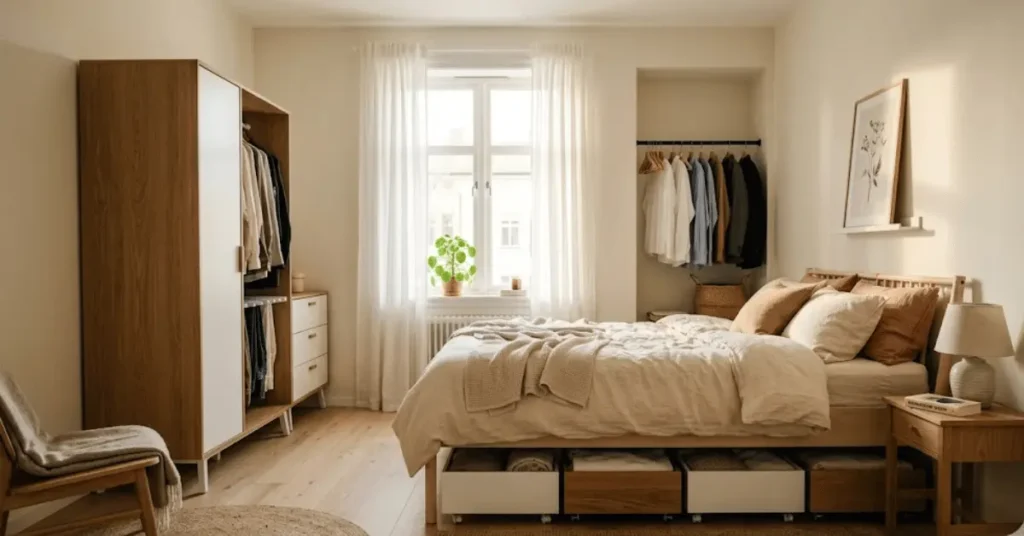
A dresser consumes 12 to 20 square feet of floor space in a room that may only have 100 to 150 total square feet available. For those implementing small bedroom ideas for renters or managing a studio apartment without traditional furniture, that trade-off is no longer acceptable. This guide covers the complete system for dresser-free wardrobe management, which is a foundational element of effective home organization: space assessment, clothing categorization, vertical space utilization, closet shelving, and long-term maintenance.
Organizing a small closet without a dresser replaces drawer-based storage with modular storage units, hanging organizers, shelf systems, and under-bed zones that collectively hold more clothing in less floor space than any standard dresser. The most common small closet mistakes are buying organizers before measuring, hanging everything without a zone system, and ignoring the vertical wall space above the primary hanging rod. This guide eliminates all three errors from the start.
How to Assess Your Closet Space for Effective Organization
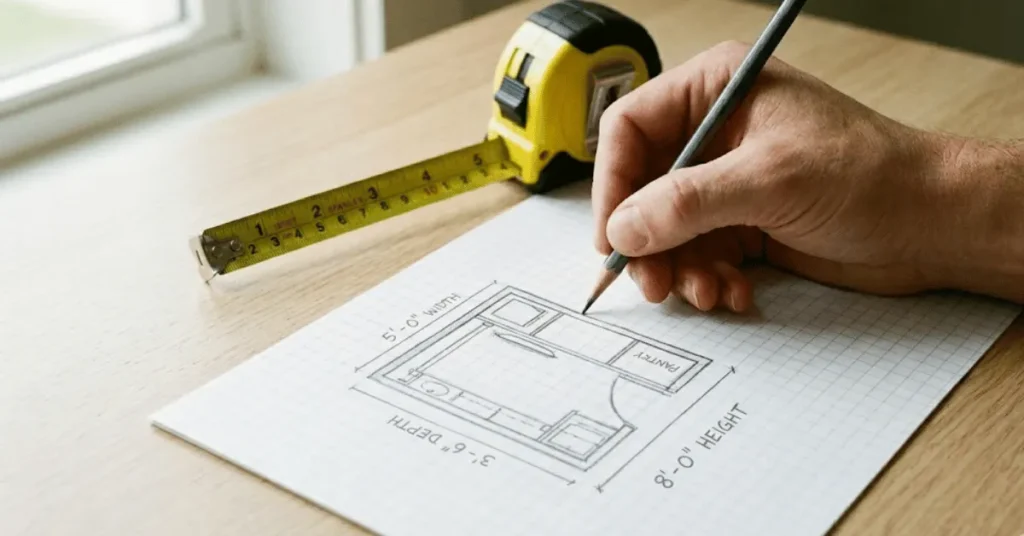
Closet space assessment is the process of measuring every usable dimension inside the closet and identifying which zones are actively used, which are underused, and which are dead space. Evaluating closet dimensions and layout involves recording interior width, depth, ceiling height, rod placement, and existing shelf positions before any product is purchased or installed.
Most small closets contain 30 to 50% wasted vertical space above the hanging rod and at least 12 inches of unused floor space in front of the base. Identifying these zones before organizing transforms the assessment from a measurement exercise into a space recovery plan.
What Are the Most Important Factors in Closet Organization?
The most important factors in closet organization are listed below.
- Hanging rod height: the rod position determines whether full-length garments clear the floor and whether a double-hang configuration is physically possible within the closet dimensions.
- Shelf depth: standard closet shelves measure 12 to 16 inches (30 to 40 cm) deep; shelves deeper than 16 inches create hidden storage areas where rear items become permanently inaccessible.
- Accessibility: items used daily must be reachable within one motion; items requiring a step stool or crouching position are effectively out of the system.
- Lighting conditions: a closet without dedicated lighting produces a visual dead zone at the back and on lower shelves, which causes items to go missing inside the closet itself.
- Door clearance: bi-fold doors reduce interior access width by 4 to 6 inches on each side; sliding doors block half the closet opening at any given time; both constraints shape which storage formats fit.
- Usable vertical space: the distance between the hanging rod and the ceiling is the most underexploited zone in small closets, capable of holding 2 to 3 additional shelf tiers without modification.
How Do You Evaluate Closet Space for Maximum Efficiency?
Evaluating closet space for maximum efficiency involves taking six measurements in sequence and marking dead zones on a simple floor plan sketch before any storage product is considered. The six measurements are: interior width at shoulder height, interior width at floor level (these differ in angled or irregular closets), total depth from door to back wall, ceiling height from floor, current rod height from floor, and clearance height from rod to ceiling.
Dead space appears in three consistent locations in small closets: the zone above the hanging rod (typically 24 to 48 inches of unused vertical wall space), the floor space beneath short garments, and the corners where standard rectangular organizers do not reach. A measuring tape and a 5-minute audit reveal all three. Once dead space is mapped, every storage decision addresses a specific gap rather than a generic problem.
How to Categorize Your Clothing for Better Storage
Categorizing your clothing for better storage requires sorting every garment by two variables simultaneously: frequency of use and garment type, before a single item is placed back into the closet. Frequency of use determines placement height. Garment type determines hanging versus folding versus shelving format.
Daily wear occupies the center rod at eye level, between 54 and 66 inches (137 to 167 cm) from the floor, following the PRP (Prominence, Relevance, Popularity) logic used by professional organizers to ensure the most-reached items are retrieved in one motion. Weekly wear goes to secondary zones: higher rods, side sections, or the back of the closet. Formal attire and rarely worn garments move to the perimeter or off-site storage entirely.
Should You Sort Clothes by Season for Better Closet Space?
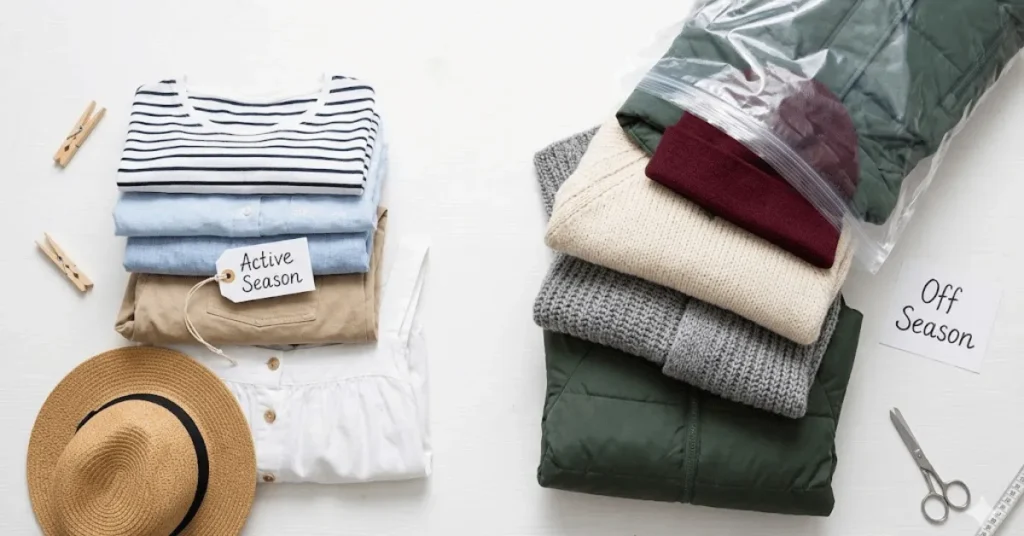
Yes, sorting clothes by season for better closet space is one of the highest-return organizational decisions available to a small closet owner. Seasonal clothing rotation removes 30 to 50% of the total wardrobe volume from active closet space by relocating winter coats, heavy knitwear, and summer apparel to vacuum storage bags under the bed or in a separate storage location during their off-season months.
A closet holding 12 months of clothing at once is at capacity by design. The same closet holding only 6 months of seasonal clothing has room for a functional system.
How to Maximize Closet Space Without a Dresser
Maximizing closet space without a dresser means replacing the horizontal storage logic of drawer-based furniture with vertical space utilization, modular storage units, and hanging organizers that exploit every usable inch from floor to ceiling. The transition from folded drawer storage to a dresser-free system is not a downgrade. It is a reallocation of the same clothing volume into a higher-density format.
8 strategies to maximize closet space without a dresser include:
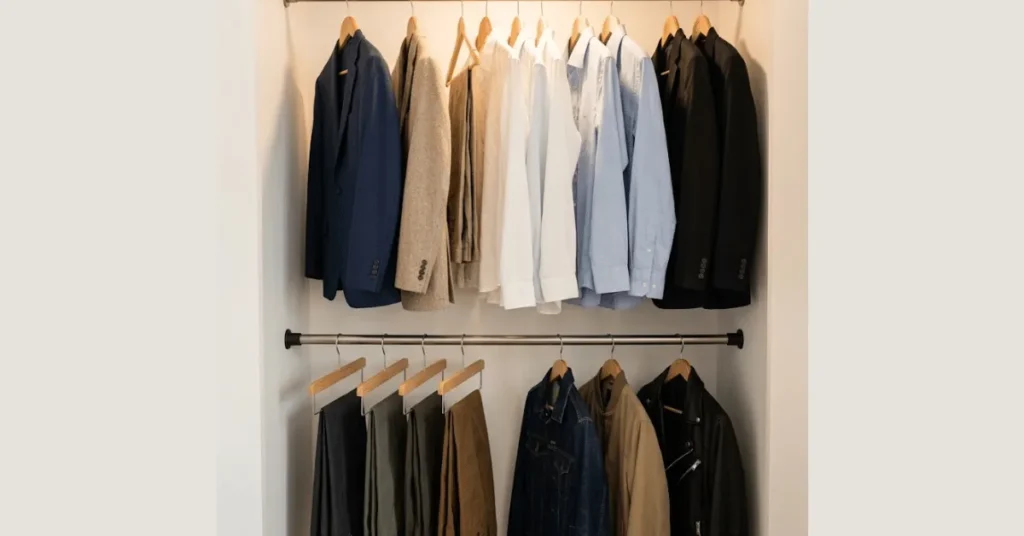
- Install a double hanging rod to convert single-height hanging into two tiers for short garments, immediately doubling the hanging capacity of any section.
- Add a shelf above the existing rod to create an additional storage tier for folded items, bins, and boxes in the dead zone that most closets leave empty.
- Use modular storage units or cube organizers on the closet floor to replace the drawer function of a dresser within the closet’s own footprint.
- Deploy slim velvet hangers at 0.2 inches (5 mm) thick compared to plastic hangers at 0.75 inches (19 mm); switching 50 hangers recovers 13 to 14 inches of rod space.
- Install wall-mounted hooks or a pegboard system on any exposed wall or door surface to hold accessories, bags, and daily worn outerwear outside the main hanging zone.
- Use under-bed storage as a secondary dresser for out-of-season items, freeing closet floor space for active-season clothing systems.
- Add canvas storage baskets or acrylic shelf dividers on existing shelves to create divided compartments that replace the individual drawer function.
- Place a storage ottoman or storage bench outside the closet to handle overflow folded items without consuming closet interior space.
Can Open Shelving or Cube Storage Improve Closet Organization?
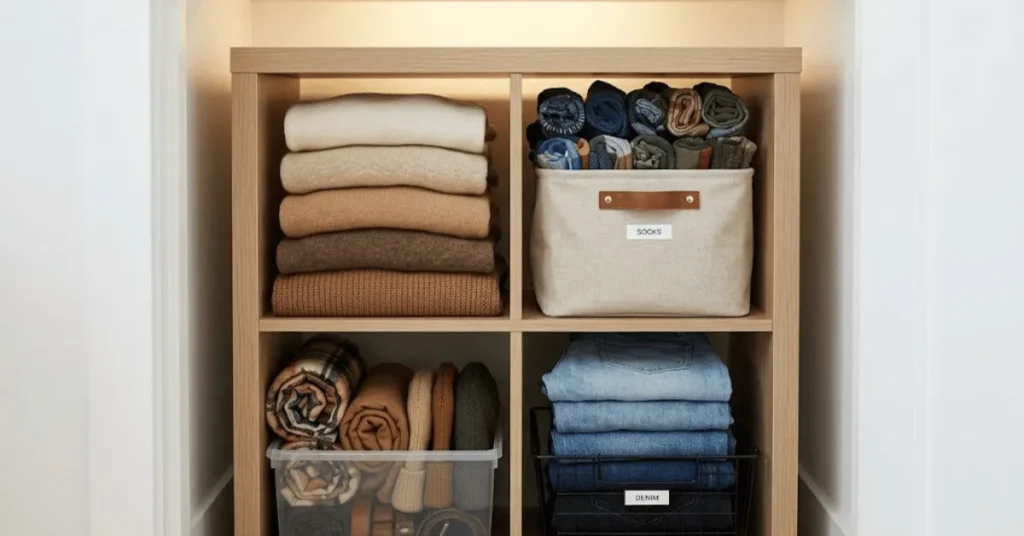
Yes, open shelving and cube storage improve closet organization significantly, particularly for bulky items like sweaters and heavy knitwear that lose their shape on hangers. Open wire shelving allows airflow around folded garments, which prevents moisture buildup and reduces the odor accumulation that solid-back shelves produce in small enclosed closets.
Cube storage organizers with fabric bins outperform open wire shelving specifically for bulky knitwear because each cube acts as a dedicated drawer substitute. A 4-cube unit (16 x 16 inches per cube) placed on the closet floor holds the same garment volume as a 4-drawer dresser in 40% less depth. Wire baskets suit shoes and folded denim. Fabric bins suit sweaters and layered base items. The format choice follows the garment type, not a universal preference.
How to Use Hanging Space Effectively Without a Dresser
6 ways to use hanging space effectively are given below.
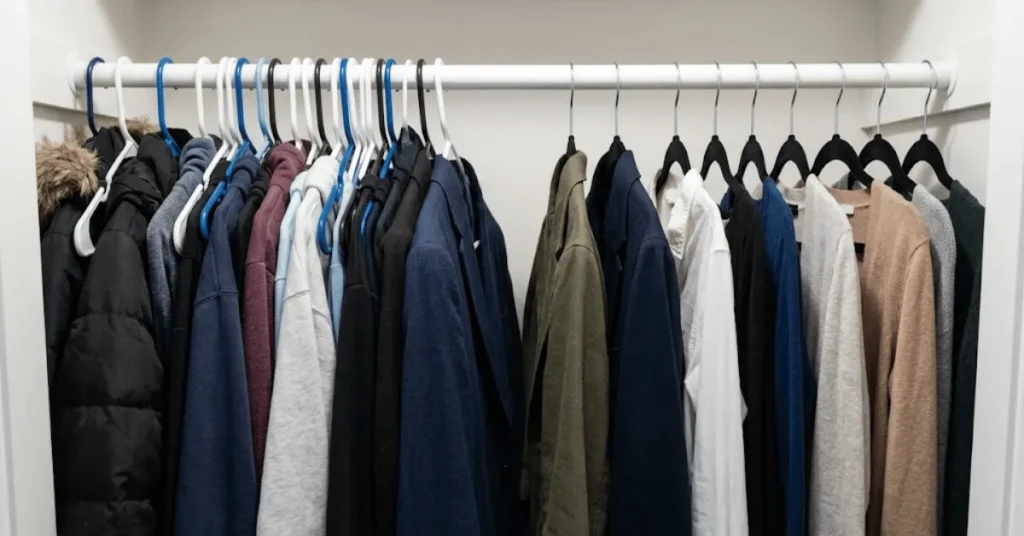
- Install double hanging rods in sections where no garment exceeds 42 inches (106 cm) in length, converting a single hanging zone into two full-capacity tiers for shirts, jackets, and folded trousers.
- Use cascading hangers (5-hook cascade sets) to hang 5 garments in the vertical space one standard hanger occupies, multiplying hanging capacity without adding rod length.
- Standardize to slim velvet hangers across the entire closet; the friction surface prevents garment slippage and the reduced hanger thickness increases rod capacity by 25 to 30% compared to plastic hangers.
- Section the rod by garment category using rod dividers or a simple color-coded system; without section boundaries, hanging space consolidates into one undifferentiated mass that resists daily use.
- Reserve the highest rod position (above 72 inches) for garments in breathable garment bags that are accessed fewer than 4 times per year, keeping prime rod space below that height for active wardrobe items.
- Use vertical hanging organizers that drop from the rod and provide 5 to 7 fabric shelves for folded t-shirts, gym wear, and base layers without consuming floor or shelf space.
How to Make the Most of Under-Bed Storage in Small Spaces
Implementing effective under-bed storage ideas involves treating the space beneath the bed frame as a secondary dresser zone, sized for out-of-season garments, extra bedding, and category overflow that the primary closet cannot hold without sacrificing active wardrobe access.
Standard bed frames provide 6 to 12 inches (15 to 30 cm) of clearance. Rolling storage bins with lids on casters fit clearances of 7 inches and above and allow full-extension retrieval without moving the bed. Under-bed drawers built into platform frames provide the equivalent of 2 to 3 dresser drawers with zero additional floor footprint. Bed risers (4 to 8 inches of additional clearance, $10 to $25) transform low-clearance frames into high-capacity under-bed storage zones in 10 minutes. Dust-proof bags protect seasonal clothing stored in this zone from particulate accumulation and pest contact over 3 to 6 months of off-season storage.
Can Wall-Mounted Hooks and Pegs Create Extra Closet Storage?
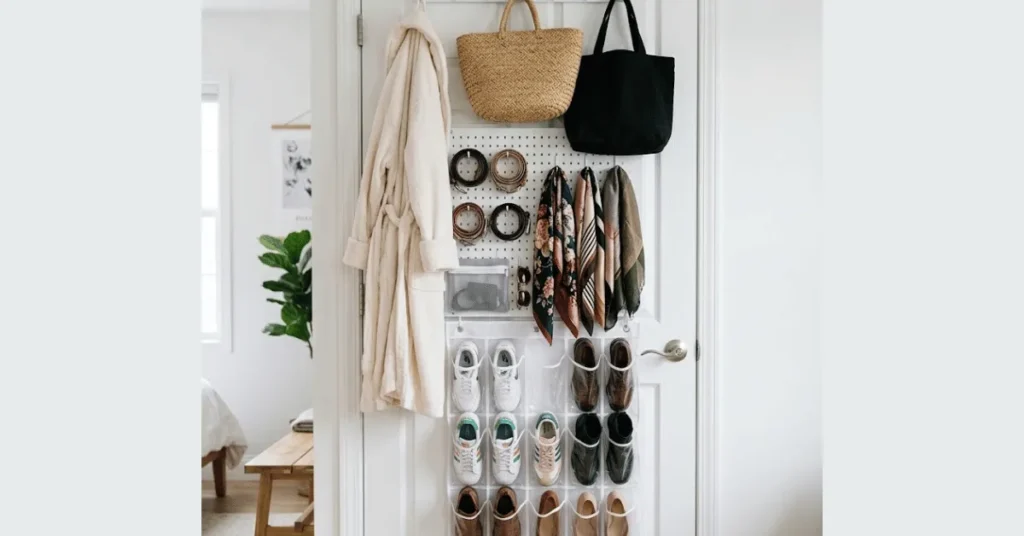
Yes, wall-mounted hooks and pegboard systems create meaningful extra closet storage by converting dead wall surface into active accessory hanging zones. Strategic hook placement on the inside of the closet door or on exposed side walls adds 6 to 12 hanging positions without consuming rod space, shelf space, or floor area.
The most effective placements: a door rack or pegboard on the interior closet door for bags, belts, and daily worn outerwear; a 3 to 5 hook bar at the entry point of the closet for items accessed before leaving the home; and a lower hook row at 36 to 42 inches height for bags and totes. Pegboard systems allow repositionable hooks and small shelves that adapt as the wardrobe changes. Command strip-mounted hooks handle loads up to 7.5 lbs (3.4 kg) per hook and remove without wall damage for renters.
How to Organize Small Items in Bins, Baskets, or Dividers
8 tips to organize small items in bins and baskets are outlined below.
- Use acrylic shelf dividers to separate folded item stacks on open shelves; without dividers, folded piles collapse laterally and consume twice the intended shelf space.
- Assign one canvas storage basket per category for underwear, socks, and base layers; basket-based storage replaces the individual drawer function within a cube unit or on an open shelf.
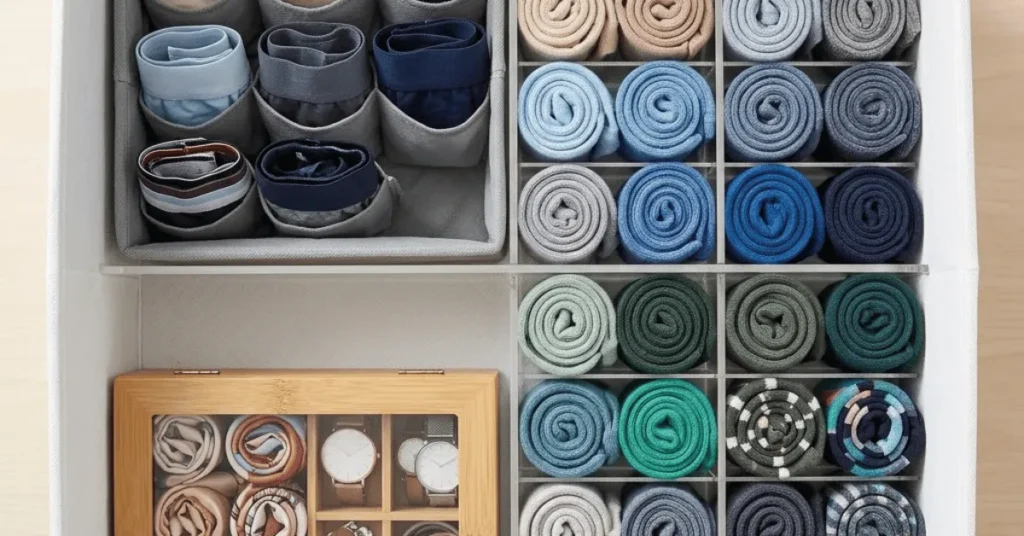
- Store socks using the file-folding method (rolling pairs vertically into a sock organizer tray) rather than stacking; a 6-inch-wide tray holds 20 to 30 pairs vertically versus 8 to 10 pairs stacked horizontally.
- Use underwear bins or fabric drawer inserts inside cube organizer shelves to subdivide each cube into 3 to 4 individual compartments without purchasing additional furniture.
- Label every bin and basket on the front face so every household member returns items to the correct container without a decision process.
- Use rigid bamboo boxes for accessories like sunglasses, watches, and small jewelry items that get lost in soft-sided fabric bins without a rigid bottom surface.
- Choose breathable cotton or canvas materials for any bin holding clothing; synthetic-sided bins trap humidity and create odor accumulation in an enclosed closet environment over 60 to 90 days.
- Size each bin to the shelf depth minus 1 inch of clearance; bins flush with the shelf edge tip forward when pulled; 1 inch of clearance allows clean retrieval without tipping adjacent containers.
How to Optimize Space with Multi-Functional Furniture
Optimizing space with multi-functional furniture requires selecting pieces that perform the storage function of a dresser while serving a second active purpose within the room — seating, surface, or display — so the floor space they consume is justified by two functions rather than one.
Storage ottomans with lift-top access hold 30 to 60 liters of folded clothing, extra bedding, or accessories inside a piece that also functions as a seating surface and a coffee table substitute. The footprint (typically 18 x 18 inches to 24 x 48 inches) replaces a small dresser while occupying the same or smaller floor area. Storage benches at the foot of the bed provide 2 to 3 compartment drawers beneath a padded seating surface, combining shoe storage, folded item storage, and a dressing bench in a single dual-purpose furniture piece. Hidden compartments inside bed frames (platform beds with built-in drawers) provide 4 to 6 drawer equivalents inside a piece of furniture the room requires regardless of storage need.
Advanced Techniques for Organizing a Small Closet Without a Dresser
Advanced techniques for organizing a small closet without a dresser focus on micro-organization and custom hardware that extract storage capacity from gaps that standard shelving and hanging systems cannot reach. The shift from basic structural setups (rods, shelves, bins) to advanced optimization (tension rod hacks, automated lighting, modular configurations) is where the final 20 to 30% of closet capacity is recovered.
Tech and advanced hardware at this level include pull-down wardrobe lifts that bring high-rod clothing to waist height, RFID-tagged garment systems for large wardrobes, and sensor-activated LED lighting that eliminates the dead zone problem in windowless closets.
Can Smart Storage Solutions Help Organize Your Closet?
Yes, smart storage solutions help organize a closet by removing the two most persistent barriers to consistent use: physical access difficulty and poor visibility. Pull-down closet rods (wardrobe lifts) bring hanging garments stored at 84 to 96 inches down to 40 to 48 inch retrieval height with a single pull of a wand, making high-rod storage fully functional rather than a depth-only reserve.
Motorized racks and motorized tie racks rotate clothing along a track system to bring any garment to the front position without moving adjacent items. Smart lighting systems triggered by door opening or motion sensors eliminate the visibility problem that causes items to be forgotten inside dark closets. RFID tags applied to garment bags allow digital inventory tracking for large wardrobes where physical auditing is time-intensive. These solutions carry a higher upfront cost ($150 to $800 depending on system complexity) but eliminate the retrieval friction that causes well-organized closets to degrade back to disorder over 6 to 12 months.
Should You Use Adjustable Shelving for Flexible Closet Storage?
Yes, adjustable shelving delivers higher long-term return on investment than fixed shelving because track shelving with adjustable shelf brackets allows shelf height reconfiguration in under 10 minutes as the wardrobe composition changes across seasons and life stages.
A fixed shelf at 14 inches above the floor holds shoes efficiently for one wardrobe configuration. When boot storage is added, that same fixed shelf becomes an obstruction. Adjustable shelf brackets on a track system reposition each shelf without tools, hardware replacement, or wall damage. The modular configurations available in track-based systems (IKEA PAX, ClosetMaid ShelfTrack, Elfa) support reconfiguration as frequently as quarterly, which means the storage system remains aligned with the actual wardrobe it holds rather than the wardrobe that existed when it was originally installed.
How to Organize Clothing Based on Function and Use
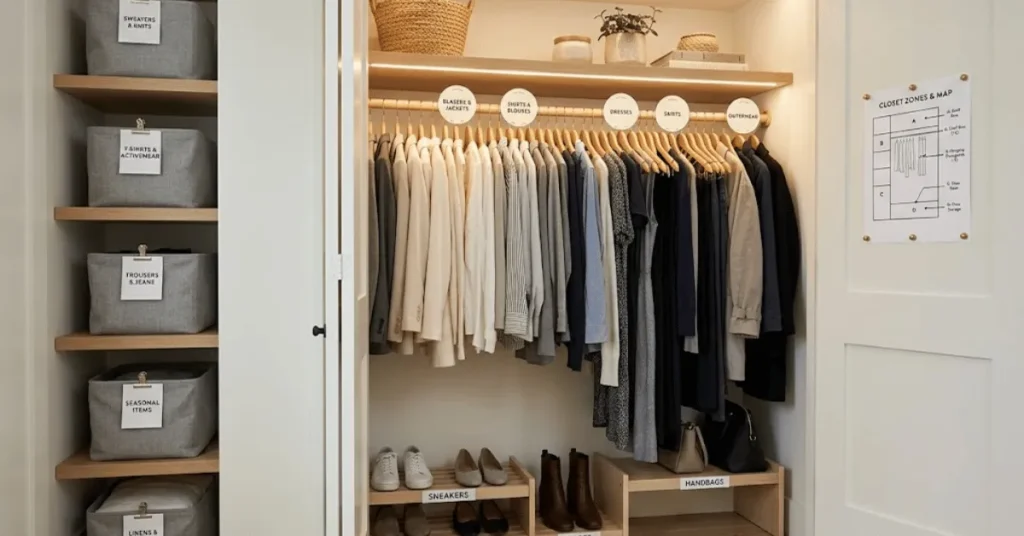
Organizing clothing based on function and use means dividing the closet into defined wardrobe zones where each zone holds one lifestyle category, so every item is stored with the other items it is worn alongside. A closet organized by function is faster to navigate than one organized by color, garment type, or frequency alone because the brain retrieves by context — gym wear, workwear, casual wear — not by category abstraction.
The standard wardrobe zoning framework for small closets: an activewear section near the closet entry for morning access; an office attire zone at center rod position for daily workday dressing; a casual and weekend zone adjacent to the workwear section; and a formal or special occasion zone at the rear or a secondary rod position. Each zone contains all items worn together for that context, including accessories stored in an adjacent bin or hook.
How to Store Seasonal Clothes Without Taking Up Too Much Space
5 methods to store seasonal clothes efficiently are detailed below.
- Vacuum seal bags compress bulky winter items (coats, down jackets, heavy knitwear) to 20 to 30% of their original volume; a queen-size comforter compresses to 4 to 5 inches of storage height.
- Top shelf bins house neatly folded off-season garments in lidded containers labeled by season and category; the top shelf zone above 72 inches is inaccessible for daily use and ideal for this purpose.
- Under-bed flat storage bins store folded summer apparel during winter months and winter base layers during summer, creating a full seasonal rotation without off-site storage.
- Climate-controlled storage units are the appropriate solution only for high-value formal garments (leather, cashmere, heirloom pieces) that require stable temperature and humidity outside the range that a standard apartment provides.
- Breathable garment bags hung at the rear of the closet hold formal dresses, suits, and specialty garments with the hanging shape preserved; vacuum-sealed alternatives damage structured garment construction and should not be used for tailored pieces.
Should You Fold or Hang Clothes to Save Closet Space?
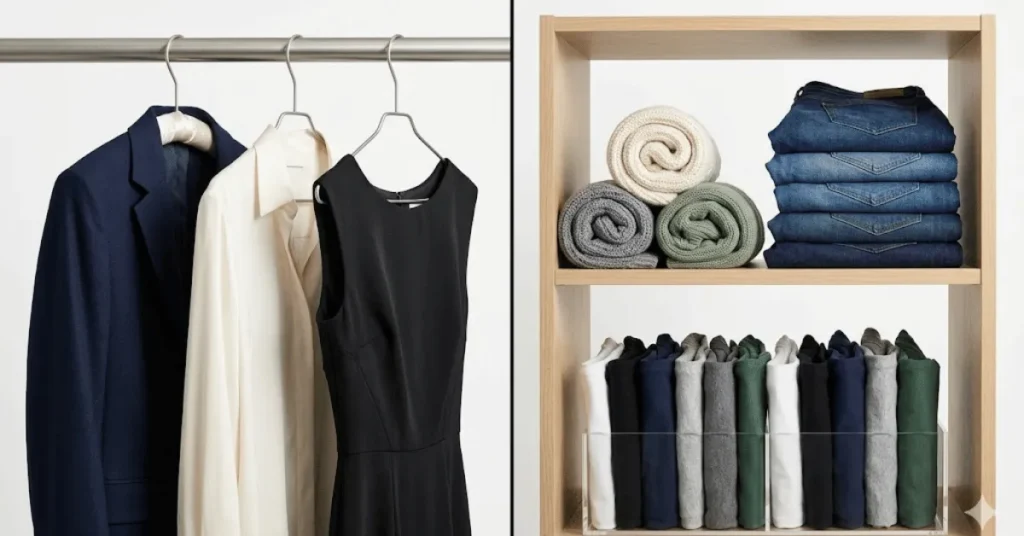
Yes, the decision to fold or hang clothes directly determines closet space efficiency, and the correct method is determined by fabric type and garment construction, not personal preference. Hanging fabric that should be folded wastes rod space. Folding fabric that should be hung creates wrinkles that require pressing before each wear.
Garments that must be hung: suits and blazers (structured shoulders lose shape within 48 hours of folding), silk and satin (the fabric care requirement for these textiles prohibits fold creases at pressure points), formal dresses and blouses (hanging length prevents crease formation that folding produces at the fold line). Garments that perform better folded: heavy knits and knitwear (hanger stretch deforms the shoulder and collar within 1 to 3 wears), denim (weight causes hanger stretch on heavy-weave fabric), t-shirts and casual cotton (the file folding method stores these at twice the density of hanging with zero shape loss). The fabric care label is the definitive source. The fold-versus-hang decision follows the label, not the available rod space.
How to Store Shoes, Accessories, and Jewelry Efficiently
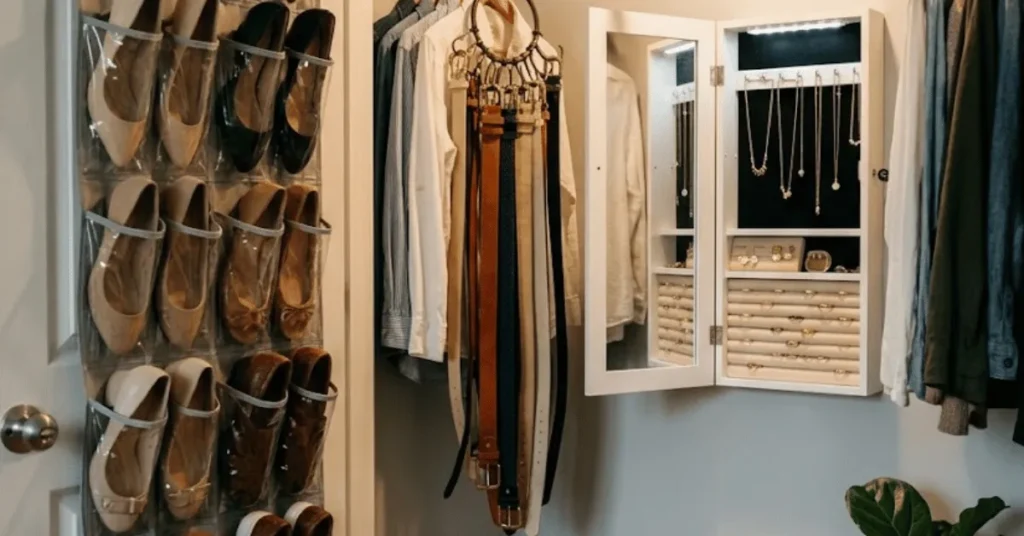
Storing shoes, accessories, and jewelry efficiently requires assigning each category a dedicated format that fits its physical shape rather than consolidating all three into the same bin or shelf system. Shoes, accessories, and jewelry each have distinct storage geometry that mismatches when combined.
Over-the-door shoe racks hold 12 to 36 pairs in the vertical space behind the closet door or bedroom door, with zero floor or shelf consumption. A clear-pocket design allows visual inventory without removing shoes. Wall-mounted jewelry cabinets with mirrored fronts hold rings, necklaces, earrings, and bracelets in individual compartments behind a surface that also functions as a mirror. Acrylic jewelry trays inside a shelf or drawer provide flat-lay storage for daily-access items. Belt rings (circular multi-hook inserts) hang from the closet rod and hold 10 to 15 belts in the space a single garment would occupy. Scarf hangers hold 20 to 25 scarves cascaded vertically from one hook position on the rod or door.
Organizing Delicate Clothing Items Without a Dresser
5 rules for organizing delicate clothing items are given below.
- Use padded satin hangers for silk, satin, and chiffon garments; the padded surface prevents the shoulder pinch that thin plastic or wire hangers create on delicate fabric construction, which produces permanent impressions within 1 to 2 wears.
- Store delicate knits flat or rolled in breathable garment bags rather than hanging; even padded hangers cause gravitational stretch in lace, open-weave knits, and loosely constructed delicate fabrics over 30 to 60 days of hanging storage.
- Wrap acid-free tissue paper around the fold points of stored formal garments; standard tissue paper contains sulfites that transfer to delicate fabric over 6-plus months of storage contact.
- Use lingerie dividers (soft-sided fabric insert trays with individual pockets) inside a canvas storage basket or cube bin to store bralettes, delicate underwear, and soft accessories without contact friction between garments.
- Keep delicate items away from direct light exposure in the closet; UV light degrades silk, satin, and pastel fabric dyes within 3 to 6 months of consistent exposure, causing irreversible color shift in stored garments even when the closet is closed most of the time.
Tips for Long-Term Closet Organization
Tips for long-term closet organization ensure that the system remains functional beyond the initial setup session by building maintenance habits that prevent the two most common failure modes: volume creep (too many items entering without items leaving) and drift (items returning to the wrong zones over weeks of daily use).
8 tips for long-term closet organization are listed below.
- Apply the one-in one-out rule at the point of purchase, not during a seasonal declutter; every new garment acquisition triggers the removal of one existing garment before the new item enters the closet.
- Run a quarterly closet audit to remove items not worn in 90 days; garments with unbroken 90-day non-use cycles have a documented return rate below 15% after the audit date [site: NAPO, wardrobe use frequency studies].
- Process laundry to completion in a single session rather than staging clean clothing on a chair or floor; incomplete laundry processing is the primary source of closet drift.
- Reset each zone visually every Sunday by returning displaced items to their assigned section before the new week begins.
- Maintain one empty hanger buffer of 5 to 10 hangers per rod section; a rod at 100% capacity makes daily retrieval difficult and signals that a declutter session is overdue.
- Label every bin, basket, and zone with a fixed identifier; labels eliminate the guesswork that causes items to be returned to the wrong location by multiple household members.
- Photograph the organized closet immediately after setup; the photograph becomes the reset reference during quarterly audits and after laundry accumulation disrupts zone alignment.
- Schedule an annual full decluttering routine timed to seasonal transitions; the fall switch removes summer apparel and the spring switch removes winter items, creating a natural audit cycle that prevents year-over-year volume accumulation.
How to Maintain an Organized Closet Over Time
8 steps to maintain an organized closet over time are given below.
- Hang garments back in their designated zone immediately after wearing or laundering rather than placing them on a chair, doorknob, or floor as a temporary staging area.
- Process the entire laundry load to completion in one session each week; partial processing leaves 30 to 50% of clothing outside the closet system and creates a parallel disorder that competes with the organized primary zone.
- Do a 5-minute daily tidying pass at a fixed time (typically morning or evening) to catch misplaced items before they accumulate into a zone reset requiring 30 minutes.
- Perform a weekly reset of folded item stacks in bins and on shelves; daily use compresses and shifts folded piles laterally, and a 2-minute straightening restores the visual order that makes the system usable.
- Check hanger spacing every 2 weeks to confirm the rod has not drifted toward 100% capacity; hanger spacing at 1.5 to 2 inches (3.8 to 5 cm) per garment is the functional minimum for damage-free daily retrieval.
- Return accessories to their designated hooks and trays as part of the daily habit building routine; accessories are the first category to leave the system and the last to be recovered during resets.
- Review the one-in one-out rule compliance monthly by counting new items purchased versus items removed in the same period; a net positive count signals that a micro-declutter session is required before the next purchase.
- Inspect garment bags and seasonal storage at the start of each season to confirm no items were stored damp, which causes mildew damage that makes those garments unwearable when retrieved.
Should You Rotate Clothes Based on Season to Keep Your Closet Tidy?
Yes, rotating clothes based on season is the single most effective structural habit for maintaining a tidy closet system long-term. Strict seasonal wardrobe switching removes 30 to 50% of total clothing volume from the active closet at any given time, which is the spatial relief that allows daily-use items to sit at correct hanger spacing, folded items to stack without compression, and accessories to occupy their designated positions without being crowded out by out-of-season clothing.
Without seasonal rotation, a small closet operates at 80 to 100% capacity year-round. At that capacity level, every retrieval disturbs adjacent items, zone boundaries erode, and the maintenance habit becomes unsustainable because the system is too dense to reset quickly. Seasonal rotation is not a preference. It is the structural prerequisite for tidy closet systems in spaces under 40 square feet (3.7 square meters).
Product Recommendations for Closet Organization
The best product recommendations for closet organization focus on storage hardware and organizational tools that replace specific dresser functions without replicating the dresser’s floor footprint. Every product below addresses one of the four functions a dresser provides: folded item storage, small item containment, accessory organization, and laundry processing staging.
What Are the Best Bins, Baskets, and Dividers for Closet Storage?
The best bins, baskets, and dividers for closet storage are detailed below.
- Breathable cotton canvas bins: the ideal format for storing clothing in enclosed closets; moisture-wicking fabric prevents humidity accumulation that synthetic bins trap over 60 to 90 days of continuous use.
- Wire baskets (chrome or white-coated): best for shoes, folded denim, and heavy items that compress soft-sided bins; wire construction provides airflow and visible inventory without removing the basket.
- Acrylic drawer dividers: rigid, transparent dividers that subdivide a shelf or cube compartment into individual sections for underwear, socks, and small accessories; cost $8 to $20 per set.
- Bamboo boxes with lids: rigid base construction supports stacking without compression; natural material resists humidity; best for jewelry, sunglasses, and small accessories stored on open shelves.
- Fabric cube bins (canvas or linen-blend): fit standard 12 x 12 inch cube organizer openings; hold 12 to 18 liters of clothing volume per cube; available in solid colors for visual consistency on open shelving.
- Stackable clear plastic bins with lids: best for seasonal storage and top-shelf bins where visual inventory matters but direct access is infrequent; clear sidewalls eliminate the need to label contents.
Should You Invest in a Freestanding Clothing Rack for Extra Storage?
Yes, a freestanding clothing rack is worth the investment when the primary closet has reached maximum rod capacity and overflow hanging storage is required without permanent installation. A heavy-duty clothing rack with a bottom shelf holds 40 to 80 garments and provides a capsule wardrobe display format that makes outfit selection faster than a closed closet system for daily-use items.
A freestanding garment rack becomes a permanent organizational tool rather than a temporary overflow solution in three specific scenarios: a capsule wardrobe where 20 to 30 core pieces are displayed and rotated deliberately; a studio apartment where no closet exists and the rack is the primary clothing storage structure; and a shared closet where one occupant’s overflow cannot fit within a divided rod section. Racks with adjustable rod height and a lower shelf (for shoes, folded items, or a storage basket) outperform single-rod designs in small spaces where every piece of furniture must carry more than one function.
Top Closet Organizers and Storage Solutions for Small Spaces
Top closet organizers and storage solutions include:
- Multi-tier pant hangers (5 to 10 bar cascade): hang 5 to 10 trousers, skirts, or folded jeans in the vertical space one standard hanger occupies; convert any rod section into a high-density trouser zone without adding rod length.
- Drop-down closet organizers (fabric shelf hangers): attach to the existing rod and provide 5 to 7 fabric-shelf tiers for folded t-shirts, gym wear, and accessories; add shelf function without wall installation.
- Shelf dividers (acrylic or metal L-brackets): clip onto existing shelves and create individual vertical lanes for folded item stacks that prevent lateral collapse across the full shelf width.
- Over-the-door shoe organizers (clear vinyl pocket, 24 to 36 pocket): hang on any standard door without installation; hold shoes, accessories, and small folded items in a completely vertical format.
- Expandable closet rod doubler: attaches below the existing rod with two adjustable height hooks; creates a second hanging tier without drilling or permanent modification.
- Pull-out trouser rack (freestanding or rod-mounted): holds 20 to 30 trousers flat on individual horizontal bars with full visibility; eliminates the fold crease that results from draping trousers over a single bar.
Final Thoughts on Organizing a Small Closet Without a Dresser
A small closet organized without a dresser performs better than the same closet with a dresser occupying adjacent floor space, provided the system addresses vertical space, categorical zoning, and daily maintenance as three non-negotiable components. The core attributes of dresser-free storage are vertical space utilization, clothing categorization by function and frequency, and modular systems that adapt as the wardrobe changes across seasons and life stages.
Abandoning the traditional dresser is not a compromise. It is a spatial efficiency decision that recovers 12 to 20 square feet of bedroom floor space, consolidates clothing into a single organized zone, and eliminates the split-storage friction of managing items across both a dresser and a closet simultaneously. The long-term workflow benefit is real and measurable: a correctly built dresser-free closet system supports daily dressing in under 3 minutes with zero item searching, which compounds into hours recovered annually from the friction that a disorganized dual-storage system creates every morning.
How Can I Prevent Clothes from Getting Wrinkled in a Small Closet?
Preventing clothes from wrinkling in a small closet requires maintaining hanger spacing of at least 1.5 to 2 inches (3.8 to 5 cm) per garment on the rod, which allows fabric breathing room and prevents compression creasing between adjacent garments. An overstuffed closet rod compresses garments laterally, which creates persistent wrinkles in woven fabrics within 24 to 48 hours. Correct folding technique prevents wrinkles in stored folded items: fold along the garment’s natural seam lines rather than across the fabric body, and store folded items with the fold edge facing up rather than the open edge.
How Do I Store Clothes for Long-Term Organization?
Storing clothes for long-term organization requires three conditions: climate control (stable temperature between 60 and 75°F / 15 and 24°C with humidity below 60%), pest prevention using cedar blocks or cedar balls renewed every 3 to 6 months as the cedar oil dissipates [site: University of Kentucky Entomology Department, cedar oil pest prevention research], and breathable cotton bags for any garment stored in a sealed or semi-sealed environment. Cedar blocks repel moths without the chemical residue that mothballs leave on fabric. Breathable cotton bags (not plastic dry-cleaning bags) allow moisture vapor to escape while preventing dust and insect contact. Plastic bags trap humidity and accelerate fabric degradation in garments stored longer than 3 months.

Mike Mann writes practical home organization and small-space living guides for CozySorted. His work focuses on apartment-friendly storage, clutter-free routines, bedroom organization, and simple systems that help renters, apartment dwellers, and small-space homeowners create calmer, easier-to-maintain homes.