Finding bedroom ideas for couples that actually work in a small shared space is harder than it looks two people, two sets of belongings, and two very different opinions on what tidy means. The good news? With the right small bedroom ideas for couples, you can create a space that feels like *both* of yours: stylish, organized, and genuinely comfortable.
Whether you’re a renter who can’t drill into walls, working with a double bed that takes up most of the floor, or just trying to figure out how to blend two styles into one cozy room this guide has you covered.
You’ll find couple bedroom decor ideas, bedroom design ideas for couples at every budget, clever storage solutions, and renter-friendly organization tips that work in real small spaces.
The average U.S. bedroom measures 132 square feet [site: U.S. Census Bureau, American Housing Survey 2023], yet two adults must share that footprint with double the clothing, double the devices, and two entirely different definitions of “tidy.” That gap is where conflict begins. Shared bedroom organization is not just about buying better bins. It requires systems designed for two different people with one limited room.
Cute Couple Bedroom Ideas That Feel Like Both of Yours
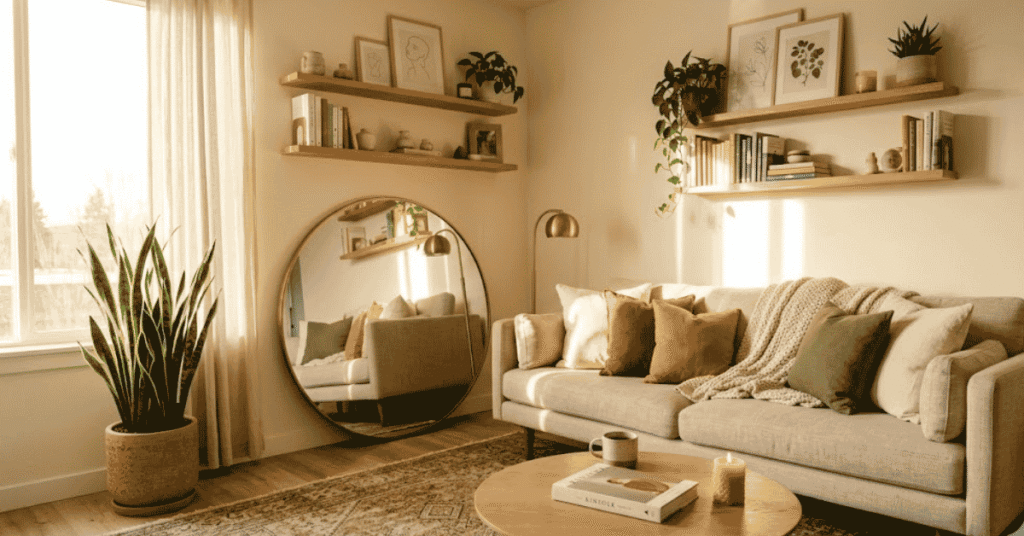
Not every couple room idea needs a major renovation. Some of the most charming, Pinterest-worthy couple room ideas come down to a few intentional choices the right colour palette, layered textures, and personal touches that make the space feel like both of yours.
Here are some couple room ideas that work beautifully, even in the smallest rental spaces:
Create a cohesive colour story. Pick 2–3 colours you both love and repeat them across your bedding, cushions, and small décor pieces. You don’t need to redo everything—even matching your throw pillow to a piece of wall art creates an instantly pulled-together look.
Layer your lighting. Overhead lighting rarely feels cosy or romantic. Add a warm-toned bedside lamp on each side (essential for two people with different sleep schedules) and consider a soft LED strip behind the headboard for an ambient evening glow.
Build a shared gallery wall. A small cluster of frames, photos, art prints, or a mirror can turn a blank rental wall into a real focal point. Command strips mean zero damage to your walls and zero lost deposit.
Invest in one statement piece. A new headboard, a bold patterned rug, or a striking duvet cover can completely transform how a room feels without touching a single wall. It’s one of the easiest couple room ideas for renters who want maximum impact with minimal effort.
Keep surfaces intentional. Two nightstands, each styled simply with just the essentials, instantly signal that the space belongs to two people—without the clutter that makes small rooms feel chaotic.
Couple Room Ideas by Style
The easiest way to find couple room ideas that work for both of you is to agree on one style direction first, then shop and decorate within it. Here are four practical styles for small shared bedrooms:
Modern Minimal
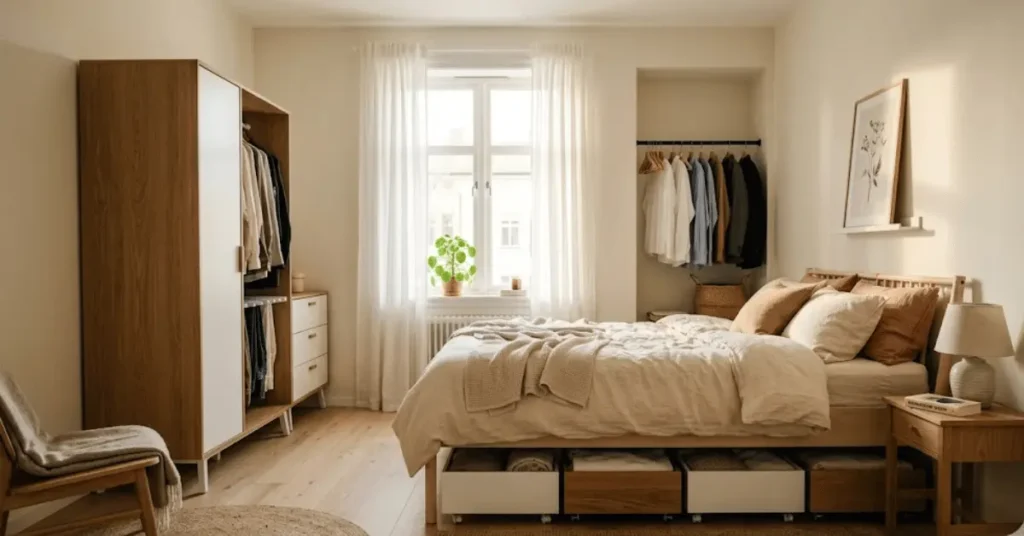
Choose clean furniture, closed storage, and a neutral color palette. This style works well when one partner prefers an organized space and the other prefers a calm visual environment. A platform bed with built-in drawers can provide extra storage without taking up additional floor space.
Warm and Romantic
Use warm-toned lamps, soft bedding, and one or two meaningful personal items. This style looks polished without requiring a lot of decor. Two matching bedside lamps and neutral bedding can create a warm, romantic atmosphere.
Cozy Scandinavian
Combine light wood tones, white or linen bedding, soft textures, and a few plants. This style is easy to achieve in a rental and naturally creates a bright, calm, and comfortable bedroom.
Boho Eclectic
Layer rugs, woven textures, cushions, and wall decor to create a relaxed and personal space. This style works especially well when couples have different design preferences because mixing colors, textures, and patterns is part of the overall look.
Best Bedroom Ideas for Couples in a Small Space
The best bedroom ideas for couples in a small space are the ideas that give both partners equal access, personal storage, shared comfort, and a calm room setup. A small shared bedroom works better when the bed placement, closet division, bedside storage, lighting, and daily reset system are planned for two people from the start.
Small bedroom ideas for couples include:
- Use two compact nightstands so both partners have their own bedside zone.
- Choose a storage bed or under-bed bins for seasonal clothes, shoes, or extra bedding.
- Add wall shelves above the dresser or bed to free floor space.
- Divide the closet into clear left and right sections.
- Use a shared laundry system with separate baskets or divided hampers.
- Keep one charging station for phones, tablets, and watches.
- Use warm bedside lamps instead of one bright overhead light.
- Choose calm bedding and simple decor to reduce visual clutter.
- Add a storage bench only if it holds blankets, pillows, or bedding.
- Keep one reset basket for items that need to be returned later.
- Create one shared focal wall above the bed with framed art, shelves, or one large print.
- Use matching bedside lamps so both sides of the bed feel equal.
- Choose one warm color palette for bedding, curtains, rugs, and baskets.
- Add one soft rug under the bed to make the room feel cozy without adding more furniture.
- Keep decor inside one display zone, such as one shelf, one wall, or one tray.
How do you declutter a small bedroom for two people?
Decluttering a small bedroom for two people involves a structured joint process where both partners sort, decide, and remove items together rather than independently.
Joint decluttering works best when both people agree on a shared standard before touching a single item. Without that agreement, the process becomes a negotiation loop. Research from the Princeton Neuroscience Institute shows that physical clutter competes directly for attention and reduces cognitive performance [site: Princeton Neuroscience Institute, 2011], making a clutter-free bedroom a functional need, not a preference.
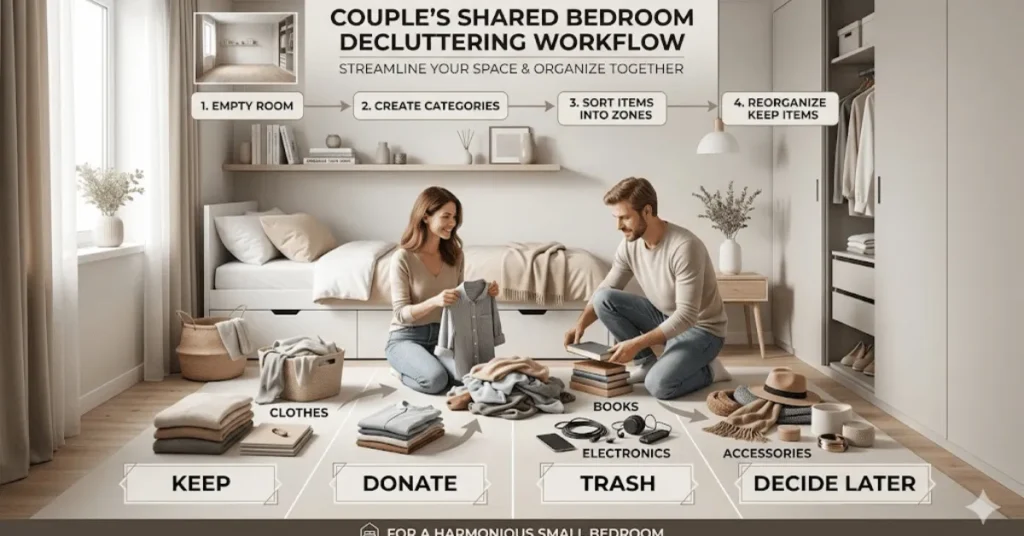
6 steps to declutter as a couple are listed below.
- Set a shared standard first. Both partners define what “necessary” means before sorting begins. This prevents the cycle of one person purging while the other quietly reclaims items.
- Declutter surfaces first. Clear every flat surface: nightstands, dressers, and windowsills. These collect the highest-density clutter fastest.
- Sort by category, not by location. Pull all clothing into one pile, all books into another. This reveals the true volume of duplicate items in the room.
- Separate into four zones: keep, donate, trash, and decide later. The “decide later” box gets a 30-day deadline. Unclaimed items move to donation.
- Address shared items last. Items owned jointly require mutual agreement. Handle personal belongings first to reduce decision fatigue before reaching shared ones.
- Commit to putting things back every time. Decluttering without a daily return habit rebuilds the same clutter within weeks.
What creates the most clutter friction for couples?
The most common sources of clutter friction for couples are behavioral differences, not storage shortages.
Two people with different clutter tolerance levels will always disagree unless the space has defined rules. One partner’s organized pile is another partner’s visual noise. Research from the UCLA Center on Everyday Lives of Families found that perceived disorder correlates with elevated cortisol levels [site: UCLA Center on Everyday Lives of Families, 2010], meaning clutter affects stress differently for each person, which escalates tension over time.
Common clutter friction points include:
- Differing tidiness standards: one partner resets daily, the other resets weekly
- Clothing pile-up near the bed or chair rather than in designated spots
- Duplicate items from two merged households that were never edited down
- No designated space for daily-carry items like wallets, keys, and chargers
- Shared responsibilities without clear ownership, so neither partner acts
- Items left on surfaces because neither person claimed them as their responsibility
How can the “his and hers” division help with purging?
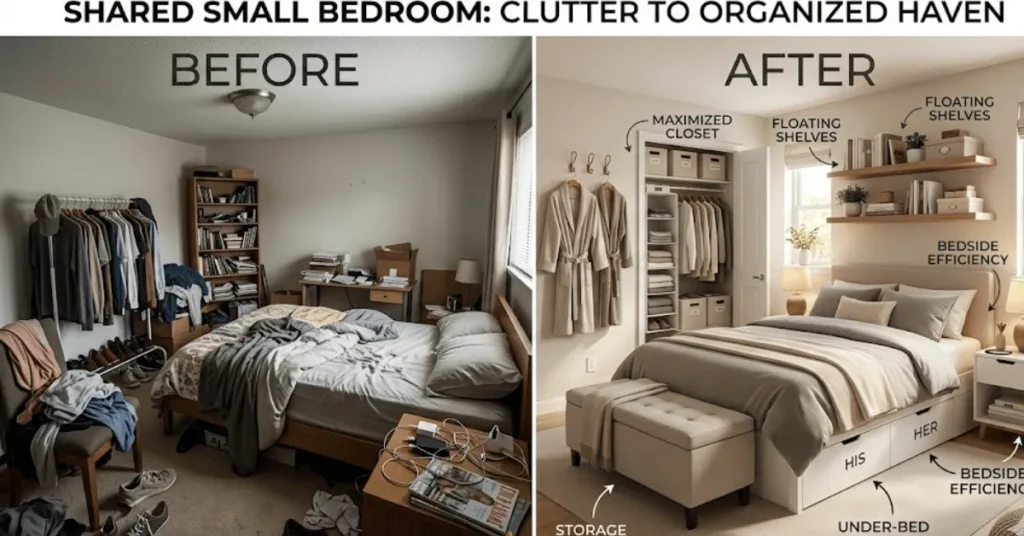
The “his and hers” division helps with purging by giving each partner full accountability over their own belongings, which removes the negotiation barrier that stalls most joint decluttering sessions. Each person sorts and decides independently. Shared items get addressed after individual purging is complete, when both partners are less fatigued and more decisive about what stays.
Small Bedroom Layout Ideas for Couples
The best layout ideas for couples in a small bedroom focus on maximizing floor clearance, creating equal access points, and eliminating furniture that serves only one person.
Smart bed arrangements determine how much usable floor space both partners can actually navigate. A bed pushed against one wall saves floor space but traps one partner against the wall each morning. A centered placement with two nightstands gives equal access but consumes more of the room. The right choice depends on room shape and door placement. Top layout ideas for shared small rooms are listed below.
| Layout Choice | Best For | What It Solves | What To Avoid |
|---|---|---|---|
| Centered bed | Rooms at least 10 feet wide | Gives both partners equal access | Do not use wide nightstands. |
| Corner bed | Rooms under 120 square feet | Opens more floor space | One partner loses easy bed access. |
| Storage bed | Rooms with no dresser space | Adds hidden storage under the mattress | Check drawer clearance first. |
| Floating shelves | Rooms with tight floor space | Stores books, decor, and small items | Do not overload shelves. |
| Wall lights | Rooms with small nightstands | Frees bedside surface space | Use warm bulbs under 3000 Kelvin. |
How does bed placement affect shared floor space?
Bed placement directly controls the usable square footage both partners navigate daily. A center-room placement with 24 inches of clearance on each side meets the minimum walkway standard set by the National Kitchen and Bath Association [site: NKBA, Residential Design Guidelines]. Corner placement recovers 15 to 25 square feet of open floor depending on room dimensions, which is significant in rooms under 150 square feet.
Bedroom Design Ideas for Couples: Fixing What Is Not Working
Bedroom design ideas for couples help when they create equal space, easy storage, and a calm room style. The best design choice supports two routines, not one person’s habits.
A couple’s bedroom design should start with bed access, storage access, and light control. Bed access means each partner can enter and leave the bed without climbing over the other person. Storage access means each person can reach daily clothes, chargers, books, and personal items fast.
When the room feels uneven
Use symmetry around the bed when one side feels more useful than the other. Symmetry means both sides match in size, use, or visual weight.
Example: Place a narrow nightstand and lamp on each side. If one side has less floor space, use a wall shelf and wall light instead.
When storage looks messy
Choose closed storage when open shelves make the room look busy. Closed storage hides visual noise from clothes, cables, books, and skin care items.
Example: A dresser with drawers works better than an open cube shelf if both partners store daily items in the bedroom.
When decor feels random
Use one shared color palette across bedding, curtains, rug, baskets, and wall art. A palette means a small group of colors used together.
Example: Warm white, beige, light wood, and soft gray can make a small bedroom feel calm without looking empty.
When both partners share one closet
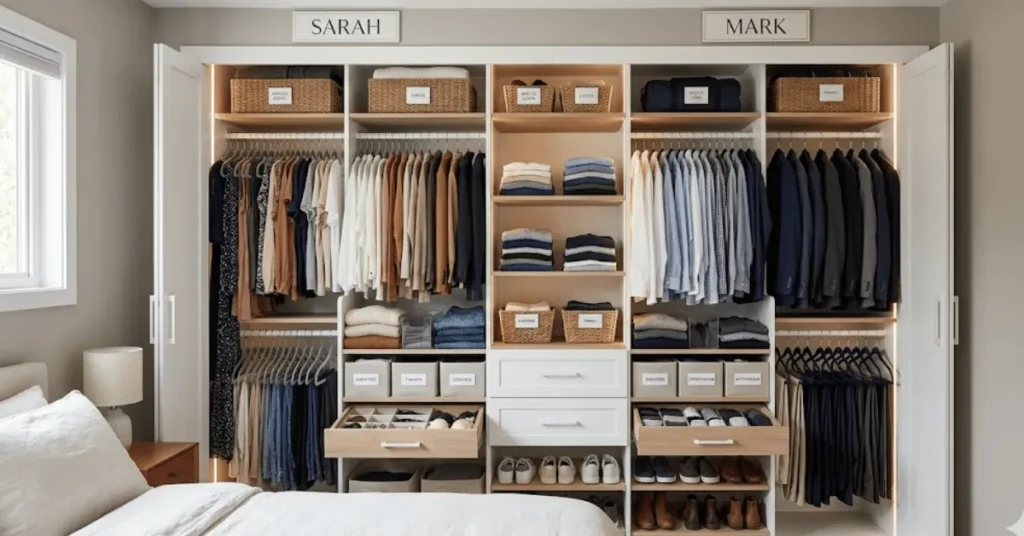
Divide the closet by person, not by item type. Each partner should control one clear zone for hanging clothes, folded clothes, shoes, and accessories.
Example: One partner gets the left side from top to bottom. The other partner gets the right side from top to bottom. Shared bedding goes on the top shelf.
When daily clutter causes stress
Create one landing zone for each person. A landing zone is a small place for daily items, such as a tray, hook, basket, or drawer.
Example: One bedside tray holds glasses, a watch, a book, and a charger. The dresser should not become the shared drop zone.
When the room needs more warmth
Use warm lighting, soft bedding, and two personal items with meaning. Keep personal items limited so the room stays calm.
Example: Use two lamps, one soft rug, one framed photo, and one storage bench. The room feels personal without turning into a storage corner.
Master Bedroom Ideas for Couples
Master bedroom ideas for couples should make the largest bedroom feel calm, useful, and shared. The master bedroom needs zones for sleep, clothes, reading, storage, and daily reset.
A master bedroom is the main bedroom in a home. In a small home or apartment, it still needs smart storage because two people bring clothing, bedding, devices, books, and personal items into one room.
When the bed fits in the center
Center the bed if the room gives each person at least 24 inches of walking space on both sides [site: National Kitchen and Bath Association Residential Design Guidelines]. This layout gives both partners equal access.
Example: Use two slim nightstands, two wall lights, and one rug under the bed. The room feels balanced and easy to move through.
When the room has extra wall space
Use the longest wall for a dresser, wardrobe, or closed cabinet. This keeps storage on one side instead of spreading furniture across every wall.
Example: Place one wide dresser opposite the bed. Add a mirror above it and baskets inside the drawers.
When the room needs comfort
Add a storage bench, reading chair, or soft rug only if the item serves a job. A storage bench can hold blankets, spare pillows, or seasonal bedding.
Example: A bench at the foot of the bed works if it opens for storage. A plain bench fails if it only collects clothes.
Vertical Storage Ideas for a Couple’s Small Bedroom
Vertical storage is essential because floor space in a shared small bedroom is fixed, but wall height above 60 inches remains almost entirely unused in most homes. When couples install floating shelves at that height, they add storage capacity without placing a single new piece of furniture on the floor. Tall shelving units and stacked hanging systems allow two people to store double the volume while keeping the room’s walking area intact. If either partner rents rather than owns, it is worth reviewing small bedroom organization ideas for renters before committing to any wall-mounted system, since the same vertical gains are achievable through freestanding and tension-pole methods that leave no damage.
Can zoning strategies create separate areas in one room?
Zoning strategies can create separate areas in one room by using visual and physical cues that define where one function ends and another begins, without structural changes.
A single area rug under the bed signals the sleep zone. A small desk with a directional light signals the work zone. These cues train both partners to treat each area differently and reduce the spread of one activity’s clutter into another. Methods to zone a shared bedroom include:
- An area rug to anchor the sleep zone and separate it from the dressing area
- A bookcase or open shelving unit used as a soft room divider
- Lighting variation: warm bulbs for the sleep zone, cooler bulbs for the work corner
- Dedicated hooks or entry trays near the door to establish boundaries for daily items
- A ceiling-mounted curtain track to create visual separation for a compact work corner
How can couples maximize small closet organization?
Couples can maximize small closet organization by dividing the space with clear physical boundaries, doubling hanging capacity, and storing out-of-season items outside the closet entirely.
Distributing closet space evenly between two people requires a system, not just an agreement. Without structure, one partner’s wardrobe expands into the other’s section over time. Modular closet systems from retailers like The Container Store and IKEA range from $150 to $400 and fit standard 5-foot to 8-foot closet widths [site: The Container Store, 2024 product catalog]. Key strategies for shared closets are listed below.
- Add shelf dividers to separate each person’s folded items on shared shelving. Dividers cost $8 to $25 per pair and stop pile migration between sections.
- Install a double hanging rod on one side to convert a single-hang section into two levels for shirts, jackets, and folded pants.
- Assign sides, not just shelves. Vertical division gives each person a complete zone: hanging space, shelving, and floor area within their half.
- Use drawer organizers inside built-in drawers to prevent each partner’s items from mixing together.
- Store folded items by person on separate shelves, labeled if needed, to make the morning routine faster for both without a search.
- Reserve the top shelf for items accessed less than once a week: extra bedding, bags, and seasonal accessories.
What are the best ways to divide a shared closet?
The best ways to divide a shared closet include both vertical and horizontal strategies chosen based on each partner’s wardrobe type and volume.
Vertical division assigns each person one full side of the closet from floor to ceiling. This works best when both partners have similar clothing volumes. Horizontal division assigns one partner the hanging zone and the other the shelving zone. Ways to split a closet for two people are:
- Left and right side split using a center divider panel or a neutral gap as a visual boundary
- Top-level shelving for one partner and bottom-level drawers or cubbies for the other
- His-and-hers labeled bins on shared shelving to define personal space without physical barriers
- A tension rod installed at mid-height to create a double-hang section on one partner’s side for shorter garments
If the shared closet also needs to absorb one partner’s full wardrobe without a dresser, the guide to organizing a small closet without a dresser covers how to replicate drawer-level organization using shelf zones and fabric inserts inside the same footprint.
Which hangers save the most space for double wardrobes?
Velvet slim hangers save the most space for double wardrobes. At 0.2 inches thick compared to 0.6 inches for standard plastic hangers, they increase hanging capacity by 60 to 70 percent across the same rod length [site: Good Housekeeping, hanger comparison test, 2023]. Cascading hooks connect multiple garments vertically, adding a second layer for rarely worn items without requiring a second rod or additional closet infrastructure.
Where should out-of-season clothes go in a small room?
Out-of-season clothes belong outside the primary closet to free up vertical wall space for active, in-season use. Vacuum storage bags compress bulky winter items like sweaters and comforters to roughly 30 percent of their original volume [site: Space Bag, product specification data]. Under-bed rolling bins with fitted lids protect flat items. The high shelf above the closet rod handles lightweight seasonal accessories that do not compress well.
Where can you find hidden storage solutions for a couple’s bedroom?
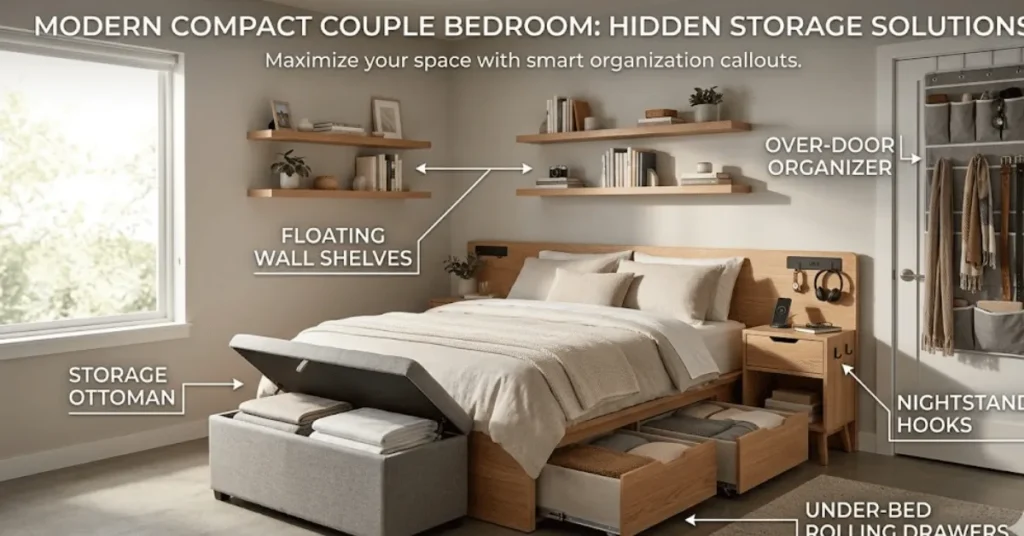
Hidden storage solutions for a couple’s bedroom are found in underused structural zones: below furniture, behind doors, above eye level, and inside furniture pieces that serve dual functions.
Shared bedroom storage does not require renovation. It requires identifying every surface currently storing nothing and treating it as potential capacity. The average bedroom contains 40 to 80 cubic feet of accessible hidden storage in under-bed space alone [site: National Association of Professional Organizers, 2022 report]. Best hidden storage spots are listed below.
- Under the bed using rolling bins, flat platform drawers, or vacuum-sealed bags for bulky seasonal items
- Behind the bedroom door with an over-the-door organizer for shoes, accessories, or small electronics
- Inside a storage platform bed base with built-in drawers positioned on both sides for equal access
- Above the closet rod on the top shelf using labeled bins that rotate seasonal items in and out
- Inside an ottoman at the foot of the bed, which holds extra blankets or spare pillows without using shelf space
- On the back of nightstand doors using small adhesive hooks for headphones, chargers, or eyewear
How does under-bed storage accommodate two people?
Under-bed storage accommodates two people by splitting the space by partner side: each person controls the rolling bins or drawers on their half of the bed frame. Labeled containers prevent items from mixing between partners and make it faster to rotate seasonal items without pulling out the entire collection to find one thing.
Why should you use wall space instead of floor space?
Wall space stores belongings without reducing the walking area both partners share daily. Floating shelves mounted above 60 inches clear the floor completely and eliminate the cramped feeling that comes from furniture pushed against every wall. Wall-mounted organizers also simplify cleaning because there is no furniture base to navigate around, which is worth noting if the messier spouse affects the other partner’s daily routine through floor-level accumulation.
Should you use the back of the door for accessory storage?
Using the back of the door for accessory storage is one of the highest-return upgrades in a small shared bedroom. An over-the-door organizer with 12 to 24 pockets holds shoes, belts, scarves, or small bags that would otherwise pile on dressers and chairs. Everything stays hidden behind closed doors, which keeps the visible room cleaner without adding a single square inch of furniture footprint.
How does bedroom design influence organization for couples?
Bedroom design influences organization for couples by shaping how naturally both partners maintain order after the initial setup. A room with functional design reduces the daily effort required to stay tidy. When storage systems match how each person actually moves through the space, items return to their places without conscious effort rather than accumulating on surfaces. Design that satisfies both partners aesthetically also increases their shared investment in keeping it that way. A room both partners genuinely find calming creates a feedback loop: the space stays organized because both people want to protect how it feels.
Which habits help maintain a clutter-free shared bedroom?
Habits that help maintain a clutter-free shared bedroom include consistent daily resets, shared ownership of specific zones, and rules that control what enters the room in the first place.
Consistent habits outperform any storage system over time. The National Sleep Foundation reports that 62 percent of people sleep better in a clean, organized bedroom [site: National Sleep Foundation, Sleep in America Poll, 2021]. That finding reflects why trying to fit everything everyone owns into organized systems matters less than building routines that keep those systems working day after day. Essential daily habits for couples are listed below.
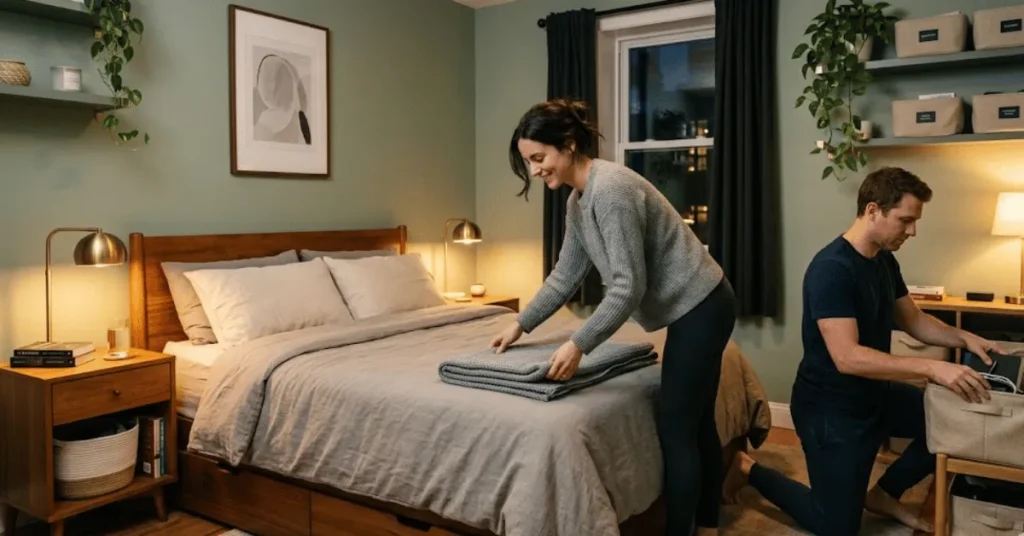
- Complete a nightly reset lasting 5 to 10 minutes where both partners return all items to their designated spots before sleeping.
- Follow the one-in, one-out rule for any new purchase: one item enters the room only after one existing item leaves.
- Assign specific zones to each person for daily items like clothing, accessories, and reading material so no shared surface becomes a default drop zone.
- Handle laundry to completion. Clean laundry left in a basket on the floor creates as much visual clutter as dirty laundry left on a chair.
- Review hidden and seasonal storage every three months to remove unused items and rotate seasonal bedroom resets for what is actively needed.
- Communicate about clutter triggers directly. Addressing a habit early prevents the resentment cycle that makes maintenance feel unequal between partners.
Why does a nightly reset routine prevent conflict?
A nightly reset routine prevents conflict by removing the accumulated visual record of who left what where throughout the day. Shared responsibility for a 5-minute tidy removes the imbalance that builds when one partner tidies consistently and the other does not. Research published in the Journal of Marriage and Family identifies perceived unfairness in household tasks as a leading driver of long-term partner resentment [site: Journal of Marriage and Family, 2019]. Ending the day in an organized room also signals a clear psychological break from daily stress, which supports better sleep for both people.
Should you follow the “one in, one out” rule?
Yes. The one-in, one-out rule is the most effective way to let go of things consistently and prevent volume creep in a shared small bedroom. Every new item that enters the room displaces an existing one through donation, disposal, or transfer to long-term storage. For two people, this doubles in importance because purchase decisions happen independently but the shared space absorbs the combined impact of both partners’ buying habits.
How do lifestyle zones impact bedroom organization?
Lifestyle zones impact bedroom organization by assigning each type of activity a fixed physical location, which stops clutter from migrating across the entire room. Defined zones for sleep, dressing, and work each hold only the items relevant to that activity. When a zone is in use, items stay within it. When it is not in use, it resets quickly without touching adjacent areas. Functional areas reduce the mental overhead of deciding where to put something: each item belongs to one zone, and that zone stays contained. Couples who zone their bedrooms report fewer daily disagreements about shared spaces, according to extension research from Cornell University’s College of Human Ecology [site: Cornell University, Human Ecology extension research].
Can a small bedroom function as a dual workspace?
Yes, a small bedroom can function as a dual workspace when both partners share one desk or maintain separate compact desks in defined corners. Clearing work items away at the end of each workday is non-negotiable for sleep quality. The American Academy of Sleep Medicine recommends keeping work activities physically separate from the sleep environment to reinforce sleep-wake boundaries [site: American Academy of Sleep Medicine, sleep hygiene guidelines, 2022]. A fold-down wall desk saves floor space and naturally enforces that daily reset when closed.
Why is cable management crucial for shared devices?
Cable management is crucial because cord clutter from multiple devices creates both visual noise and a safety hazard in a high-traffic shared bedroom. Two people charging phones, tablets, and laptops generate 6 to 12 cables that tangle across nightstands and floor surfaces near the bed. A single shared charging station consolidates all devices into one managed location. Cord clips and cable concealers mounted to the back of furniture eliminate visible wiring without requiring tools or structural changes to the room.
Why is lighting important for different sleep schedules?
Lighting is important for different sleep schedules because light exposure directly suppresses melatonin production, the hormone that regulates sleep onset [site: Harvard Medical School, Division of Sleep Medicine, 2023]. When sleeping times differ between partners by even one or two hours, overhead lighting disturbs the sleeping partner’s circadian rhythm in measurable ways. Targeted solutions allow one person to read, work, or move through the room without flooding the sleep environment with disruptive light. These adjustments preserve both partners’ sleep quality even when their schedules diverge significantly.
How does task lighting improve shared sleep routines?
Task lighting improves shared sleep routines by directing light only where it is needed and away from the sleeping partner’s face. A clip-on reading lamp or directional bedside light with a warm color temperature below 3000 Kelvin produces minimal light spill across the bed [site: Lighting Research Center, Rensselaer Polytechnic Institute]. Overhead lighting, by contrast, illuminates the entire room and disrupts the sleeping partner regardless of position. Smart bulbs with individual dimming controls give both partners independent adjustment over their side of the room without waking the other.
What design elements enhance intimacy in organized spaces?
Removing clutter reduces ambient stress, which directly improves emotional connection between partners who share a room. A calm, visually quiet bedroom lowers cortisol by reducing the number of competing stimuli the brain processes during rest [site: UCLA Center on Everyday Lives of Families, 2010]. Soft textures like linen bedding, a muted warm-neutral color palette, and two or three intentionally placed personal items signal comfort without adding visual complexity. These elements cost less than storage products and produce a measurable shift in how both partners experience the shared space together.
Small Bedroom Ideas for Couples: Quick Answers
What are good couple bedroom ideas for small rooms? Agree on one decor style first, give each partner a compact nightstand zone, and divide the closet into clear left and right sections. See the Couple Room Ideas by Style, Best Bedroom Ideas for Couples in a Small Space, and How can couples maximize small closet organization? sections above for the full breakdown.
How do you organize a small bedroom for a couple? Set up a shared nightly reset system, create one landing zone per person for daily items, and keep a his-and-hers closet division. The Which habits help maintain a clutter-free shared bedroom? and Bedroom Design Ideas for Couples: Fixing What Is Not Working sections above show how these systems work.
How can two people share a small bedroom without clutter? Follow the one-in, one-out rule, choose closed storage over open piles, and keep one reset basket for stray items. The Should you follow the "one in, one out" rule? and Where can you find hidden storage solutions for a couple’s bedroom? sections above cover each tactic in detail.

Mike Mann writes practical home organization and small-space living guides for CozySorted. His work focuses on apartment-friendly storage, clutter-free routines, bedroom organization, and simple systems that help renters, apartment dwellers, and small-space homeowners create calmer, easier-to-maintain homes.