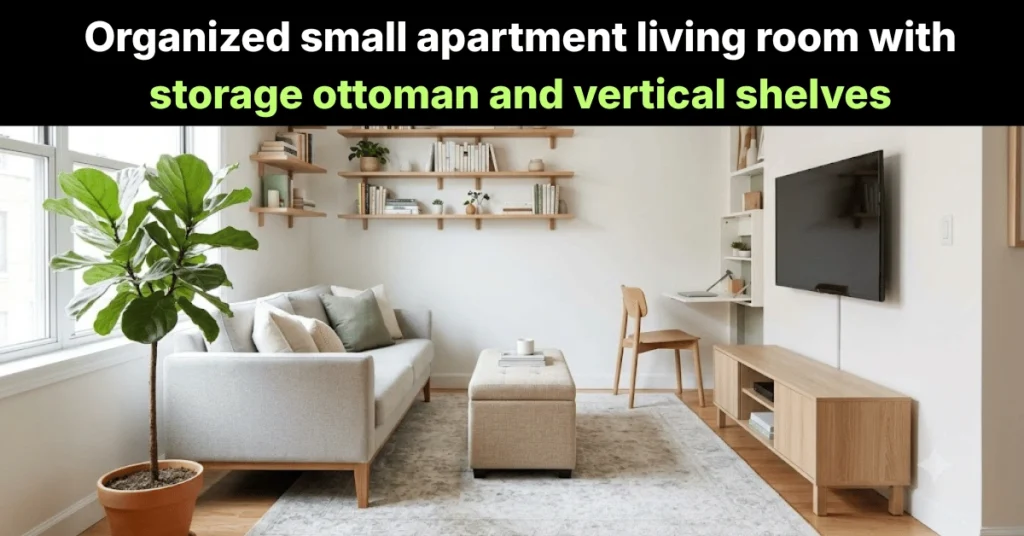
Organizing a living room with no built-in storage means creating clear homes for daily items without using fixed cabinets, closets, wall units, or custom shelves.
A living room without storage can still feel calm, open, and easy to reset. The key is to build a freestanding living room storage system with zones, baskets, cabinets, bookcases, consoles, hidden storage, and renter-friendly storage that fits how the room works each day.
Most living rooms collect the same things: remotes, blankets, books, toys, cables, chargers, games, mail, shoes, and decor. Without item homes, these things spread across the sofa, coffee table, floor, and TV area.
The fix is not buying random bins. The fix is sorting first, measuring the room, mapping storage zones, then choosing furniture that works like built-ins without becoming permanent.
Example: A small apartment living room can use a media console for devices, a storage ottoman for blankets, a tall bookcase for books, and two labeled baskets for toys or pet items.
What does organizing a living room without built-in storage mean?
Organizing a living room without built-in storage means creating storage zones and item homes without permanent cabinets, closets, alcoves, or custom shelves.
This system uses freestanding furniture, baskets, wall-safe storage, trays, hidden storage, and daily reset rules. It helps the living room hold useful items without turning into a catch-all room.
A living room without storage needs structure because the room often does many jobs. It may be used for relaxing, watching TV, reading, hosting guests, working, playing with kids, or keeping pet items nearby.
Each job needs a clear storage home.
Example: Remotes can live in a tray. Blankets can live in a storage ottoman. Books can live on a bookcase. Chargers can live in a small tech box near the sofa.
The goal is not to hide everything. The goal is to make every visible and hidden item look planned.
| Living Room Problem | Storage Fix | Best Item Home |
| Remotes on tables | Small tray or caddy | Coffee table or side table |
| Blankets on sofa | Storage ottoman or basket | Near seating |
| Books on floor | Bookcase or cube shelf | Reading zone |
| Cords near TV | Cable box and clips | Media console |
| Toys spread out | Labeled bins | Lower shelf or basket |
| Mail piles | Small sorter | Entry basket outside living room |
Why does a living room with no built-in storage need a freestanding system?
A living room with no built-in storage needs a freestanding system because items need assigned homes when the room has no cabinets, closets, or permanent shelves.
A freestanding system gives structure to daily clutter. It works through movable pieces, such as cabinets, bookcases, media consoles, baskets, carts, ottomans, and benches.
This matters more in a small apartment living room because one room often holds several routines. The same space may handle TV, work, toys, guests, pets, and entry overflow.
Without clear storage, each surface becomes a drop zone.
Example: A coffee table starts with one remote. Then it collects chargers, cups, mail, books, and toys. A tray limits the zone and makes reset easier.
A good living room freestanding system has 4 parts:
- Sort daily items by use.
- Assign each group one home.
- Use closed storage for messy items.
- Use open storage for neat items.
This keeps the room useful without making it feel packed.
How should you declutter before adding storage?
Steps to declutter a living room before adding storage are listed below.
- Remove unrelated items that belong in bedrooms, closets, kitchens, entryways, or utility areas.
- Group daily items like remotes, books, chargers, toys, games, blankets, and pet supplies.
- Check duplicates, including extra throws, old magazines, unused candles, and repeated decor pieces.
- Relocate entry clutter, such as shoes, bags, keys, mail, and loose shopping items.
- Edit decor by keeping pieces that add style, use, or meaning to the room.
- Remove broken items, dead batteries, damaged toys, torn baskets, and unusable cords.
- Separate seasonal items, including holiday decor, winter throws, guest linens, and extra pillows.
Decluttering comes before storage buying because storage should hold useful items, not old clutter.
Example: If you own 9 blankets but use 3, store 3 in the living room and move the rest elsewhere.
How should you measure walls, walkways, and furniture zones?
Measure walls, walkways, and furniture zones before buying freestanding storage.
Start with wall width, outlet locations, TV position, sofa depth, door swing, window height, walkway width, and storage furniture footprint. These measurements stop you from buying furniture that blocks movement.
A living room walkway should stay open enough for people, pets, kids, and cleaning tools to pass with ease. A storage piece that looks good online can feel too deep in a small room.
Use this short measurement checklist:
- Measure wall width behind the sofa, TV, or empty corner.
- Mark outlet spots for lamps, chargers, and media devices.
- Check door swing, balcony doors, and closet doors.
- Measure sofa-to-coffee-table space before choosing ottomans.
- Measure TV height before choosing a media console.
- Check window height before placing tall shelves.
- Leave room for cleaning tools to move around furniture.
Example: A 16-inch deep cabinet may work beside a wall, but it can block traffic beside a sofa.
How should you map storage zones without cabinets or closets?
Map storage zones by assigning every common item category to a freestanding piece, basket, shelf, tray, drawer, or hidden compartment.
A living room storage zone is a small area that holds one kind of item. This keeps the room easy to use and easy to reset.
Common zones include:
- Media zone for remotes, cords, game controllers, and devices.
- Reading zone for books, magazines, bookmarks, and glasses.
- Blanket zone for throws, pillows, and guest covers.
- Toy zone for kids’ toys, puzzles, and small games.
- Work zone for laptop items, notebooks, pens, and chargers.
- Pet zone for leashes, toys, brushes, and treats.
- Guest zone for extra pillows, coasters, and light blankets.
Example: If you watch TV from the sofa, remote storage should sit near the sofa, not across the room.
How should you organize a living room with no built-in storage first?
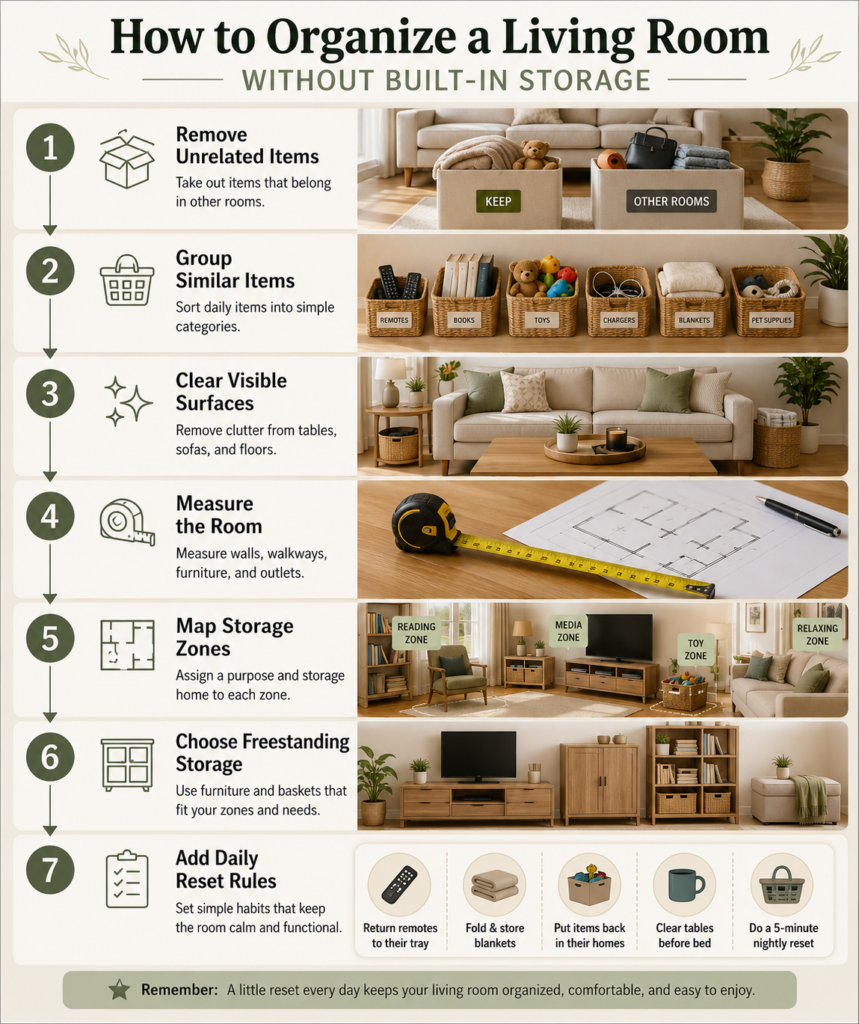
Organize a living room with no built-in storage first by grouping items, clearing surfaces, assigning zones, and choosing storage only after the room’s real needs are clear.
This order prevents overbuying. It also stops the room from filling with baskets that look neat for one week, then turn into hidden junk bins.
Start with the way people use the room each day. A family room needs kid-accessible bins. A renter’s studio apartment may need vertical storage and closed cabinets. A TV-heavy room needs strong media storage and cord control.
The system should match daily habits.
Example: If you always read on the sofa, put books and reading glasses near the sofa. Do not store them in a cabinet across the room.
| Step | Action | Result |
| 1 | Remove unrelated items | Less clutter before buying |
| 2 | Group item types | Clear categories |
| 3 | Clear surfaces | Better visual calm |
| 4 | Map zones | Clear item homes |
| 5 | Choose storage | Better furniture fit |
| 6 | Add reset rules | Easier daily upkeep |
How should everyday living room items be grouped?
Everyday living room item groups are listed below.
- Remotes, controllers, and small tech items need one tray, drawer, basket, or caddy.
- Chargers, cables, and power banks need one labeled tech box near an outlet.
- Books, magazines, and notebooks need one shelf, basket, or reading corner.
- Blankets, pillows, and throws need one ottoman, bench, basket, or trunk.
- Toys, games, and puzzles need low bins that kids can reach.
- Pet items, brushes, and toys need one basket near the pet’s resting spot.
- Work supplies, craft items, and papers need one cart, bin, or closed cabinet.
Each group needs one storage home. This stops items from spreading into new piles.
Example: If chargers live in 3 places, people stop returning them. One tech basket fixes that.
How should surfaces stay clear without hiding useful items?
Surfaces stay clear when only useful or intentional items remain visible.
A coffee table, side table, TV console, and shelf can hold daily items if each item has a boundary. A tray creates a visual border. A small basket hides remotes. A decorative box can hold chargers.
Useful items do not need to disappear. They need to look placed, not dropped.
Good surface rules include:
- Keep remotes in one tray or caddy.
- Limit magazines to 2 or 3 current issues.
- Store chargers in a box, not loose on tables.
- Use one coffee table tray for daily items.
- Remove cups, mail, and wrappers each night.
- Keep decor grouped by size, color, or purpose.
Example: A candle, a book, and a remote tray can stay on the coffee table. Five loose chargers cannot.
How should shared living rooms stay easy for everyone to reset?
Shared living rooms stay easy to reset when every person understands the zones and storage homes.
A shared room fails when one person knows the system and everyone else guesses. Labels, open bins, low baskets, and clear rules make reset easier for roommates, families, kids, and guests.
The system should not depend on one person.
Use simple rules:
- Give each roommate one basket for personal items.
- Use labels for toys, games, blankets, and pet items.
- Place kid bins low enough for children to reach.
- Keep guest blankets in one basket or ottoman.
- Use closed storage for messy shared items.
- Keep daily items near the place where people use them.
Example: If kids play in the living room, toy bins should sit near the play area, not inside a tall cabinet.
What freestanding storage works best in a living room without built-ins?
The best freestanding storage for a living room without built-ins depends on item type, room size, visual clutter, and access needs.
Strong options include bookcases, cabinets, media consoles, storage ottomans, benches, lift-top coffee tables, baskets, carts, cube shelves, and side tables with drawers.
Each piece should solve a real problem. A bookcase should not become a random display wall. A cabinet should not hold items you forgot you own. A basket should not become a mystery bin.
Choose storage by item type:
- Use cabinets for messy items.
- Use bookcases for books and styled baskets.
- Use consoles for TV devices and cords.
- Use ottomans for blankets and pillows.
- Use carts for work, crafts, or hobbies.
- Use trays for remotes and small daily items.
Example: A renter can replace built-in cabinets with a sideboard, a tall bookcase, and two lidded baskets.
Which storage furniture can replace built-in cabinets?
Storage furniture that can replace built-in cabinets is listed below.
- Freestanding cabinets hide cables, games, paperwork, toys, pet items, and extra blankets behind doors.
- Sideboards add closed living room storage while also holding lamps, decor, trays, or framed photos.
- Media consoles replace entertainment centers with drawers, shelves, cable holes, and device storage.
- Bookcases hold books, baskets, decor, plants, framed photos, and small storage boxes.
- Modular shelves fit changing layouts because pieces can move, stack, or expand over time.
- Cube storage works for toys, games, baskets, books, craft supplies, and shared apartment items.
- Storage benches hold blankets, shoes, pet items, or guest supplies near seating areas.
- Storage ottomans hide throws, pillows, board games, chargers, and living room overflow.
- Lift-top coffee tables store remotes, work supplies, devices, books, and daily tech accessories.
Example: A sideboard can replace built-in cabinets behind a sofa or along an empty wall.
How should bookcases, cabinets, and consoles be used?
Bookcases, cabinets, and consoles should each serve a different storage role.
A bookcase works best for books, baskets, plants, framed photos, and neat decor. A cabinet works best for hidden clutter, such as toys, papers, cables, and extra blankets. A console works best for TV devices, remotes, gaming items, and cord control.
Mix doors, drawers, and shelves for practical access. Open shelves keep neat items visible. Closed doors hide messy items. Drawers hold small items that get lost in deep cabinets.
Example: Put books and baskets on a bookcase. Put board games inside a cabinet. Put routers and consoles inside a media console with cable openings.
This creates a clear freestanding storage system without built-ins.
How should ottomans, benches, and coffee tables add hidden storage?
Ottomans, benches, and coffee tables add hidden storage by turning seating and surfaces into concealed storage.
These pieces work well in small living room organization because they use space that already exists. A storage ottoman can hold blankets. A bench can hold guest pillows. A lift-top coffee table can hold remotes, chargers, notebooks, and small devices.
Hidden living room storage works best when each piece holds one clear group.
Avoid making hidden storage a random catch-all. Deep storage can hide clutter so well that nobody remembers what is inside.
Example: Use one ottoman for blankets only. Use one lift-top coffee table for remotes and chargers only.
That rule keeps hidden storage useful.
How should baskets, bins, and carts organize loose items?
Baskets, bins, and carts organize loose items by collecting small categories without permanent storage.
Lidded baskets work for blankets and pillows. Handled bins work for toys and games. Trays work for remotes and glasses. Rolling carts work for work supplies, craft items, and hobby tools.
Labels help shared homes because people return items faster when the basket has one job.
Good basket uses include:
- Store blankets in one large lidded basket.
- Place toys in two low bins by type.
- Keep remotes in one small tray.
- Hold pet toys in one handled basket.
- Store laptop items on a rolling cart.
- Keep craft supplies in closed bins.
Example: A rolling cart can become a small work zone during the day and move beside a wall at night.
How can vertical storage help when a living room has no built-ins?
Vertical storage helps when a living room has no built-ins by using wall height instead of limited floor space.
Tall bookcases, ladder shelves, floating shelves, hooks, rails, over-door storage, and renter-friendly wall storage can hold items without crowding the floor.
This helps most in apartments, studios, and small living rooms where floor space is tight. The goal is to move storage upward while keeping walkways open.
Vertical storage should still look calm. Open shelves can become visual clutter when they hold too many small objects.
Example: A tall bookcase can hold books on the middle shelves, baskets on the lower shelves, and lighter decor on the top shelves.
How should shelves and tall bookcases use wall height?
Shelves and tall bookcases should use wall height to move storage upward while keeping the floor open.
Use lower shelves for heavier items and baskets. Use middle shelves for books and daily items. Use upper shelves for light decor, framed photos, or seasonal pieces.
Anchor tall furniture where the lease and wall type allow it. Anchoring means attaching furniture to the wall to reduce tipping risk. This matters more in homes with kids, pets, or narrow rooms.
Avoid overloaded open shelves. Too many small items make the wall feel busy.
Example: Put toy bins on the bottom shelf, books in the middle, and plants or baskets above eye level.
This keeps storage safe, useful, and balanced.
How can renters add vertical storage without drilling?
Renters can add vertical storage without drilling by using freestanding bookcases, leaning ladder shelves, tension poles, over-door hooks, adhesive hooks, and no-damage picture ledges where suitable.
A renter-friendly storage plan should respect lease rules, wall material, weight limits, and removal needs. Adhesive hooks can hold light items, but they should not hold heavy baskets or glass objects.
No-drill storage works best for light and medium items.
Good renter-friendly options include:
- Use a tall freestanding bookcase.
- Add a leaning ladder shelf.
- Place over-door hooks on nearby doors.
- Use adhesive hooks for light items.
- Add a tension pole shelf where it fits.
- Choose floor lamps with small shelves.
Example: A leaning ladder shelf can hold blankets, small baskets, books, and decor without wall holes.
How should wall storage avoid visual clutter?
Wall storage avoids visual clutter when it combines closed boxes, matching baskets, limited decor, and breathing room.
Open shelves need editing. Breathing room means leaving empty space around objects so the shelf does not look packed.
Use matching baskets for small loose items. Use closed boxes for cables, papers, backup remotes, and craft pieces. Keep similar items together so the eye reads the shelf as one planned area.
Good wall storage rules include:
- Hide messy items in boxes or baskets.
- Group books by size or color.
- Leave empty space on each shelf.
- Limit small decor to 1 or 2 pieces per shelf.
- Repeat one material, such as wood, wicker, or metal.
- Keep heavy storage on lower levels.
Example: Three matching baskets on one lower shelf look cleaner than 8 different bins across the wall.
Recommended Video: Small Living Room Storage
Recommended Video: Search YouTube for “small living room organization without built in storage” to watch a visual guide.
A video guide can help you see furniture scale, walkway space, shelf balance, and basket placement in a real room. This is useful before buying tall shelves, consoles, ottomans, or renter-friendly storage.
Example: Watch how a small apartment uses one media console, one bookcase, and one storage ottoman before copying the layout.
How should media, cords, remotes, and devices be stored without built-ins?
Media, cords, remotes, and devices should be stored without built-ins using a freestanding media console, cord-control tools, remote trays, charger stations, and device baskets.
Tech clutter is one of the biggest causes of messy living rooms because it spreads across tables, floors, sofas, and TV stands.
The media zone needs closed and open storage. Devices need airflow. Cords need safe paths. Remotes need one easy home near seating. Chargers need a small station near an outlet.
A good no built-in media storage setup includes:
- A media console with drawers or doors.
- Cable clips behind the console.
- A ventilated cable box.
- A tray for remotes.
- A labeled tech box.
- A charging station near seating.
Example: Keep remotes in a tray on the coffee table, chargers in a tech box, and cords clipped behind the TV console.
How should a media console replace a built-in entertainment center?
A media console can replace a built-in entertainment center when it provides drawers, cabinets, shelves, cable openings, and surface space for the TV or decor.
Choose the width first. A console should fit the TV wall without crowding doors, windows, or walkway paths. Then choose the height, storage type, and door style.
Closed doors hide routers, game systems, DVDs, and cables. Drawers hold remotes, batteries, and controllers. Open shelves work for items that need airflow.
Example: A 60-inch TV needs a console wide enough to feel balanced under the screen. A narrow console can make the wall look unfinished.
Use the console as the main media storage living room zone, not as a display shelf for random decor.
How should cords and chargers be hidden safely?
Cords and chargers should be hidden safely with cable boxes, cord clips, zip ties, charging trays, labeled cables, and surge protectors with ventilation.
Cord safety matters because covered cords can trap heat. A surge protector should have airflow. A cable box should not be packed tightly with hot adapters.
Keep cords away from heat, water, pets, and high-traffic walkways. Do not run loose cables where people walk.
Good cord control tools include:
- Cable clips for the back of furniture.
- Zip ties for grouped cords.
- Cable boxes for power strips.
- Labeled tags for device cords.
- Charging trays for phones and tablets.
- Cord covers for visible wall paths.
Example: Label one cord “router” and another “lamp” before placing both inside a cable box.
How should remotes and small tech accessories stay easy to find?
Remotes and small tech accessories stay easy to find when they have one visible or hidden home near the seating area.
The best remote control storage sits where people already use the remote. A tray, small basket, side table drawer, remote caddy, or labeled tech box can work.
Small tech accessories include batteries, earbuds, charging cords, game controllers, screen wipes, and device adapters. These items disappear when they lack one home.
Use one weekly reset check to return each item to its place.
Example: Place remotes in a tray on the coffee table every night. Put game controllers inside the media console drawer after use.
This keeps the media zone easy to use.
What should you store in a living room with no built-in storage?
A living room with no built-in storage should store items that directly support relaxing, watching TV, reading, hosting, working, playing, or daily household routines.
Unrelated overflow should move to the bedroom, closet, entryway, kitchen, bathroom, laundry area, or utility storage. This keeps the living room from becoming the home’s drop zone.
Store only what the room uses.
Good living room storage items include blankets, remotes, books, coasters, games, toys, pet items, small work supplies, guest pillows, and media accessories.
Poor living room storage items include laundry, extra shoes, old mail, cleaning products, tools, spare packaging, and out-of-season decor.
Example: A board game used every Friday can stay in the living room. A box of tax papers should not.
This rule protects the room’s main job: comfort.
Which living room items need hidden storage?
Living room items that need hidden storage are listed below.
- Extra blankets need hidden storage because they create sofa clutter when left out.
- Pillows need hidden storage when the room has more pillows than seats.
- Cables need hidden storage because loose cords make surfaces look messy.
- Chargers need hidden storage because small wires spread fast.
- Toys need hidden storage so the room resets after play.
- Board games need hidden storage because boxes can look busy.
- Pet items need hidden storage when brushes, leashes, and toys pile up.
- Work supplies need hidden storage so the living room does not feel like an office.
- Paperwork needs hidden storage because loose papers create visual stress.
- Backup decor needs hidden storage because unused pieces crowd shelves.
Example: Put board games in a cabinet and keep one current game on an open shelf.
Which items can stay visible as decor?
Some items can stay visible when they add style, function, or personality.
Visible decor storage works when the item looks intentional. Books, plants, candles, framed photos, trays, baskets, ceramic boxes, blankets on a ladder, and curated objects can stay out.
The item should have a reason and a place.
A blanket draped on a ladder can look warm and useful. The same blanket dropped over a chair can look messy. A stack of books can look styled. A pile of random papers cannot.
Example: Place 3 books beside a small plant on one shelf. Store extra books in a basket or cabinet.
Visible items should support the room, not cover every surface.
Which items should leave the living room?
Some items should leave the living room because they create clutter or belong to another zone.
Laundry belongs in the bedroom or laundry area. Shoes belong near the entry. Mail belongs in a mail station. Cleaning supplies belong in a utility space. Extra packaging belongs in recycling or storage.
Common items to remove include:
- Move laundry to the bedroom or laundry area.
- Move shoes to the entryway.
- Move mail piles to a mail sorter.
- Move tools to a utility drawer.
- Move extra packaging to recycling.
- Move unused toys to a toy rotation bin.
- Move out-of-season decor to seasonal storage.
Example: If shoes keep landing near the sofa, the entryway needs a better shoe system.
The living room should not fix every storage problem in the home.
Should you use open storage or closed storage in a living room with no built-ins?
You should use open storage or closed storage in a living room with no built-ins based on what needs to be displayed, hidden, reached daily, or kept visually quiet.
Most living rooms need a mixed storage system. Open storage works for neat, styled, and useful items. Closed storage works for messy, private, or bulky items.
A room with only open shelves can look busy. A room with only closed cabinets can feel heavy. The better choice is balance.
Example: Use a bookcase with baskets on the bottom shelves, books in the middle, and decor on the top shelves. Add a cabinet for cables, toys, and paperwork.
| Storage Type | Best For | Avoid Using For |
| Open shelves | Books, plants, baskets, framed photos | Loose cords, papers, mixed toys |
| Closed cabinets | Cables, games, toys, paperwork | Items used every few minutes |
| Drawers | Remotes, batteries, chargers | Large blankets or bulky pillows |
| Baskets | Blankets, toys, pet items | Unsorted mixed clutter |
| Trays | Remotes, candles, glasses | Papers, cords, snacks |
| Carts | Work, crafts, hobby items | Heavy decor or fragile items |
When does open storage work better?
Open storage works better for books, plants, baskets, framed decor, and frequently used items that stay neat.
Open shelves, cube shelves, ladder shelves, and display bookcases help when the item can be seen without making the room look messy. Open storage also helps people find and return items fast.
But open storage needs editing and spacing. Every object is visible, so each shelf needs a limit.
Good open storage items include:
- Display books by size or color.
- Place plants on upper shelves.
- Use baskets for loose items.
- Add framed photos in small groups.
- Keep daily items at eye level.
- Leave empty space between objects.
Example: A cube shelf can hold 4 baskets and 4 open display cubes. This mix feels cleaner than 8 open cluttered cubes.
When does closed storage work better?
Closed storage works better for messy, bulky, private, or mismatched items.
Cables, paperwork, toys, games, craft supplies, pet items, chargers, and extra blankets should often go behind doors, inside drawers, or under lids.
Closed storage helps the room feel calmer because the eye sees fewer small objects. It also works well in shared homes where people use the room in different ways.
Good closed storage options include cabinets, drawers, trunks, lidded baskets, media consoles, storage benches, and ottomans.
Example: Put board games in a closed cabinet, not stacked beside the TV. Put chargers in a drawer, not spread across the coffee table.
Closed storage should still be labeled when more than one person uses it.
When does mixed storage work better?
Mixed storage works better when the living room needs both display and clutter control.
Use closed storage for messy items and open shelves for styled books, plants, baskets, and decor. This gives the room function and personality without visual clutter.
A simple ratio works well: keep more hidden storage than open storage in small rooms. This gives the eye places to rest.
Example: A media console with closed doors can hide tech clutter. A nearby bookcase can show books, plants, and two matching baskets.
Mixed storage is the most realistic choice because living rooms hold both beautiful items and everyday mess.
How do you style a living room without making storage obvious?
Style a living room without making storage obvious by choosing pieces that match the room’s color, scale, texture, and layout.
Good storage should feel like furniture, not a pile of containers. A cabinet, sideboard, bench, or ottoman should fit the room before it solves storage.
Start with the room’s main colors and materials. Match wood tones where possible. Repeat metal finishes. Choose slim storage furniture for small rooms. Use baskets that match the room’s texture.
Example: A woven basket looks planned when the room also has wood, linen, jute, or warm neutral colors.
Storage can look cozy when it blends with the room instead of shouting for attention.
How should storage furniture match the room style?
Storage furniture should match the room style through color, material, proportion, leg style, hardware, and finish.
A room feels calmer when storage pieces repeat what already exists. Match warm wood with warm wood. Match black metal with black metal. Match light walls with light cabinets when you want furniture to feel lighter.
Small rooms need slim silhouettes. A slim silhouette means a narrow, light-looking shape that does not feel bulky.
Avoid bulky mismatched pieces in small living rooms. Too many finishes make the room feel busy.
Example: If your coffee table has black legs, choose a media console with black hardware or black legs. The repeat makes the room feel planned.
Storage should support the room’s style, not fight it.
How should trays, baskets, books, and decor look intentional?
Trays, baskets, books, and decor look intentional when grouped by purpose, color, height, and frequency of use.
A tray can group remotes, candles, and coasters. A basket pair can hold blankets and toys. A vertical book stack can support a small decor item. A decorative box can hide chargers or batteries.
Limit small loose objects. Small items create visual clutter faster than large pieces.
Use these styling rules:
- Group items in sets of 2 or 3.
- Repeat one color across the shelf.
- Mix tall and short objects.
- Use baskets in pairs.
- Keep daily items within reach.
- Store messy items inside boxes.
Example: Put remotes and coasters in one tray. Place books beside the tray. Remove loose receipts, cables, and wrappers.
How should color and scale make storage feel lighter?
Color and scale make storage feel lighter when large pieces blend with walls, sit on legs, use slim profiles, or repeat existing room tones.
Light colors can reduce visual weight. Leggy furniture lets the floor show underneath. Glass and woven textures can feel lighter than solid dark blocks. Vertical lines can draw the eye upward.
Scale matters more than style in a small room. A beautiful cabinet still fails if it blocks the walkway.
Example: A tall white bookcase against a white wall can feel lighter than a short dark cabinet that sticks out into the room.
Choose storage that fits the wall, walkway, and daily use.
What mistakes make a no-built-in living room harder to organize?
Common mistakes make a no-built-in living room harder to organize by adding storage before solving clutter, blocking movement, or making every item visible.
The most common mistakes are buying storage too soon, using too many baskets, ignoring measurements, blocking walkways, and creating catch-all bins.
These mistakes happen because a no-storage living room feels urgent. People want a fast fix, so they buy bins, shelves, and cabinets before knowing what the room needs.
Example: Buying 10 baskets can hide clutter for one week. After that, each basket becomes a new pile with a lid.
A better system starts with sorting, measuring, zoning, and choosing fewer pieces with clear jobs.
Why does buying storage before decluttering fail?
Buying storage before decluttering fails because it gives unnecessary items a new home instead of removing them.
Storage should hold items you use, not items you forgot to sort. If you buy shelves first, you may size the room around clutter instead of real needs.
Sort, measure, and count categories before buying cabinets, baskets, shelves, or ottomans.
Use this order:
- Remove items that do not belong.
- Group the items that remain.
- Count each category.
- Measure the storage area.
- Choose furniture by item type.
- Label shared storage where needed.
Example: Count blankets before buying a basket. Three blankets need one basket. Nine blankets need editing first.
Why do too many baskets create clutter?
Too many baskets create clutter when they become unlabeled catch-alls or cover every open surface.
A basket helps when it has one purpose. A basket fails when it holds remotes, mail, toys, chargers, snacks, and random papers together.
Mismatched baskets can also make a room feel busy. Overflowing bins make the room look unfinished.
Use fewer baskets with clear purposes.
Good basket rules include:
- Use one basket for one item group.
- Label baskets in shared homes.
- Choose matching baskets for open shelves.
- Avoid baskets on every surface.
- Empty catch-all baskets every week.
Example: One basket for blankets works. Five random baskets beside the sofa look like clutter wearing a costume.
Why does blocking walkways make the room feel smaller?
Blocking walkways makes the room feel smaller because furniture and storage pieces interrupt movement.
A living room needs clear paths between the sofa, coffee table, TV, door, windows, balcony, and seating areas. Storage should not make people step around furniture.
Blocked walkways affect cleaning, child movement, pet movement, and guest comfort.
Check these areas before buying storage:
- Sofa-to-coffee-table space.
- Doorway access.
- TV wall path.
- Balcony or patio door swing.
- Window access.
- Pet walking path.
- Cleaning tool access.
Example: A deep storage bench may look useful, but it fails if it blocks the path from the sofa to the door.
Good storage supports movement.
How do you keep a living room organized without built-in storage?
You keep a living room organized without built-in storage by resetting surfaces, returning items to freestanding zones, editing visible storage, and adjusting categories as routines change.
The system should be easy enough to repeat daily and weekly. If the reset takes too long, the system is too complex.
A no built-in reset plan needs 3 levels: daily, weekly, and seasonal. Daily reset handles surfaces. Weekly reset handles zones. Seasonal reset handles blankets, decor, toys, and guest items.
Example: Return remotes to the tray every night. Check baskets every week. Rotate blankets and decor each season.
This keeps the living room storage system working after the first organizing day.
How often should you reset the living room?
Reset the living room daily for surfaces, weekly for storage zones, and seasonally for decor, blankets, toys, and guest items.
A simple living room reset routine is listed below.
- Reset coffee tables, side tables, and TV surfaces every night.
- Return remotes, chargers, books, toys, and blankets to their homes daily.
- Empty catch-all baskets once a week.
- Check media cords and chargers once a week.
- Edit visible shelves every month.
- Rotate blankets, pillows, toys, and seasonal decor every 3 months.
- Remove unused items before buying new storage.
Example: A 5-minute nightly reset keeps a small living room from becoming a weekend cleaning project.
How should storage zones change over time?
Storage zones should change when routines, seasons, family needs, hobbies, or furniture layouts change.
A living room storage system should not stay frozen. Kids grow. Hobbies change. Work routines move. Guests visit. Pets need new items. Seasons bring blankets, fans, holiday decor, and different daily habits.
Update the zones when the room stops working.
Good updates include:
- Add kid storage when toys move into the room.
- Remove unused decor when shelves feel crowded.
- Adjust work supplies when remote work changes.
- Rotate blankets when seasons change.
- Update basket labels after category changes.
- Reassign shelves when hobbies change.
Example: If a work laptop now lives in the living room, create one work basket instead of letting papers spread across the sofa.
FAQs
How do I organize a living room with no storage?
Organize a living room with no storage by removing unrelated items, grouping daily items, assigning storage zones, and choosing freestanding storage after sorting.
Use bookcases, cabinets, media consoles, baskets, ottomans, benches, and trays. Keep daily items near where people use them.
Example: Store remotes near the sofa, blankets inside an ottoman, and cords inside the media console.
What is the best storage for small living rooms?
The best storage for small living rooms is furniture that does more than one job.
Good options include storage ottomans, lift-top coffee tables, narrow media consoles, tall bookcases, side tables with drawers, and storage benches. These pieces add storage without taking over the room.
Example: A lift-top coffee table can hold remotes, chargers, notebooks, and small tech items.
How can I hide clutter without built-ins?
Hide clutter without built-ins by using closed cabinets, lidded baskets, storage ottomans, drawers, trunks, and media consoles.
Closed storage works best for messy items, such as cables, paperwork, toys, games, pet items, and chargers. Keep each hidden area assigned to one category.
Example: Use one cabinet drawer for tech accessories and one basket for blankets.
How do renters add living room storage?
Renters add living room storage with freestanding furniture, leaning shelves, over-door hooks, adhesive hooks, carts, baskets, and no-drill storage pieces.
Check lease rules and weight limits before using wall-safe products. Use tall freestanding pieces when wall drilling is not allowed.
Example: A tall bookcase can replace wall shelves without making holes.
How do I stop my living room from becoming messy again?
Stop your living room from becoming messy again by using a daily reset, clear item homes, fewer baskets, and weekly zone checks.
The system should be easy for everyone in the home to follow. If people cannot return items fast, the storage plan needs to be simpler.
Example: Keep one remote tray, one blanket basket, and one tech box.
Final Living Room Storage Checklist
Use this checklist to organize a living room with no built-in storage.
- Remove items that belong in other rooms.
- Group remotes, chargers, books, blankets, toys, games, and pet items.
- Measure walls, walkways, outlets, doors, windows, and furniture depth.
- Map storage zones for media, reading, blankets, toys, work, pets, and guests.
- Choose freestanding living room storage based on item type.
- Use vertical storage when floor space is limited.
- Hide cords, chargers, and devices safely.
- Mix open storage and closed storage.
- Style storage furniture with matching colors, scale, texture, and finish.
- Reset surfaces daily, storage zones weekly, and seasonal items every 3 months.
Organize living room storage by giving every useful item one clear home. A no built in storage room works best with freestanding living room storage, hidden storage, vertical storage, and a simple reset routine that fits daily life.

Mike Mann writes practical home organization and small-space living guides for CozySorted. His work focuses on apartment-friendly storage, clutter-free routines, bedroom organization, and simple systems that help renters, apartment dwellers, and small-space homeowners create calmer, easier-to-maintain homes.