A rental bathroom is the hardest room in the home to refresh and, under $30, the most honest one. You cannot paint it, tile it, or swap a single fixture, and the room is small enough that every object in it is visible at once. That turns out to be the advantage. A bathroom’s visible identity is carried almost entirely by two textiles: the shower curtain, which is the largest fabric surface in the room and the backdrop to everything, and the towels, which hang at eye and hand level in every sightline. Change those two, in one palette, after a free layer of cleaning and clearing, and the room reads as a different bathroom. This plan demonstrates the change for $20.97 of the $30, priced from live retailer pages checked on October 24, 2026, and it deliberately keeps the rest. Nothing here is drilled, glued, painted, or plumbed; every change comes back out in minutes, which for a renter is not a constraint on the makeover but the definition of one.
What Should You Do for Free Before Spending Anything?
Clean like it is the makeover, because in a bathroom it mostly is. The mirror first: a filmed mirror flattens the whole room’s light, and polishing it is the single largest free improvement most bathrooms have available. The brightwork next: taps, faucet, and showerhead wiped and polished until they reflect; chrome that reflects reads as new fixtures at a distance of one doorway. The grout and silicone at eye level: the lines around the tub and sink are where a bathroom confesses its age, and an hour with a brush and bathroom cleaner lightens them more than any accessory. The existing curtain’s verdict: wash it if it is fabric, wipe it if it is plastic, and look honestly at the bottom edge; a curtain that comes clean was never the problem, and a curtain that does not has just justified the first purchase. The counter cleared to the daily set, because in a small bathroom the counter is a stage and clutter on it taxes every other improvement; the standing method for that surface lives in the bathroom counter organization system, and this page borrows its result without spending on it. Finally, retire the worst towel: every household has one that has gone grey, thin, or rough, and simply removing it from display duty to cleaning duty improves the room’s textile average for $0.
What the free layer cannot change is fabric that has finished its life. A curtain whose print fights the room or whose edge stays stained, and towels whose color has washed to a tired nowhere, will still be tired after the deepest clean. Those are the two things the money is for, and the free layer’s job is to prove they are the only two things it is for.
Which Two Purchases Change a Rental Bathroom the Most?
The shower curtain and the towels, because between them they are the room’s entire textile story, and in a small room textiles are the color story. The curtain goes first in impact: it stands vertically, fills the doorway view in most layouts, and backs every other object in the room the way a wall color would, except that a renter is allowed to change it. The towels go second: they hang in two or three places at once, they are the only decor a guest actually touches, and they are the fastest textile in the home to look old, which is why tired towels date a bathroom out of proportion to their size. The alternatives lose on renter arithmetic. A new bath mat touches one strip of floor and mostly reads underfoot. Counter accessories are small, expensive per inch, and clutter-shaped. Peel-and-stick anything spends the whole budget on one surface with a removal risk attached, which is a landlord conversation no $30 plan should start. Paint is forbidden twice over, by the lease and by the budget.
So the $30 becomes a textile budget: roughly a sixth on the curtain, roughly half on the towels, and the rest deliberately unspent. That restraint is available because bathroom textiles are genuinely cheap at the entry level, and it is worth more than a third object: it is what keeps the plan honest when prices move.
What Does the Demonstrated Basket Actually Cost?
Two lines, priced from live retailer product pages checked on October 24, 2026.
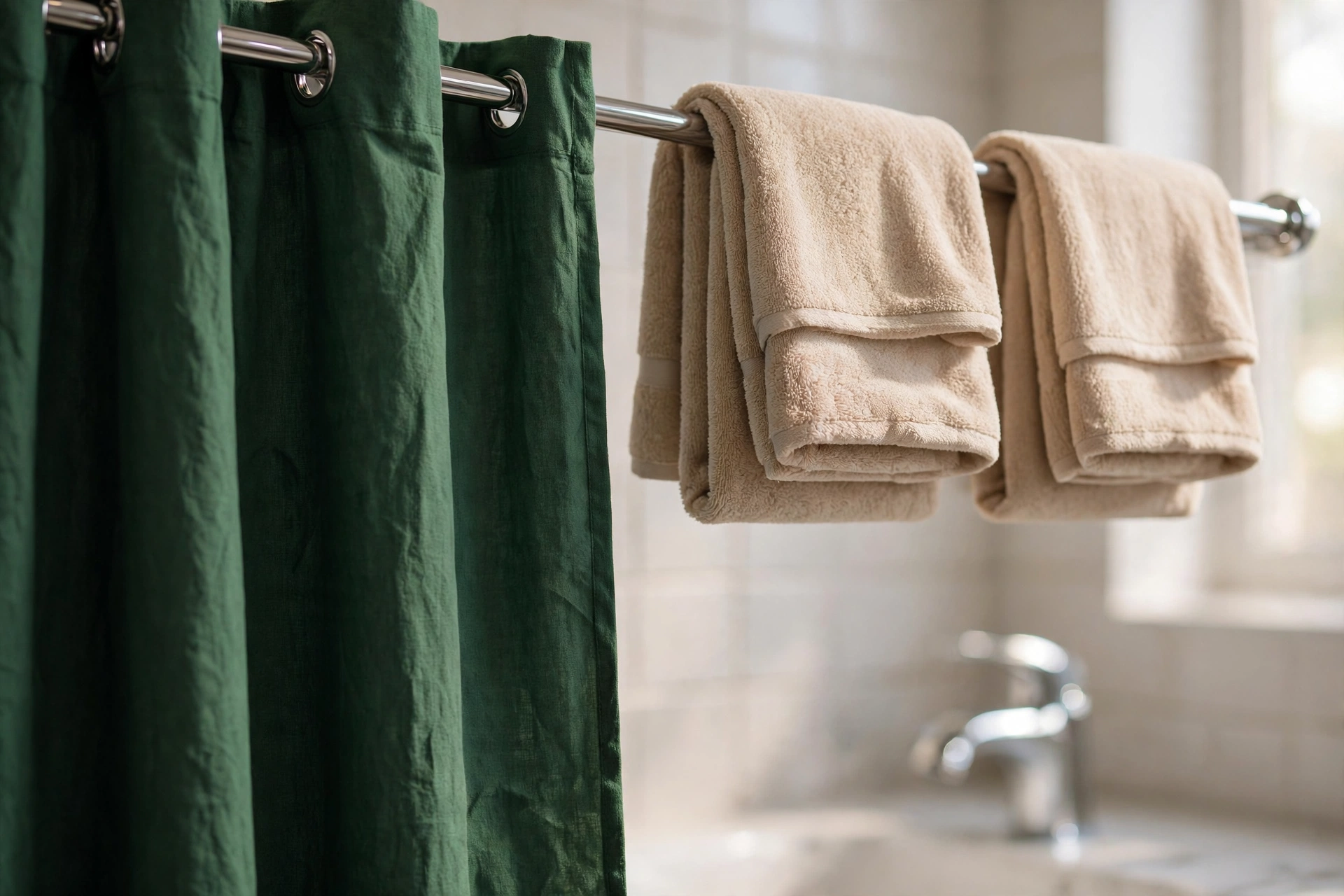
Shower curtain, solid color, $4.99 (IKEA). The backdrop change. A solid, considered color rather than a print, because the curtain’s job is to give the room one calm field that the towels and the fixed tile can both live with; prints date faster, fight more palettes, and shout in a small room. It hangs on the rings and rod already there, trims to length if needed, and comes down in a minute when you move.
Bath towels, two, $7.99 each, $15.98 total (IKEA). The second textile, bought as a coordinated pair in one color that answers the curtain: an echo if the curtain carries the color, a clean contrast if the curtain went quiet. Two, not one, because a single new towel next to its tired partner advertises the difference instead of the refresh, and not a whole new set, because the hand towel already owned joins the story if its color passes the audit in the next section.
The total is $20.97. The remaining $9.03 of the $30 stays unspent on purpose. It absorbs sales tax in any state and the ordinary drift between the day a price is checked and the day it is paid, and beyond that it is simply kept, because a third purchase at this level adds an object to a small room rather than impact to it. A makeover that ends with money returned to your pocket is not an unfinished makeover; at $30, it is the definition of one that was aimed properly.
How Do a Curtain and Towels Become One Refresh?
By reading the room’s fixed colors first and letting them choose the palette. A rental bathroom arrives with its colors already decided: the tile, the tub, the floor, the vanity, usually some combination of white, beige, grey, or a landlord-era pastel. Stand in the doorway and name them, because the curtain and towels must be chosen against that fixed cast, not against a photograph of someone else’s bathroom. Then pick one lead color for the textiles. If the fixed colors are quiet neutrals, the lead can be a real color, a deep green, a warm terracotta, a dusty blue, carried by the towels with the curtain in the same family or a shade quieter. If the fixed colors are already loud or odd, the lead goes the other way: curtain and towels both in warm white or soft beige, calming the room by refusing to compete.
The coherence is in the repetition. The lead color appears on the curtain and on the towels, which between them touch every sightline in the room, so the eye reads one decision instead of two purchases. The hand towel and bath mat already in the room are then audited against the story: anything that harmonizes stays, anything that fights is moved to another room, a cupboard, or cleaning duty, at $0, because in a room this small one clashing textile is a third of the visible fabric. Fold and hang with the same intention each time, towels squared on the rail, curtain pulled evenly to one side when the tub is dry, and the refresh holds its composition by habit rather than by hardware. Where the towels live between uses, and how they dry in a small room, is a system of its own; the towel storage method covers it, and this refresh simply hangs its pair where that system says.
What If the Basket Items Are Unavailable or Cost More Near You?
Substitute by job and keep the palette discipline, because at this budget the palette is the makeover and the objects are just its carriers. If the curtain is out of stock: any solid-color curtain from any big-box store does the same job; the specification is solid, calm, and the right lead color, not a brand. If you prefer a fabric curtain to a plastic one, that is a legitimate upgrade and the unspent remainder exists partly for it: spend some of the $9 on the better material rather than on a third object. If towels cost more where you shop: buy one bath towel and the matching hand towel in the same color instead of two bath towels; the story reads the same in the doorway, and the second bath towel can follow later without changing the plan. If your bathroom has a glass shower door and no curtain at all: the curtain’s share moves to the towels and a hand towel set in the lead color, and the free layer’s mirror and brightwork work carries more of the change; the logic survives because it was always textile-first, not curtain-first. Secondhand is the one route this plan does not take for towels: a towel’s useful softness is most of its life, used ones have spent it unpredictably, and at these entry prices the new pair is already the economy option. What never substitutes is the order: free layer, curtain, towels, stop.
What Should You Deliberately Not Buy on a $30 Budget?
Anything permanent, anything plumbed, and anything whose job is storage. Paint and peel-and-stick surfaces: paint risks the deposit and eats the budget in supplies alone; adhesive tiles and wraps can take the wall’s surface with them on removal, which converts a $30 makeover into a repair bill. Fixtures and hardware: faucets, showerheads, and towel rails are the landlord’s property and a plumber’s errand, and swapping them is neither reversible nor cheap. Accessory sets: the matched dispenser, cup, tray, and bin bundles are priced to consume exactly this kind of budget while changing nothing a doorway can see, and their pieces become counter clutter with a theme. Storage and organizers: shower caddies, over-door racks, under-sink systems, and counter containers solve real problems, but they belong to a different budget and a different set of guides; the room-system version lives in the bathroom with no storage plan, and spending refresh money there leaves the room organized and exactly as tired-looking. Scent and novelty: candles, diffusers, and themed decor change an evening and photograph as clutter by morning. The test at the shelf is unchanged: can you name this item’s job in the doorway view, in one sentence, without using the words storage or cute? At $30, almost nothing passes except textiles, which is the point.
How Do You Know the Refresh Worked, and That It Comes Out Clean?
By three tests, the third of which only a renter needs. The doorway test: from the door, the room should read as one palette, curtain calm, towels answering it, brightwork catching light, and nothing on the counter arguing. The mirror test: at the sink, in the morning, under the room’s own light, the space in the mirror’s background should look like a bathroom you would photograph rather than apologize for, because that reflected view is the one you actually live with. The reversibility audit: walk the room and touch every change you made. Curtain off its rings, towels into a box, borrowed items back to their rooms, and the bathroom stands exactly as the lease found it, in well under fifteen minutes, with no mark, hole, residue, or missing fixture. A renter makeover that cannot pass that audit was never a renter makeover, whatever it cost.
Give it a week of real use before judging the details. Keeping it costs nothing further: the cleaning rhythm from the free layer, repeated lightly, is the maintenance, the towels wash in rotation like any towels, and the curtain wipes down in the shower it hangs in. When the room tires again it will tire in the textiles first, and the same order will fix it: clean, curtain, towels, stop, with money left over.

Mike Maan writes practical home organization and small-space living guides for CozySorted. His work focuses on apartment-friendly storage, clutter-free routines, bedroom organization, and simple systems that help renters, apartment dwellers, and small-space homeowners create calmer, easier-to-maintain homes.