A rental kitchen holds its biggest surfaces hostage. The cabinets, counters, and backsplash belong to the landlord, and they are usually exactly the parts that date the room. What is left to you is everything the eye reads after those surfaces: the light, the textiles, the cleanliness of the lines, and the one or two objects allowed to stay out. Worked in that order, those leftovers are enough. This plan spends $46.97 of its $75 on four priced items, keeps the remaining $28.03 deliberately unspent, and touches nothing permanent: no paint, no adhesive sheets, no plumbing, no wiring, nothing your deposit would notice.
What Should You Do for Free Before Spending Anything?
Degrease the room, clear the counters to their working minimum, strip the fridge front, and launder every textile the kitchen already owns. A kitchen’s age is mostly a film: cooking grease settles on cabinet fronts, dulls the light, and makes white look tired. Removing it is the single largest visual change available at any budget, and it costs an hour.
Start with the cabinet fronts, working top to bottom with hot water and a small amount of dish soap on a cloth, rinsed and dried as you go. Pay double attention to the area around each handle, above the stove, and on the underside edges, where the film is thickest. Clean the range hood’s underside and wash its filter if it lifts out, polish the faucet and sink until they reflect, and wipe the fronts of the appliances. A clean kitchen reads as a newer kitchen before anything new enters it.
Then clear the counters down to what earns a permanent place: the machine you use daily, the knife block or board, and nothing else by default. Which items pass that test and which get stored is a whole discipline of its own, covered in the counter organization rules. For the refresh, borrow the result without rebuilding the system: every object that leaves the counter takes visual noise with it, and the styled moment later in this plan needs that empty stage.
Strip the fridge front completely: magnets, takeaway menus, old notes, the calendar from two years ago. A papered fridge is the loudest object in most rental kitchens, and clearing it costs nothing but the decision. Finally, wash the kitchen mat or runner you already own and re-lay it straight, and put every existing towel through a hot wash. If the refresh ended here, the room would already look deliberately kept.
Which Purchase Changes a Rental Kitchen the Most?
A battery-powered under-cabinet light bar, because rental kitchens are lit for the room and worked in shadow. One ceiling fitting washes the floor and the tops of your shoulders while the counters, where every task happens, sit in the shadow of the wall cabinets. A slim LED bar mounted under those cabinets puts warm light exactly on the work surface, and in the evening it changes the room’s whole register from overhead glare to pools of light. It is the closest thing to a renovation effect that installs with no wiring at all.
Choose the bar by three facts: it runs on batteries, so no electrician and no new circuit; it is warm white, matching the bulbs from the earlier refreshes, so the room’s light has one temperature; and it is long enough to cover the main prep run, roughly twenty inches in the demonstrated basket. A motion sensor is genuinely useful here: the light comes on as you approach the counter and switches itself off after you leave, which suits a battery tool.
Mount it the renter’s way, in this order. First choice: removable adhesive strips rated for the bar’s weight, applied to a degreased cabinet underside, because they come off clean at move-out. Screws, which many bars include fittings for, only if your lease plainly allows small holes. Never hardwire anything, never open a junction box, and if the only lighting improvement you can imagine needs an electrician, it is not a refresh item, it is renovation, and it is out.
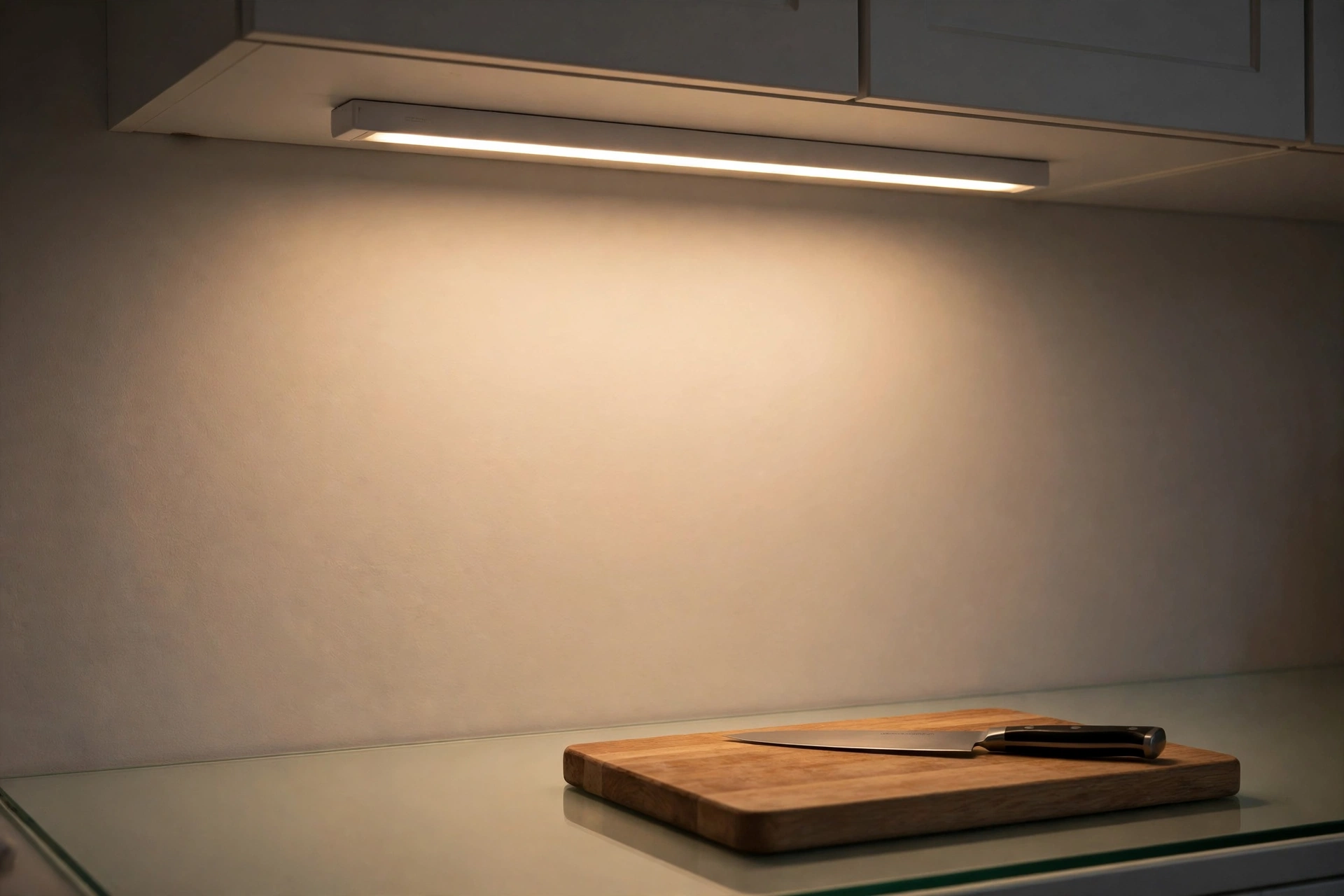
One honesty point, because it decides the basket: the batteries are sold separately. The bar in the demonstrated basket takes three rechargeable AA batteries, and their price is counted in the basket below rather than discovered at the checkout. Budget the light and its power as one purchase, always.
What Does the Demonstrated $75 Basket Actually Cost?
$46.97 in total, priced from live product pages checked on October 24, 2026, listed below with the store and the check date so you can re-verify every figure before you buy. The remaining $28.03 of the $75 is kept back on purpose.
- Battery LED light bar with sensor, warm white, about 20 inches: $20.00 (IKEA US, checked October 24, 2026).
- Rechargeable AA batteries, 4-pack: $11.99 (IKEA US, checked October 24, 2026). The bar takes three; the fourth is the charged spare, so the light never waits on a charging cycle.
- Cotton dish towels, patterned, 4-pack: $4.99 (IKEA US, checked October 24, 2026).
- Small faux potted plant, about 3.5 inches: $9.99 (IKEA US, checked October 24, 2026).
Total: $46.97. The kept-back $28.03 absorbs sales tax and ordinary price movement on this basket, and anything left after that is simply not spent. A $75 ceiling is permission, not a target: the refresh works because the light is right and the room is clean, not because the total crept close to the number. Prices move and stock varies by store and date, which is exactly why each line names where and when it was checked.
How Do Light, Textiles, and One Green Thing Become One Refresh?
By giving each one a single job and a shared temperature. The bar owns the work surface. The towels own the pattern. The plant owns the life. Nothing else is bought, and the counters stay clear enough for all three to read.
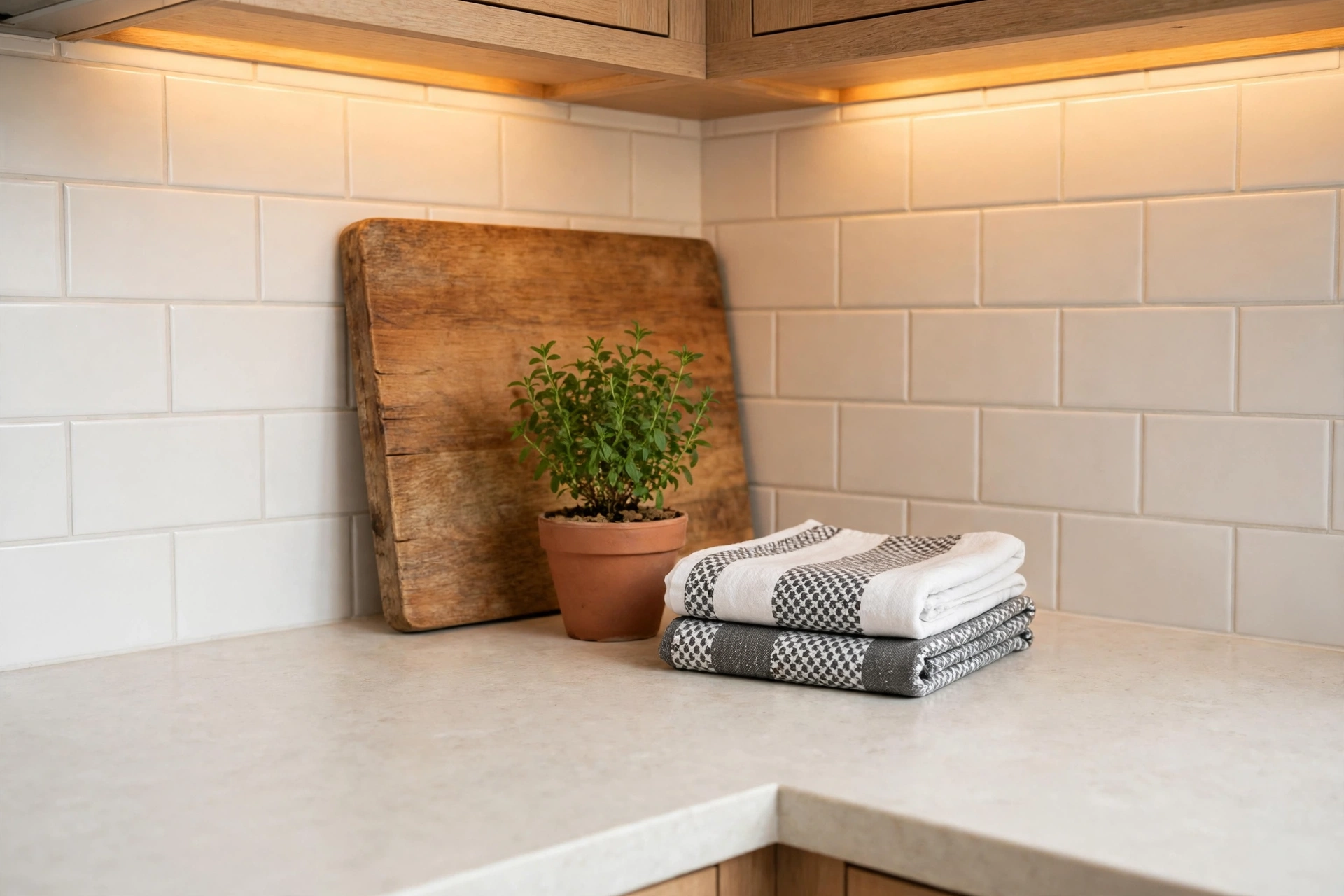
Hang the new towels where towels actually live, on the oven handle and a hook by the sink, folded to show the pattern, and retire the stalest old towel to cleaning duty. Towels are the kitchen’s cheapest large-pattern surface, and a fresh coordinated set against degreased cabinets reads as intentional in a way that scattered, faded towels never do. Choose one pattern family and stop; two competing patterns in a small kitchen is noise, not layering.
Place the plant at the sink’s end of the counter or on the windowsill, the one green note in the room, next to the light’s warm pool. A small faux plant earns its place in a kitchen specifically: the sill above a sink is hot, steamy, and splashy, and the plant asks for nothing through any of it. Group it with the one wooden board you already own, propped behind it, and that corner is the room’s single styled moment. Everything else stays away, per the free layer’s clearing. Restraint is what separates a refresh from a shopping trip: visitors should notice the light and the calm, not count new objects.
What If a Basket Item Is Unavailable or Costs More Near You?
Substitute by job, protect the light and its batteries, and cut the plant first if the total creeps. The jobs, in the order the budget protects them: light on the work surface, power for the light, fresh pattern on the towels, one green note. Any item that does the same job is a fair substitute.
If the exact bar is out of stock, another battery LED bar of a similar length and warm temperature does the job, including plug-in strips where an existing outlet sits right at the counter, since plugging into a socket you already have is not electrical work. If towels in the demonstrated pattern are gone, any cotton four-pack in one pattern family works; the discipline is the single family, not the specific print. If the faux plant is unavailable, a real herb in a pot from your grocery trip does the same job with more charm and more upkeep, or a cutting from a plant you own, in a glass of water, does it for free.
If local prices run higher than the register, spend the headroom first, then cut in this order: the plant, then nothing else. Never cut the batteries to afford the bar; a light you cannot power is not a saving. If the total still cannot stay honest under $75 where you live, run the free layer and the light alone and call that the refresh. It carries most of the effect anyway.
What Should You Deliberately Not Buy or Attempt on This Budget?
Anything adhesive, anything plumbed, anything wired, and anything that belongs to the landlord’s surfaces, because the no-renovation line is the whole point of this refresh and most deposit losses hide exactly there. The tempting items fail in predictable ways:
- Peel-and-stick backsplash panels and tile sheets. They market themselves as renter-friendly, but adhesive on a landlord’s wall is a removal gamble, and heat and steam behind a stove lift edges within months. Your deposit is not worth the gamble for a pattern.
- Contact paper on counters. It traps water at seams, scorches near burners, and can lift the counter’s surface finish on removal, turning a $10 idea into a damage claim.
- Paint, on cabinets, walls, or anything else. It is the landlord’s finish, and an unapproved color is a repainting bill.
- New cabinet hardware. The knobs are the landlord’s, hole patterns vary, and a run of cabinets takes a dozen or more; a partial swap looks worse than the original set.
- A replacement faucet or anything that touches plumbing. One slow leak under a sink costs more than this entire budget, several times over.
- Storage products dressed as decor: canister sets, racks, shelf risers, organizer systems. Storage is a different problem with its own discipline, covered in the small kitchen organization system, and spending the refresh budget on it buys a tidier cabinet behind the same tired room.
The test for anything not on the basket: does it touch a surface the landlord owns, need a tool beyond a cloth and adhesive strips, or fail to reverse in minutes? Any yes puts it outside this refresh, whatever the marketing says.
How Do You Know the Refresh Worked, and That Everything Reverses?
Run the evening test, the doorway test, and the reversibility audit. Cook one ordinary dinner under the new light: the counter should be lit where your hands work, with no shadow of your own body across the board, and the room should feel warmer with the ceiling light off than it did before with it on. If you are still squinting at the prep counter, the bar is in the wrong place, and moving it costs nothing but a fresh set of strips.
From the doorway, the room should read in the right order: clean cabinet lines, a lit work surface, one pattern on the towels, one green note, and clear counters. Take the phone photo from the door; small kitchens photograph honestly, and anything that jumps out as clutter in the photo was invisible to your familiarity, not absent.
Then audit the exit, because a rental refresh is only finished when it can be undone. The towels and plant simply leave with you. The bar unclips or peels away on its strips, which come off by their pull tabs. Nothing was painted, glued to a wall, plumbed, or wired. Walk the room once and confirm it could be returned to exactly its leased state in well under fifteen minutes, because that, as much as the $46.97, is what no renovation means. For the same receipt-based approach in the bathroom, see the rental bathroom makeover under $30.

Mike Maan writes practical home organization and small-space living guides for CozySorted. His work focuses on apartment-friendly storage, clutter-free routines, bedroom organization, and simple systems that help renters, apartment dwellers, and small-space homeowners create calmer, easier-to-maintain homes.