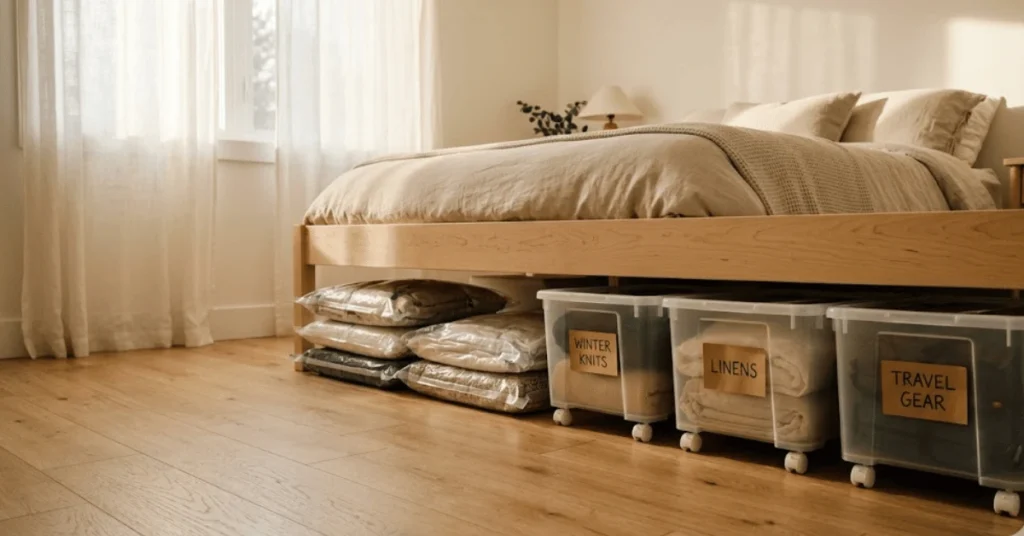
Renters lose an average of $126 from security deposits due to wall damage alone. [site: American Apartment Owners Association survey] Most of that damage comes from storage attempts gone wrong.
Renter-friendly bedroom organization means building a functional storage system using only reversible, non-invasive methods. That includes adhesive strips, tension rods, freestanding units, and under-bed containers. No drilling. No permanent changes. No lease violations.
This guide covers six core solution categories: vertical storage without anchors, adhesive-based systems, under-bed storage, multi-functional furniture, closet organization hacks, and deposit protection. Each section addresses a real constraint renters face, not just a style preference.
You are not a generic organizer. You are a renter working within a lease, a fixed floor plan, and a damage-free storage requirement. Every solution here respects those constraints.
What makes small bedroom organization different for renters?
Small bedroom organization for renters is different because the solutions must be fully reversible, landlord-safe, and leave zero wall damage at move-out.
A standard homeowner installs shelves, mounts brackets, and drills freely. You cannot. Renter-specific storage constraints include lease clauses, deposit risk, and uncertainty about what your wall type can handle. These three factors eliminate most conventional storage advice immediately.
The three core problems renters face are lease restrictions that prohibit wall modification, financial exposure through security deposit deductions, and wall surface variability that makes adhesive performance unpredictable. Every solution in this guide is fully reversible and landlord-safe. For a broader look at how the declutter-organize-decorate framework applies across every room in a rental, the complete home organization guide for small spaces covers the full system from audit to daily maintenance.
What restrictions do most rental leases place on wall modifications?
Most rental leases restrict wall modifications by explicitly prohibiting drilling, nailing, and the use of adhesives that damage paint or surfaces.
Common lease clauses include:
- No drilling or nailing into walls, ceilings, or floors without written landlord consent
- No use of adhesives that leave
residue, including mounting tape rated above a specified weight - No installation of shelving brackets, curtain rods, or wall anchors of any kind
- No modifications to existing closet rods, door hardware, or built-in fixtures
- No painting, patching, or altering wall surfaces without prior approval
- Restoration clauses requiring the unit to be returned in
move-in condition
Leases vary. Some explicitly allow small nails under 1.5 mm diameter for hanging artwork. Read yours before assuming anything is permitted. [site: Nolo.com tenant rights resource]
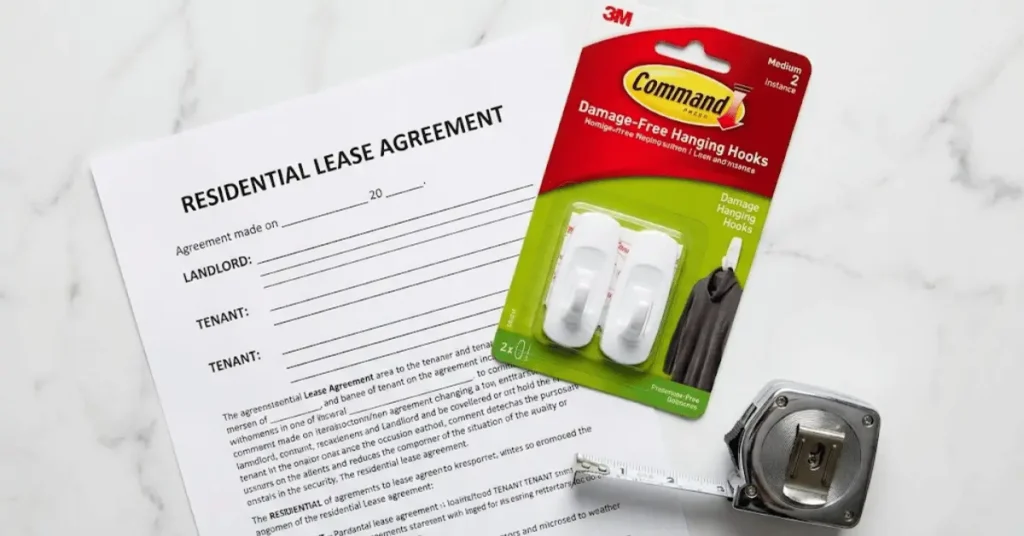
How does security deposit risk affect storage choices in a rental bedroom?
Security deposit deductions for wall damage range from $50 for minor paint scuffs to over $300 for anchor holes requiring professional repair. [site: National Apartment Association landlord survey]
That financial exposure turns every storage decision into a deposit protection decision. A single shelf bracket installed without approval can cost more than the shelf itself to fix. Landlords apply deductions based on repair cost, not your intent.
The average security deposit in the U.S. sits at 1 to 2 months’ rent. Protecting it means treating every storage choice as a financial strategy, not just a convenience decision.
What types of walls are common in rental units and why does that matter?
Common rental wall types and their effect on storage solutions are listed below.
- Drywall, the most common type in post-1950s buildings, accepts Command strips well but fails with heavy loads above 5 lbs per strip
- Plaster, found in pre-1960s units, is harder and denser, reducing adhesive bond strength by up to 30% compared to drywall [site: 3M product testing data]
- Concrete or cinder block, typical in basement units and older urban buildings, requires specific nano-suction or clip-based adhesives, not standard foam tape
- Brick, common in industrial conversions, has a textured surface that reduces adhesive contact area and lowers hold strength significantly
Knowing your wall type before buying any adhesive storage product prevents failed installs and accidental damage.
How do you assess a small bedroom before choosing any storage solution?
Assessing a small bedroom before choosing storage involves a three-step audit: layout mapping, precise measurement, and clutter diagnosis.
Skipping this step leads to buying shelves that do not fit, bins that block doors, and systems that solve the wrong problem. A bedroom storage audit takes less than 20 minutes and prevents expensive mistakes. Most renters skip it and regret it.
Start with layout, then measure every relevant dimension, then identify whether your core problem is excess clutter, insufficient surface area, or poor room flow. Each problem has a different solution.
How does bedroom layout shape which no-damage storage options work best?
Standard rectangular bedrooms work best with tall freestanding shelving units placed along the longest unbroken wall, maximizing vertical space without consuming floor area.
L-shaped rooms benefit from modular cube systems placed at the inner corner, turning dead space into functional storage. Studio corner layouts often have one dominant wall that accommodates a freestanding wardrobe or garment rack without blocking natural light. Narrow, awkward bedrooms require rolling carts and slim vertical freestanding units that slide between existing furniture rather than anchoring to walls.
Match your layout type to the right system before buying anything.
What measurements do renters need before buying freestanding or modular storage?
Key measurements to take before buying bedroom storage are listed below.
- Floor-to-ceiling height, measured in at least two spots since older rentals often have uneven ceilings that affect tension-pole compatibility
- Wall width on each usable surface, measured from corner to corner to confirm shelf or wardrobe fit
- Door swing radius, the full arc a door travels when opened, to prevent storage from blocking access
- Bed clearance on all three open sides, typically needing a minimum of 24 inches for comfortable movement
- Window sill height and width, especially relevant for low-profile storage placed beneath windows
Bring a tape measure. Write the numbers down. Do not estimate.
How do you identify whether your bedroom problem is clutter, lack of surface area, or poor flow?
The three bedroom problem types each look different in practice and each require a different storage approach.
Clutter looks like surfaces covered with objects that have no designated home. A lack of surface area looks like tidy but overfilled drawers and closets with no room to expand. Poor flow looks like a room where moving from the door to the bed to the closet requires navigating around furniture.
Ask yourself three questions to identify your actual problem:
- Do I have empty storage that I still do not use? If yes, the problem is clutter, not space.
- Do I run out of room even after tidying? If yes, the problem is insufficient storage capacity.
- Do I avoid using parts of my room because they feel inaccessible? If yes, the problem is poor flow.
Each answer maps to a different solution category covered below.
How does vertical storage work in a small bedroom without drilling?
Vertical storage in a small bedroom without drilling works by redirecting storage upward, using floor-to-ceiling height instead of wall surface area.
Most small bedrooms waste the top 3 to 5 feet of wall height. Freestanding vertical shelving and tension-pole systems capture that space without anchors, screws, or adhesives. This approach maximizes space without leaving any trace at move-out.
Four vertical storage methods work reliably for renters: freestanding shelf units, leaning ladder shelves, tension-pole systems, and modular cube stacks. Each suits a different layout and budget.
What freestanding shelving units are most stable on rental flooring?
Most stable freestanding shelving units for rental bedrooms are listed below.
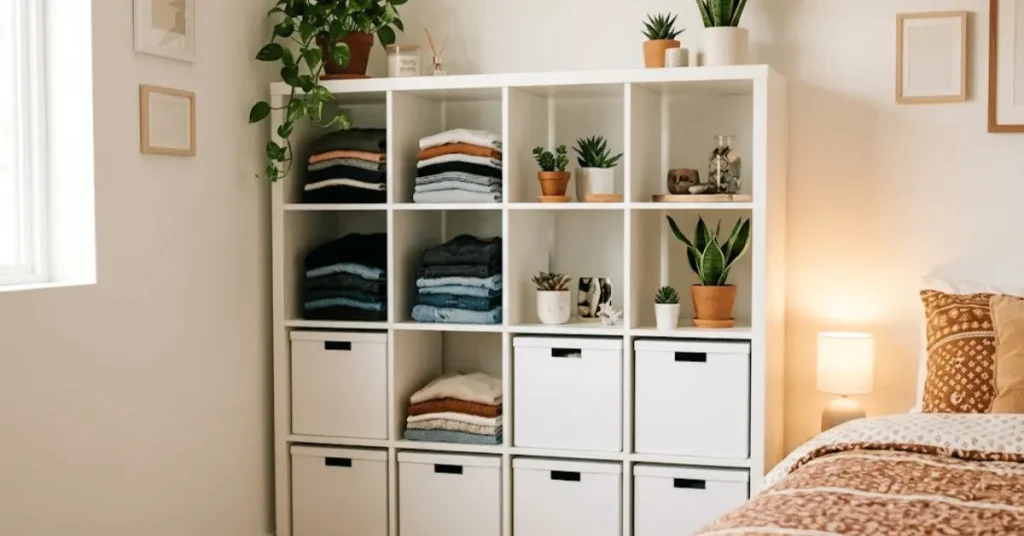
- IKEA KALLAX (77 x 77 cm or 147 x 77 cm), a cube-based unit with a low center of gravity, wide base footprint, and optional anti-tip hardware included in the box
- IKEA IVAR, a pine freestanding system with adjustable shelf heights and a narrow 30 cm depth, suitable for tight layouts without consuming floor space
- Amazon Basics 5-Shelf Adjustable Storage, a steel wire unit with rubber non-slip feet, rated to 350 lbs total capacity across shelves and compatible with most laminate and hardwood rental flooring
- ClosetMaid 3-Tier Stackable Organizer, a modular cube system stackable to four tiers, with a base width of 43 cm providing enough stability without anchoring
- Mainstays 5-Shelf Bookcase, a budget option with a wide base and pre-drilled knock-down assembly, available at Walmart for under $40
Prioritize units with a base width at least 40% of total height. Taller units with narrow bases tip at lower weights.
How do leaning ladder shelves perform in a small bedroom with limited floor space?
Leaning ladder shelves lean against a wall at an angle between 70 and 80 degrees, relying on gravity and friction rather than wall anchors to stay in place.
The floor footprint of a standard ladder shelf ranges from 35 to 50 cm deep, which is significantly less than most freestanding bookcase systems. Rubber feet or felt pads prevent sliding on hardwood and tile floors common in rental units, and protect the flooring surface from scratches. The vertical capacity typically spans 5 to 6 shelf tiers within a 150 to 180 cm height range.
The trade-off is weight limit. Most ladder shelves hold 15 to 25 lbs per shelf. They suit display items and lightweight bins, not books or heavy containers.
What is the difference between tension-pole shelving and freestanding shelving for renters?
The difference between tension-pole shelving and freestanding shelving for renters is installation method: tension-pole systems press between floor and ceiling using spring or screw pressure, while freestanding units rest entirely on the floor.
Tension-pole shelves require a ceiling height of at least 220 cm and perform poorly on popcorn or drop-tile ceilings. They hold 20 to 40 lbs per shelf on average and consume almost no floor footprint. Freestanding units hold more weight per shelf, typically 50 to 100 lbs, and are compatible with any ceiling type.
Cost also differs. Tension-pole systems range from $60 to $180. Quality freestanding units range from $40 to $250.
How do floor-to-ceiling tension shelves get installed without wall anchors?
Steps to install floor-to-ceiling tension shelves without wall anchors are listed below.
- Measure floor-to-ceiling height precisely at the installation spot, accounting for any baseboard height that reduces the usable span
- Select a tension-pole shelf system rated for your ceiling height range, typically sold in 200 to 270 cm adjustable spans
- Assemble the shelf unit horizontally on the floor according to the manufacturer’s instructions before raising it
- Stand the unit upright and position it at the target wall location with at least 5 cm of clearance from the wall surface
- Extend the tension pole or top cap using the adjustment mechanism until it contacts the ceiling firmly
- Tighten the locking collar or screw mechanism to maintain constant pressure, then test stability by pushing gently at the midpoint
Popcorn and drop-tile ceilings reduce grip. Add a rubber ceiling cap or felt pad to increase friction and distribute pressure evenly.
How do adhesive storage products hold in a rental bedroom?
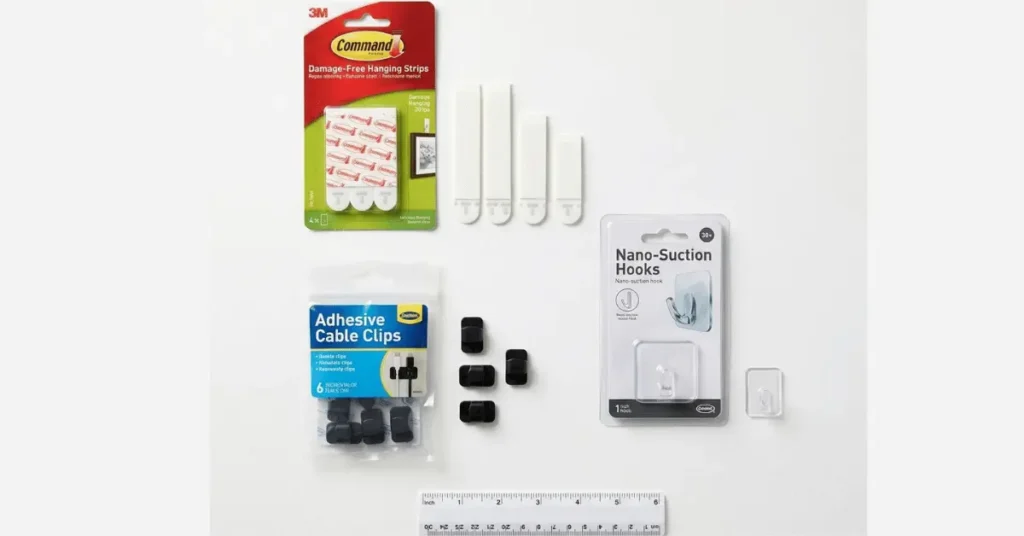
Adhesive storage products hold in a rental bedroom by using VHB (Very High Bond) foam tape, nano-suction, or hook-and-loop systems that grip painted surfaces without penetrating them.
VHB foam adhesive, the technology behind Command strips, creates a bond through surface contact area and foam compression, not chemical etching. This makes removal possible without paint damage when done correctly. Nano-suction uses micro-suction cups that grip smooth surfaces and release cleanly. Hook-and-loop systems like Velcro Removable use low-tack adhesive layers paired with fabric fasteners.
Each adhesive mechanism has a weight ceiling and a surface compatibility profile. Matching product to wall type determines whether the system holds or fails.
How much weight do Command strips hold on drywall vs plaster vs tile?
Command strip weight limits by wall surface are listed below.
| Surface Type | Strip Type | Weight Capacity | Notes |
| Painted drywall | Large picture-hanging strip (pair) | Up to 16 lbs | Works best on smooth, fully cured paint |
| Painted drywall | Standard medium hook strip | Up to 5 lbs | Reduce load by 20% in humid rooms |
| Plaster | Large picture-hanging strip (pair) | Up to 10 lbs | Bond reduced by surface porosity [site: 3M Command product specs] |
| Tile (glazed) | Large strip (pair) | Up to 16 lbs | Requires 100% clean, dry, grease-free surface |
| Concrete block | Standard hook strip | Up to 2 lbs | Textured surface reduces contact area significantly |
Weight ratings assume correct application: 30-second press, 1-hour cure before loading, and surface cleaned with isopropyl alcohol first.
Which adhesive hook brands offer the strongest hold with the cleanest removal?
Top adhesive hook brands for rental bedrooms ranked by hold strength and clean removal are listed below.
- Command (3M), the market standard for renter-safe adhesive hooks, holds up to 7.5 lbs per single hook on drywall, removes cleanly by pulling the tab slowly at a 45-degree angle, and costs $4 to $12 per pack
- Gorilla Mounting Tape, a double-sided VHB tape rather than a hook system, holds up to 30 lbs per square foot on smooth surfaces but carries more residue risk and is harder to remove without damage
- Scotch Removable Mounting Strips, a lighter-duty option rated to 4 lbs per strip pair, with a lower adhesion profile that suits lightweight items and reduces paint damage risk on older rental walls
- Velcro Removable Mounting Strips, a hook-and-loop system rated to 1 lb per strip, ideal for fabric organizers, lightweight frames, and cable management solutions where repositioning is needed
Command remains the safest choice for renters prioritizing clean removal over maximum hold weight.
How do you remove adhesive strips from rental walls without damaging paint?
Steps to remove adhesive strips from rental walls without damaging paint are listed below.
- Wait until room temperature is between 18 and 27 degrees Celsius (65 to 80 degrees Fahrenheit), as cold walls make adhesive brittle and increase paint pull risk
- Remove any object hanging on the hook or strip before pulling the tab
- Grasp the pull tab at the base and stretch it slowly downward at a 45-degree angle, parallel to the wall surface, not outward
- Pull the tab in one continuous slow motion without stopping, maintaining consistent tension for 30 to 60 seconds
- If any adhesive residue remains, apply a small amount of Goo Gone to a microfiber cloth and rub gently in circular motions
- Allow the wall to dry fully before inspecting for paint damage or discoloration
If paint lifts during removal, a touch-up paint pen matched to your wall color fixes minor spots before the move-out inspection.
What items should renters avoid hanging with adhesive hooks?
Items renters should avoid hanging with adhesive hooks are listed below.
- Heavy coats, bags, or backpacks exceeding 5 lbs total load on a single hook, even if the strip is rated higher
- Cast iron cookware, metal tools, or any item with concentrated weight at a single hanging point
- Items stored in areas with consistent humidity above 60%, such as hooks placed near windows or exterior walls in humid climates
- Towel bars or rails bearing wet towels daily, as moisture cycling weakens adhesive bond over time
- Shelving units or platforms carrying books, electronics, or stacked items where load shifts unpredictably
- Any item the renter cannot afford to replace if the hook fails and the item falls
Adhesive storage methods work best for lightweight, consistent loads in stable temperature and humidity environments.
How does under-bed space become usable storage in a small rental bedroom?
Under-bed space becomes usable storage in a small rental bedroom by adding bed risers to increase clearance and using low-profile containers that slide in without modifying the bed frame.
Under-bed storage requires no drilling, no wall contact, and no permanent alteration, making it one of the most deposit-safe options available. The average queen bed has approximately 9 to 12 inches of clearance at standard frame height, which accommodates flat bins, vacuum bags, and some rolling drawer systems.
Three product types maximize under-bed capacity: bed risers for height adjustment, rolling drawers for accessibility, and vacuum compression bags for seasonal items, with specific product picks for frames under 7 inches and raised platforms alike.
What bed riser height gives renters the most useful clearance for storage bins?
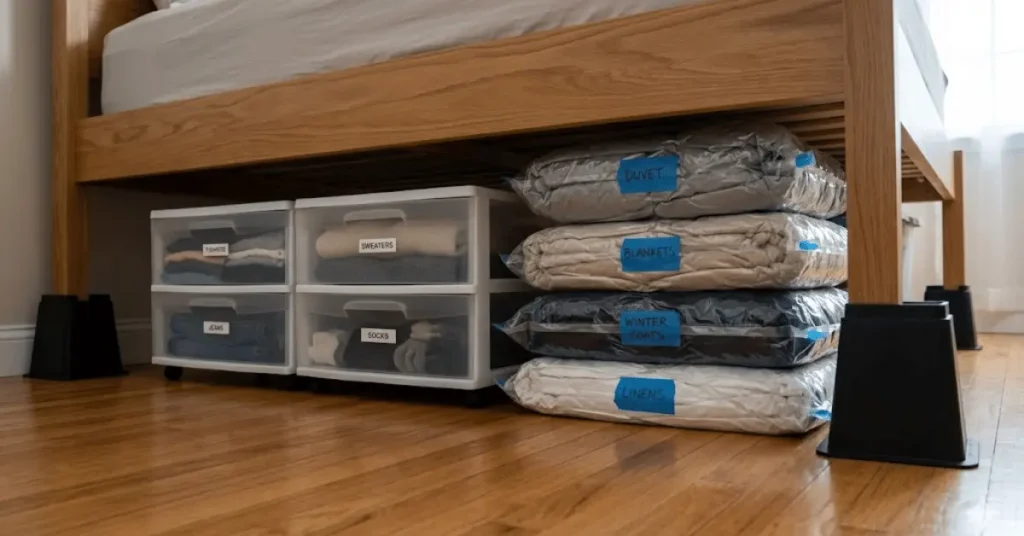
Bed risers come in three standard height ranges: 3-inch, 6-inch, and 8-inch, each accommodating different bin sizes and use cases.
6-inch risers deliver the most versatile clearance, raising total under-bed height to roughly 15 to 18 inches on a standard platform frame, which fits most rolling drawer units and lidded bins up to 12 inches tall. Three-inch risers add minimal clearance and work only for flat vacuum bags or thin slide-in trays. Eight-inch risers create maximum under-bed space but raise bed height enough to affect accessibility for shorter users and children.
Standard plastic bed risers hold 1,200 to 2,000 lbs per set of four. Steel-reinforced risers hold up to 4,000 lbs. Check the riser weight rating, not just the bin size.
How do rolling drawers, flat vacuum bags, and stackable bins compare for under-bed use?
Rolling drawers, flat vacuum bags, and stackable bins differ for under-bed use in that each serves a different item type, access frequency, and available clearance height.
- Rolling under-bed drawers (typically 6 to 8 inches tall), the best option for frequently accessed items like extra bedding or off-season shoes, include wheels or sliders for full drawer extension without moving the bed
- Flat vacuum storage bags, ideal for bulky seasonal clothing like down jackets and winter sweaters, compress items to 50 to 70% of original volume [site: Space Bag product specs], but require a vacuum for reuse and 30 to 60 minutes to repack
- Stackable rigid bins with lids (4 to 6 inches tall), suited for books, documents, or shoes in original boxes, stack two units deep under most raised frames and protect contents from dust
Accessibility drives the choice. Daily-use items go in rolling drawers. Annual items go in vacuum bags. Archived items go in stacked bins. For a full clearance-height comparison chart and the specific container dimensions that fit each frame type.
How do you organize under-bed storage so items stay accessible and visible?
Steps to organize under-bed storage for accessibility are listed below.
- Sort items into three categories before buying any containers: frequent access (weekly or more), occasional access (monthly), and seasonal archive (twice yearly or less)
- Assign each category to the correct container type based on access frequency, placing frequent-access items in rolling drawers positioned at the foot or side of the bed
- Label every container on its short end, visible from the side of the bed when the container is partially extended
- Zone the under-bed space into left and right halves, dedicating each half to a different item category to prevent mixing
- Rotate seasonal items at the start of each season by swapping vacuum bags from under-bed storage to the top shelf of a wardrobe or closet
Photograph the contents of every sealed bin when you close it. That photograph eliminates the need to open and search every container when looking for a specific item.
How do tension rods expand storage in a small renter’s bedroom?
Tension rods expand storage in a small renter’s bedroom by using spring pressure to wedge between two surfaces, creating hanging or dividing structures without screws, adhesives, or wall contact.
Tension rod hacks require no tools, install in under two minutes, and remove completely without leaving any trace. The mechanism works on any two parallel surfaces within the rod’s adjustable length range. That includes closet openings, drawer interiors, cabinet frames, and window recesses.
Three applications deliver the highest return in a small bedroom: doubling closet hanging space, creating drawer dividers, and building modular storage zones between furniture pieces.
How do tension rods create extra hanging space inside a closet without screws?
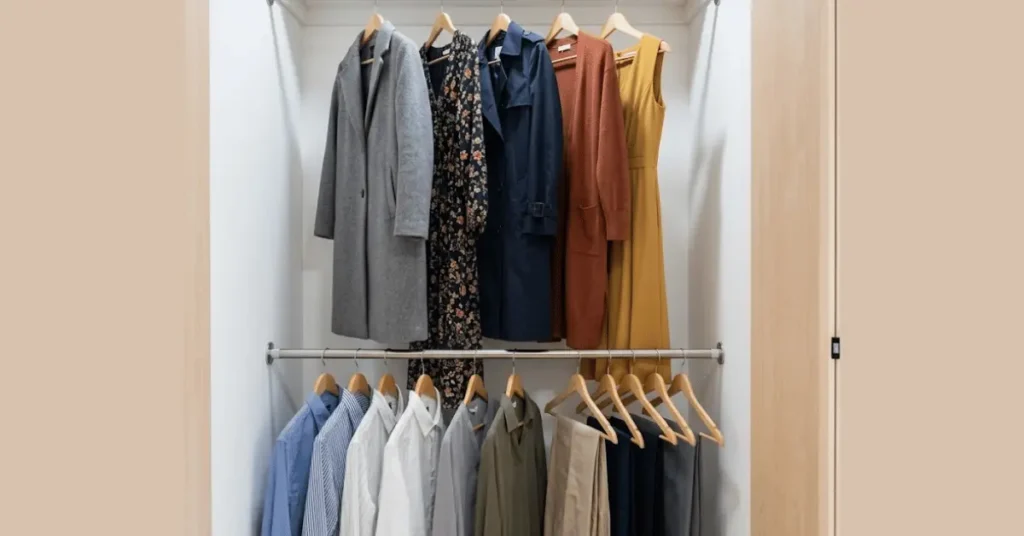
Steps to add tension rod hanging space inside a closet without screws are listed below.
- Measure the interior width of the closet at the target height, typically 30 to 45 cm below the existing closet rod
- Select a tension rod rated for at least 15 lbs and long enough to span the full closet width plus 2 to 5 cm for secure pressure
- Adjust the rod to approximately 3 cm longer than the measured width before installation to ensure sufficient tension pressure
- Press the rod ends against both side walls simultaneously and release, allowing spring tension to hold the rod horizontally
- Hang shorter garments such as folded trousers, jackets, or shirts on the new lower rod using standard hangers
A double-hang closet rod system created this way effectively doubles hanging capacity for garments under 90 cm in length. Standard tension rods hold 10 to 20 lbs at closet widths up to 120 cm.
How do renters use tension rods as drawer dividers for any drawer depth?
Measure the interior width of the drawer, select a tension rod that spans that width, and install it horizontally to create separate compartments within the drawer.
This method works in any drawer regardless of depth, material, or drawer design because it requires only two parallel inner walls. Items best organized by tension rod dividers include:
- Socks, underwear, and folded t-shirts separated into distinct zones
- Kitchen utensils or bathroom toiletries grouped by frequency of use
- Office supplies separated by category in a desk drawer
- Charging cables contained in a single zone to prevent tangling
The rod adjusts to any drawer width from 20 to 90 cm depending on the product selected. No adhesive, no tools, no drawer modification required.
What weight capacity and diameter should renters look for when selecting tension rods?
Key specs to check when buying a tension rod for bedroom storage are listed below.
- Load rating: light-duty rods handle 5 to 15 lbs, suited for lightweight clothing and small accessories; heavy-duty rods rated at 25 to 50 lbs support folded denim, jackets, and heavier bins
- Diameter: 19 mm (3/4 inch) rods provide sufficient rigidity for spans up to 90 cm; 25 mm (1 inch) diameter rods are required for spans above 90 cm to prevent bowing under load
- End caps: rubber or silicone end caps prevent wall and surface marking; metal end caps scratch painted surfaces and should be avoided in rental units
- Adjustable range: select a rod whose maximum length is at least 5 cm above your measured span to maintain consistent tension pressure over time
Spring-loaded rods lose tension faster than twist-to-tighten screw-collar designs. For closet use, screw-collar tension rods last significantly longer under daily garment load.
How does a small bedroom closet get organized without permanent fixtures?
A small bedroom closet gets organized without permanent fixtures by layering no-drill solutions: doubler bars that hook onto existing rods, stackable shelf expanders that sit on existing shelves, and modular organizers that stand on the closet floor.
Closet organization hacks for renters work around what is already installed rather than replacing it. A standard rental closet has one rod and one shelf. That configuration wastes 60 to 70% of available vertical space. Four approaches address different closet types: the standard single-rod setup, shallow closets, wide reach-in layouts, and the no-closet situation entirely. If you’re also working around the absence of a dresser, the guide to organizing a small closet without a dresser covers how to replicate drawer function using shelf zones, fabric inserts, and floor zone shoe systems — all without any permanent hardware.
How do no-drill double hang rods double usable closet hanging space?
Closet doubler bars hook directly onto an existing closet rod using built-in metal clips, adding a second hanging level below without screws or wall contact.
The system works by suspending a second rod from the original, typically positioning it 45 to 60 cm lower. This lower position accommodates folded trousers, shirts, jackets, and blazers under 90 cm in length. Closet doubler bars from brands like Whitmor, Zober, and Simple Houseware hold 20 to 35 lbs and install in under 60 seconds. They are fully removable and leave no marks on the original rod.
Products to consider:
- Whitmor Double Rod Closet Organizer: rated 35 lbs, adjustable width 63 to 107 cm, $18 to $25
- Simple Houseware Hanging Closet Organizer Rod: rated 20 lbs, steel construction, $12 to $18
- Zober Closet Doubler: rated 30 lbs, non-slip chrome finish, $15 to $22
What shelf expanders and stackable dividers work in shallow rental closets?
Best shelf expanders and stackable dividers for shallow rental closets are listed below.
- Lynk Professional Slide Out Shelf (30 cm depth), a pull-out unit that rests on existing closet shelving and extends outward for access to items pushed to the back
- Sorbus Stackable Closet Organizer (35 cm wide), a four-tier stackable unit that fits inside shallow closet shelves and organizes folded items vertically rather than in flat piles
- mDesign Stackable Shelf Divider (fits shelves up to 4 cm thick), clips onto existing shelf edges without adhesive to separate sweater stacks and prevent collapsing piles
- SimpleHouseware Crystal Clear Stackable Shoe Box (30 x 18 x 11 cm), stackable up to 5 units high and compatible with closets as shallow as 32 cm
Shallow closets under 35 cm deep benefit most from pull-out accessories and vertical stackers rather than depth-based bin systems.
How do renters handle bedroom organization when there is no built-in closet?
Renters handle bedroom organization with no built-in closet by choosing one of three freestanding systems: a freestanding wardrobe, a garment rack, or a modular cube unit with a hanging rod insert.
A freestanding wardrobe, such as the IKEA PAX or a Songmics fabric wardrobe, provides enclosed storage for both hanging garments and folded items in one unit. Garment racks, including freestanding options from Honey-Can-Do or AmazonBasics, offer open hanging storage and suit renters who prefer visible, accessible wardrobes. Modular cube systems with hanging rod inserts, such as the IKEA KALLAX with hanging rail accessory, combine shelf storage and hanging capacity in a customizable layout.
The wardrobe suits a longer lease. The rack suits a shorter stay. The cube system suits renters who need storage to adapt to different item categories over time.
How do freestanding wardrobes and garment racks fit into a small bedroom without overwhelming it?
Freestanding wardrobes and garment racks fit a small bedroom best when placed against the longest unbroken wall, minimizing intrusion into floor space and visual weight.
An enclosed wardrobe, while visually bulky, creates a clean wall-like surface on its exterior that reads as structure rather than clutter. Open garment racks expose every item and require consistent visual organization to avoid making the room feel chaotic. Placement against a corner at a slight inward angle reduces visual dominance in rooms where the wardrobe would otherwise face the entry point directly.
For rooms under 10 square meters, an open rack with uniform hangers and a neutral fabric cover creates far less visual weight than an enclosed wardrobe of the same storage volume.
How does multi-functional furniture solve storage problems in a small renter’s bedroom?
Multi-functional furniture solves small bedroom storage problems for renters by ensuring every piece of furniture performs at least two jobs simultaneously, reducing the total number of items in the room.
Multi-purpose furniture is the most space-efficient investment available to renters because it eliminates redundancy. A storage ottoman replaces both a bench and a storage box. A bed with built-in drawers replaces both a bed frame and a dresser. Each dual-function piece reclaims floor space that would otherwise hold a second standalone item.
Four furniture types deliver the highest multi-function return: storage beds, nightstand alternatives, foot-of-bed storage units, and desk-and-vanity combinations.
How do storage beds, ottoman beds, and bed frames with drawers compare for renters?
Storage beds, ottoman beds, and bed frames with drawers compare for renters in that each offers a different storage capacity, access method, and assembly commitment.
- Storage beds with under-frame drawers, such as the IKEA BRIMNES or Zinus platform bed with drawers, provide 2 to 4 pull-out drawers holding 40 to 80 lbs each, require no permanent installation, and suit renters planning to stay 12 or more months
- Ottoman beds with a gas-lift mechanism, such as divan-style Ottoman beds from Happy Beds, lift the entire mattress platform to reveal a full under-bed cavity holding up to 500 liters of storage, ideal for bulky seasonal items but require 60 to 90 minutes to assemble
- Open-platform bed frames with no drawers or lift mechanism, the most portable and renter-friendly option, work as a blank canvas for any under-bed container system and move out in under 30 minutes with no tools
Price ranges: drawer bed frames from $150 to $400, ottoman beds from $350 to $900, open-platform frames from $80 to $250.
What are the best nightstand alternatives for bedrooms too small for standard bedside tables?
Best nightstand alternatives for small rental bedrooms are listed below.
- Floating bedside caddy, a fabric organizer that hooks over the mattress edge or box spring without adhesive, holds phone, book, glasses, and remote for items needed within arm’s reach
- Bedside Command-strip mounted crate, a wooden or wire crate adhered to the wall at mattress height using large Command strips rated to 16 lbs, creates a solid surface without floor footprint
- Over-mattress shelf organizer, a U-shaped unit that slides under the mattress and extends a flat surface over the mattress edge, requiring no wall contact or adhesive
- Small wooden stool or step stool, a floor-standing option under 35 cm wide that doubles as a seat and surface, compatible with any rental layout
- Wall-mounted pocket organizer, a fabric panel adhered with Command hooks that creates multiple compartments for small items at headboard height
How do benches, trunks, and storage poufs at the foot of the bed add capacity without drilling?
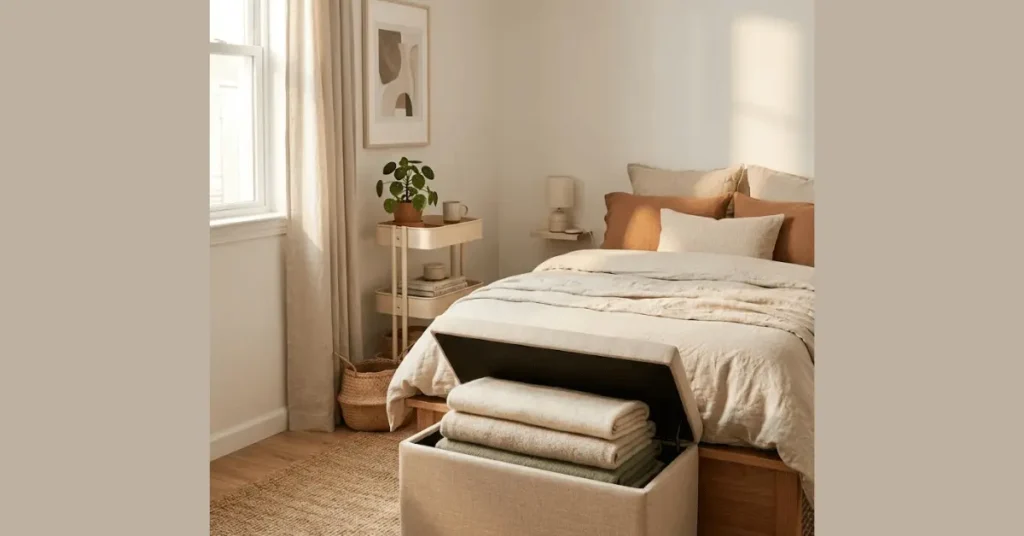
A storage bench, trunk, or pouf placed at the foot of the bed adds both seating and hidden storage capacity without requiring any wall contact or floor modification.
A storage bench (typically 90 to 120 cm wide, 35 to 45 cm deep) provides a flat seating surface with a hinged lid compartment holding 60 to 100 liters. A trunk or blanket chest offers a larger internal volume, often 120 to 180 liters, and suits renters storing bulky items like extra bedding or winter gear. A storage pouf (40 to 50 cm diameter) holds the least volume at 20 to 40 liters but occupies the smallest footprint and works in beds with under 90 cm of clearance at the foot.
Choose based on the width of your room at the foot of the bed. Rooms under 240 cm wide should use a pouf. Rooms 240 to 300 cm wide accommodate a bench. Rooms above 300 cm can fit a full trunk.
How do small bedroom desks double as vanity or workspace storage for renters?
A small desk in a rental bedroom doubles as a vanity by combining a tabletop organizer, a propped mirror, and a drawer tower beneath the desk surface, creating a dual-function station without any wall mounting.
The setup works at desk dimensions of 80 to 100 cm wide and 45 to 55 cm deep. A tabletop organizer holds makeup, stationery, or charging cables. A full-length or standing mirror leaned against the wall behind the desk eliminates the need for a wall-mounted mirror. A rolling drawer tower, such as the IKEA ALEX or a Bisley three-drawer unit, slides under the desk surface and moves with you at the end of a lease.
Total cost for the full setup ranges from $80 to $250 depending on desk and drawer unit selection.
How do renters handle seasonal clothing rotation in a small bedroom?
Renters handle seasonal clothing rotation in a small bedroom by dividing their wardrobe into three distinct zones based on access frequency, then rotating items between zones at the start of each season.
The three-zone wardrobe system keeps only current-season items in prime, easy-access locations, moves near-season items to secondary storage, and compresses off-season items for long-term storage. This system eliminates the most common small bedroom problem: a closet overloaded with clothes worn three months per year. Three tools make it work: closet zoning, vacuum storage bags, and off-site or under-bed archive storage.

How does a three-zone wardrobe system reduce bedroom clutter?
A three-zone wardrobe system reduces bedroom clutter by assigning every garment to one of three physical locations based on how recently and frequently it is worn.
Zone 1 (active) holds daily wear: the current season’s core 15 to 25 garments kept in the primary closet or wardrobe. Zone 2 (seasonal backup) holds items for the current season worn occasionally, stored in a secondary closet section, an under-bed rolling drawer, or a freestanding garment rack. Zone 3 (archive) holds completely off-season items, stored in vacuum compression bags inside under-bed containers or on the top shelf of a wardrobe.
Rotating zones at the change of each season takes 30 to 60 minutes and keeps the active closet at a consistent, manageable volume year-round.
How do vacuum storage bags work and what clothing types do they damage?
Vacuum storage bags work by removing air from a sealed bag using a standard vacuum cleaner nozzle, compressing fabric items to 50 to 70% of their original volume for long-term storage.
The compression mechanism uses a one-way valve that holds the reduced air volume indefinitely after sealing. This makes vacuum bags effective for bulky items like comforters, blankets, and knit sweaters. Clothing types to avoid storing in vacuum bags are listed below.
- Down-filled items (jackets, duvets, pillows): compression collapses loft permanently, reducing insulation performance
- Structured wool garments: blazers, suit jackets, and structured coats deform under compression and do not fully recover
- Leather and faux leather: compression causes cracking and surface breakdown over time
- Items with embellishments: beading, sequins, or applique crush and detach under sustained pressure
Natural fibers like cotton, linen, and polyester compress and recover well.
Where do renters store off-season items when the unit has no attic, basement, or garage?
Storage alternatives for renters with no attic, basement, or garage are listed below.
- Under-bed storage, the highest-value option for most renters, accommodates vacuum bags and flat bins when combined with 6-inch bed risers for adequate clearance
- Top-of-wardrobe space, usable for vacuum bags or lidded bins in units where the wardrobe does not extend to the ceiling
- Over-door shelving, including over-door shelf units with hooks that hang on standard door frames without drilling, holding up to 20 lbs of folded or bagged items
- Self-storage unit, a paid option starting at $30 to $80 per month for a 5×5 ft unit, suitable for renters in small studios with truly no on-site storage capacity [site: SSNB Self Storage market data 2023]
- Mutual storage with a friend or family member, a zero-cost option where two parties exchange off-season storage space across separate locations
How do renters organize cables and charging stations without drilling or altering outlets?
Renters organize cables and charging stations without drilling by using adhesive cable management products and freestanding charging station units that require no wall penetration.
Cable management is a storage issue because loose cables on floors and surfaces consume visual space, create trip hazards, and make rooms feel disorganized even when everything else is tidy. Adhesive clips, raceways, and cord channels solve this at the wall surface level. Freestanding charging stations consolidate device charging into one portable unit.
Two product categories handle this entirely: adhesive cable management systems and tabletop or bedside charging stations.
What adhesive cable management products work best on rental bedroom surfaces?
Adhesive cable management products for rental bedrooms cover three product types, each suited to different cable diameters and surface materials.
- Adhesive cable clips (brands: Command Cable Clips, IKEA FIXA), individual clip-on anchors that hold single cables against wall surfaces or along baseboards, rated to 0.5 lbs per clip, available in clear or white to match rental wall colors
- Cable raceways (brands: Cord Concealer, D-Line), rigid plastic channels that adhere to walls with peel-and-stick backing and enclose multiple cables in a single managed run, compatible with painted drywall and plaster surfaces
- Adhesive cord channels (brands: Alex Tech, Electriduct), flexible silicone or PVC channels that stick to surfaces and flex around corners, suited for managing TV or desk cables that change direction
All three types remove cleanly when the adhesive backer is pulled slowly at a 45-degree angle following the same method used for Command strips.
How do freestanding bedside charging stations replace wall-mounted solutions for renters?
Freestanding bedside charging stations replace wall-mounted charging solutions by consolidating all device power into a single tabletop unit that plugs into one existing outlet.
A tabletop multi-port charging station, such as the Anker 6-port USB hub or Belkin Boost Charge Pro stand, sits on a nightstand or dresser surface and charges up to 6 devices simultaneously without any wall mounting. A bedside caddy with integrated charging loops over the mattress edge or clips to the bed frame and routes cables to a single power strip below the bed. Nightstands with built-in USB ports, such as those from Nathan James or Walker Edison, combine the surface and charging function in one freestanding unit.
Each option eliminates the need to mount anything, costs between $20 and $80, and moves with you at lease end.
How does bedroom organization for renters change across different budget levels?
Bedroom organization for renters changes across budget levels because higher spending enables modular, long-lasting systems, while lower budgets require creative use of existing objects and single high-impact purchases.
Three budget tiers address different renter situations: zero-cost DIY for short leases or immediate needs, under $50 for high-impact single purchases, and $50 to $200 for modular systems worth building when staying 12 months or more. Higher investment correlates with adaptability, not just aesthetics.
What free and DIY methods let renters reorganize with no new purchases?
Free DIY bedroom organization methods requiring no purchases are listed below.
- Declutter by category: remove every item from one storage zone, sort by keep or donate, and return only what you actually use, instantly reclaiming 20 to 40% of existing capacity
- Repurpose existing cardboard boxes as drawer dividers or under-shelf organizers by cutting them to fit the target compartment
- Rearrange furniture to place the highest-use item nearest the entry point and lowest-use items against the furthest wall
- Stack folded clothing vertically (file-fold method) inside existing drawers instead of horizontally, typically increasing drawer capacity by 30 to 50% [site: KonMari Method organizational research]
- Use existing grocery bags or reusable totes for temporary under-bed storage before purchasing proper bins
These actions cost nothing and reveal whether a paid storage product is actually needed. For a step-by-step declutter framework that works alongside any of these free methods, the home organization guide walks through the full category-based audit process room by room.
Which storage products under $50 deliver the highest impact in a small rental bedroom?
Highest-impact storage products under $50 for small rental bedrooms are listed below.
- Over-door shoe organizer ($10 to $18): hangs on any standard door without drilling, adds 24 to 36 clear pockets for shoes, accessories, or small items that otherwise sit on surfaces
- Command Large Picture-Hanging Strips, 14-pair pack ($12 to $16): the highest-value adhesive product for renters, enables lightweight shelf mounting, art hanging, and hook installation with clean removal guaranteed
- 6-inch bed risers, set of 4 ($15 to $22): instantly adds 15 to 18 cm of under-bed clearance, compatible with most standard bed frames, transforms dead space into primary storage
- Heavy-duty tension rod 2-pack ($12 to $20): installs in any closet or cabinet opening in under 2 minutes, doubles hanging capacity without screws
- Stackable cube organizer, 6-cube ($30 to $45): a modular freestanding system that reconfigures as needed and holds up to 25 lbs per cube
What modular storage systems are worth a $50 to $200 investment for renters staying long-term?
A long-term renter is defined here as someone staying 12 or more months in the same unit. At that threshold, modular storage systems pay for themselves through daily functional benefit and move with you at lease end.
Modular storage systems worth investing in for long-term renters are listed below.
- IKEA KALLAX (from $69), a cube-based modular shelving unit with optional drawer inserts, door attachments, and basket accessories that adapt to any room layout as your needs change
- IKEA TROFAST (from $55), a storage system with a narrow depth of 30 cm that suits small bedrooms and organizes bins, hobby supplies, or clothing with adjustable shelf positions
- Elfa Freestanding Solution (from $150), a premium freestanding shelving system from The Container Store with adjustable shelf heights, modular column design, and a lifetime guarantee
- Amazon Basics Modular Cube Organizer, 9-cube (from $65), a stackable and reconfigurable unit that accommodates both open shelving and fabric bin inserts
Each of these systems provides multiple storage levels and moves to your next rental without modification.
How does smart storage planning protect a renter’s security deposit at move-out?
Smart storage planning protects a renter’s security deposit at move-out by selecting only reversible methods, documenting wall and floor condition before installation, and reversing any minor cosmetic changes before the landlord inspection.
Deposit protection is the financial case for renter-friendly storage. The average security deposit in the U.S. ranges from $800 to $2,400 depending on market. [site: Zillow rental market data 2023] A $25 box of Command strips protects that entire amount when used correctly. Three actions determine whether the deposit returns in full: documentation before installation, anticipating inspection criteria, and reversing any incidental damage.

What documentation should renters create before installing any storage product?
Documentation renters should create before installing storage products is listed below.
- Time-stamped photographs of every wall, floor, and ceiling surface in the bedroom taken on move-in day, before any item is placed or installed
- Written condition notes describing any existing damage: scuffs, holes, stains, or surface imperfections present before your tenancy began
- A confirmation email sent to the landlord or property manager listing observed pre-existing conditions, creating a dated written record
- A copy of the move-in inspection checklist signed by both parties, stored digitally in a cloud folder alongside your photographs
Photograph every surface at close range and at full-room distance. Date every file. Store everything in a location accessible after the lease ends.
What do landlords typically inspect for storage-related wall damage at move-out?
Common landlord inspection points for storage-related wall damage at move-out are listed below.
- Adhesive residue on painted walls, particularly near light switches, door frames, and window casings where adhesive hooks are commonly placed
- Paint discoloration or ghosting left by adhesive foam that held against a surface for 12 or more months
- Anchor or nail holes in walls, even small ones, that go beyond what most jurisdictions define as normal wear and tear
- Wall scratches or scuff marks from furniture pushed against or dragged along wall surfaces
- Floor scratches from unprotected furniture feet on hardwood or laminate flooring, the most common non-wall damage claim
- Ceiling marks from tension-pole systems that were overtightened or used on soft ceiling tile
Document all pre-existing versions of these issues on move-in to protect yourself at move-out.
How do renters reverse adhesive residue, tension rod marks, and furniture scratches before returning keys?
Steps to reverse common storage-related damage before move-out are listed below.
- Apply Goo Gone Adhesive Remover to a microfiber cloth (not directly to the wall) and rub adhesive residue in small circular motions until fully dissolved, then wipe the surface clean with a damp cloth
- For paint ghosting or adhesive discoloration, apply a touch-up paint pen or small brush loaded with paint matched to your wall color, feathering the edge outward to blend
- Remove floor scratches from hardwood using a furniture scratch repair marker in the closest wood tone, or a wood filler crayon for deeper marks
- Buff minor scuff marks from painted walls using a melamine foam eraser (Magic Eraser) with light pressure, testing in an inconspicuous area first
- Replace felt furniture pads under all freestanding units before the inspection to show the landlord that floor protection is in place
Take post-repair photographs at the same angles as your move-in photos to create a before-and-after documentation record.
What storage approaches work when a renter’s bedroom comes furnished?
When a renter’s bedroom comes furnished, storage approaches shift to systems that layer on top of, beside, or above existing furniture without moving or modifying any piece.
Furnished rental bedrooms eliminate the option to rearrange for better flow. You work with the layout given. The constraint is real but manageable. Over-door systems, tension rod applications, and narrow freestanding additions all function independently of fixed furniture position.
How do over-door and tension solutions work around fixed furniture in a furnished rental?
Over-door and tension rod solutions work around fixed furniture because neither system requires floor clearance, wall contact, or access to surfaces occupied by existing pieces.
Over-door organizers hang on the top edge of any standard door using built-in hooks, adding vertical storage in an area that existing furniture never occupies. Tension rods install between any two parallel surfaces, including the sides of fixed wardrobes, inside drawer openings, or between a wall and a fixed furniture edge. Applications that work independently of furniture placement include:
- Over-door pocket organizers for accessories, toiletries, or documents
- Over-door hooks for bags, belts, and robes
- Tension rods inside fixed wardrobe interiors to double hanging space
- Tension rods across window recesses to create display or drying space
What freestanding additions are compatible with furnished rental bedroom layouts?
Freestanding storage additions that work in furnished rental bedrooms are listed below.
- Narrow rolling cart (25 to 35 cm wide), such as the IKEA RASKOG or Songmics 3-tier cart, slides between fixed furniture pieces and uses otherwise wasted gap space for accessible storage
- Corner shelf unit (freestanding, 3 to 5 tiers), placed in the corner left open by fixed furniture positioning, adds vertical storage without requiring wall space or floor modification
- Over-bed laptop or breakfast tray table, a U-shaped freestanding unit that slides under the mattress edge and extends a shelf over the bed surface for use as a bedside table replacement
- Hanging closet organizer, a fabric shelf unit that hooks directly onto the existing closet rod inside a furnished wardrobe, adding 4 to 6 folded-item compartments below hanging garments
Should renters ever request landlord permission for removable storage upgrades?
Renters should request landlord permission for removable storage upgrades when the installation involves any surface contact beyond what standard adhesive strip packaging explicitly states is damage-free.
Asking is always low-risk. Receiving written permission in advance eliminates dispute risk at move-out even for products that are genuinely damage-free. Written landlord approval converts a gray-area installation into a documented, agreed action that protects both parties.
When does written landlord approval reduce deposit risk for no-damage storage?
Written landlord approval reduces deposit risk in three scenarios: when adhesive products exceed the weight ratings typically accepted without question, when you plan to install more than 10 adhesive hook points in a single room, or when your wall surface is unusual (plaster, brick, or textured paint) and adhesive removal outcomes are less predictable.
Approval is unnecessary for: single Command hook installations, tension rod use inside closets, freestanding furniture with no wall or ceiling contact, and under-bed storage systems.
To request approval by email, write: “I would like to install [specific product] in the bedroom using [specific method]. This product is marketed as damage-free and leaves no residue on removal. Please confirm in writing whether this is acceptable under my lease terms.”
What removable improvements are renters allowed to keep when they move out?
Renters keep any freestanding furniture and storage products they purchased, as these are personal property rather than fixtures attached to the unit.
Items that become legally ambiguous include anything physically integrated into the rental’s existing structure. A freestanding wardrobe remains yours. A wardrobe you bolt to a wall bracket may not. The legal standard in most U.S. jurisdictions is whether the item can be removed without altering the unit’s original condition. [site: Nolo.com tenant property rights] When in doubt, document the installation method in writing and confirm with your landlord before move-out.
Should renters disclose adhesive hook usage to a landlord at move-out?
No. Proactively disclosing adhesive hook usage to a landlord at move-out creates unnecessary scrutiny where none would otherwise exist.
If hooks were removed correctly and left no residue or paint damage, there is nothing to disclose. Disclosure invites a landlord to look for damage they would not have noticed independently. The exception: if removal caused visible paint lifting or residue you could not fully remediate, disclose the specific spot proactively and offer a solution, such as a paint touch-up, before the inspection occurs.
Can renters put nails or small holes in apartment walls without losing their deposit?
In most U.S. states, small nail holes under 1.5 mm diameter for standard picture hanging fall within the legal definition of normal wear and tear and cannot result in a deposit deduction. [site: HUD tenant rights guidelines] However, lease terms override this default in many cases. Read your lease before assuming this applies. Landlords in stricter markets routinely include clauses that define any hole, regardless of size, as damage. When in doubt, use Command Picture Hanging Strips rated to 16 lbs instead of any nail.
What is the maximum weight Command strips safely hold on a painted drywall surface?
Command strips hold between 1 lb per small strip pair and 16 lbs per large picture-hanging strip pair on smooth, painted drywall. [site: 3M Command product specifications] The large picture-hanging strips represent the highest-rated option in the standard product line. Weight capacity drops by 20 to 30% on textured paint, plaster, or surfaces not cleaned with isopropyl alcohol before installation. Never exceed the rated weight, and never stack multiple loads on a single strip when a second separate hook position is available.
What is the best storage solution for a rental bedroom with no closet?
A freestanding wardrobe is the top choice. It provides enclosed storage for both hanging and folded items, requires no wall anchors, and moves with you at lease end. A freestanding garment rack is the second option, better for shorter leases or renters who prefer visible wardrobe access. A modular cube system with a hanging rod insert ranks third, best for renters who need storage to adapt to different item categories over time. All three options are fully deposit-safe.
Are freestanding shelving units safe to use in a rental without floor anchoring?
Yes, with one condition: the unit’s height-to-base ratio must stay below 3:1. A shelf 180 cm tall needs a base at least 60 cm wide to remain stable without anchoring. [site: CPSC furniture tip-over safety data] Units exceeding this ratio require an anti-tip strap. Command-strip anti-tip straps provide a damage-free alternative to wall anchors for units up to 50 lbs. Distribute weight evenly across shelves and place heaviest items on the bottom two tiers.
How do tension rods stay in place in a closet without screws or adhesives?
Tension rods stay in place through spring pressure or screw-collar tension that pushes outward against two parallel surfaces with enough force to resist movement under normal load. The mechanism works on any smooth, rigid surface including painted drywall, wood closet framing, and laminate panels. It fails on textured or uneven surfaces where end caps cannot maintain full contact. To prevent slipping, select rods with rubber or silicone end caps and set the rod 2 to 3 cm longer than the measured span before installation.

Mike Mann writes practical home organization and small-space living guides for CozySorted. His work focuses on apartment-friendly storage, clutter-free routines, bedroom organization, and simple systems that help renters, apartment dwellers, and small-space homeowners create calmer, easier-to-maintain homes.