A $50 bedroom refresh fails the same way a $500 one does: spread across a dozen small things, none of which the eye can find afterward. Fifty dollars is not a small version of a big budget. It is a different discipline, concentration. The bed is the largest visual surface in the room and its natural focal point, so the money goes where the surface is: one hero purchase that re-skins the bed, one support purchase that fixes the light the bed is seen in, and one small green note to finish the composition. Everything else is either free or forbidden. This plan runs the free layer first, demonstrates a three-item basket priced from live retailer pages checked on October 24, 2026, totaling $44.98, and states its substitutions and its skip list in the open. It changes how the bedroom looks and feels; it does not reorganize it, and the room’s storage and systems keep their own methods elsewhere on this site.
What Should You Do for Free Before Spending the $50?
The unglamorous work that decides whether the purchases will show at all. Make the bed properly, every day, for the week before you shop: smooth cover, pillows standing, a fold at the top. A made bed is the single largest free visual upgrade a bedroom can receive, and it is also the diagnostic: a bed that still looks tired when it is properly made has a bedding problem, which is a purchase; a bed that looks fine made was never a bedding problem at all. Clear the nightstand to its essentials, lamp, book, water, charger, because the nightstand is the refresh’s second stage and clutter there taxes every photograph of the room; the standing method for it lives in the nightstand organization system. Wash what light passes through and lands on: the window, the lampshades, the mirror if there is one, and launder the curtains if they can be washed; tired rooms are frequently just filmed-over rooms. Shop the rest of the house: a throw for the bed’s foot, a picture hung where nobody sees it, a plant crowded in the kitchen, all of it is refresh stock at $0. The wider renter bedroom system these habits belong to is the small bedroom organization guide; this page borrows its surface discipline and spends nothing on it.
What the free layer cannot do is change fabric or light. If the bedding itself is faded, pilled, or a color you have disliked for two years, no arrangement rescues it. If the room’s bulbs are cold and mismatched, no textile warms them. Those two honest failures are exactly what the $50 is for, which is why the free layer comes first: it keeps the budget aimed at the two things money must fix.
Which One Purchase Changes a Bedroom the Most?
The bedding set, and it is not close. Stand in the doorway of any bedroom and measure where your eye goes: the bed takes the largest share of the room’s visual field, usually more than the floor, the walls, and every piece of furniture combined, and it is where the room’s color story is either told or muffled. A duvet cover and sham set re-skins that entire surface in one purchase, because the cover goes over the duvet or comforter you already own and the shams dress the pillows you already sleep on. The alternatives lose on arithmetic. New sheets are mostly hidden under the cover. A rug covers a smaller share, costs more of the budget for anything decent, and competes with the floor you may not dislike. Curtains dress one wall’s edge and matter most in rooms where the window is the problem, which the free layer’s diagnosis will have told you. Paint is a project, a deposit risk for renters, and a budget of its own once supplies are counted.
So the hero takes the majority of the $50, roughly three-fifths of it, and the discipline is to protect that share from erosion by small purchases. Everything else in the basket exists to serve the hero: the light that shows it off in the evening, and the one green note that keeps the composition from reading as a bedding advertisement.
What Does the Demonstrated $50 Basket Actually Buy?
Three items, each priced from a live retailer product page checked on October 24, 2026, each with one job in the composition.
Duvet cover and sham set, $30.00 (Target). The hero. A cotton-blend set in a calm color or a soft pattern, chosen against whatever the room already holds: if the walls and curtains are plain, the set can carry the room’s one pattern; if the room is already busy, the set goes quiet and light. It covers the bed you own, which is the entire point: $30 re-skins the room’s largest surface because the expensive part, the duvet itself, is already in the house.
Warm-white LED bulbs, 2-pack, $4.99 (IKEA). The support act with the highest return per dollar in the whole refresh. Bedrooms live at night, under lamplight, and one consistent warm temperature in the bedside and ceiling fixtures makes new bedding look rich and old furniture look intentional. If the room’s bulbs already match and glow warm, this line is already spent in your favor and the headroom grows.
Small faux trailing plant, $9.99 (IKEA). The finish. One organic note on the nightstand or dresser, trailing where a real plant would struggle for light. It repeats the living note that bedrooms ask for and gives the eye a soft place to end. This is also the basket’s flexible line: a cutting from a friend’s plant in a glass of water does the same job for $0, and if anything must be cut, it is cut here.
The total is $44.98. The $5.02 left over is the plan’s headroom, enough to absorb sales tax on this basket in most states and small price movements between the day these pages were checked and the day you shop. It is deliberately not spent on a fourth object, because the fourth object is where concentration goes to die.
How Do Three Purchases Become One Refresh Instead of Three Objects?
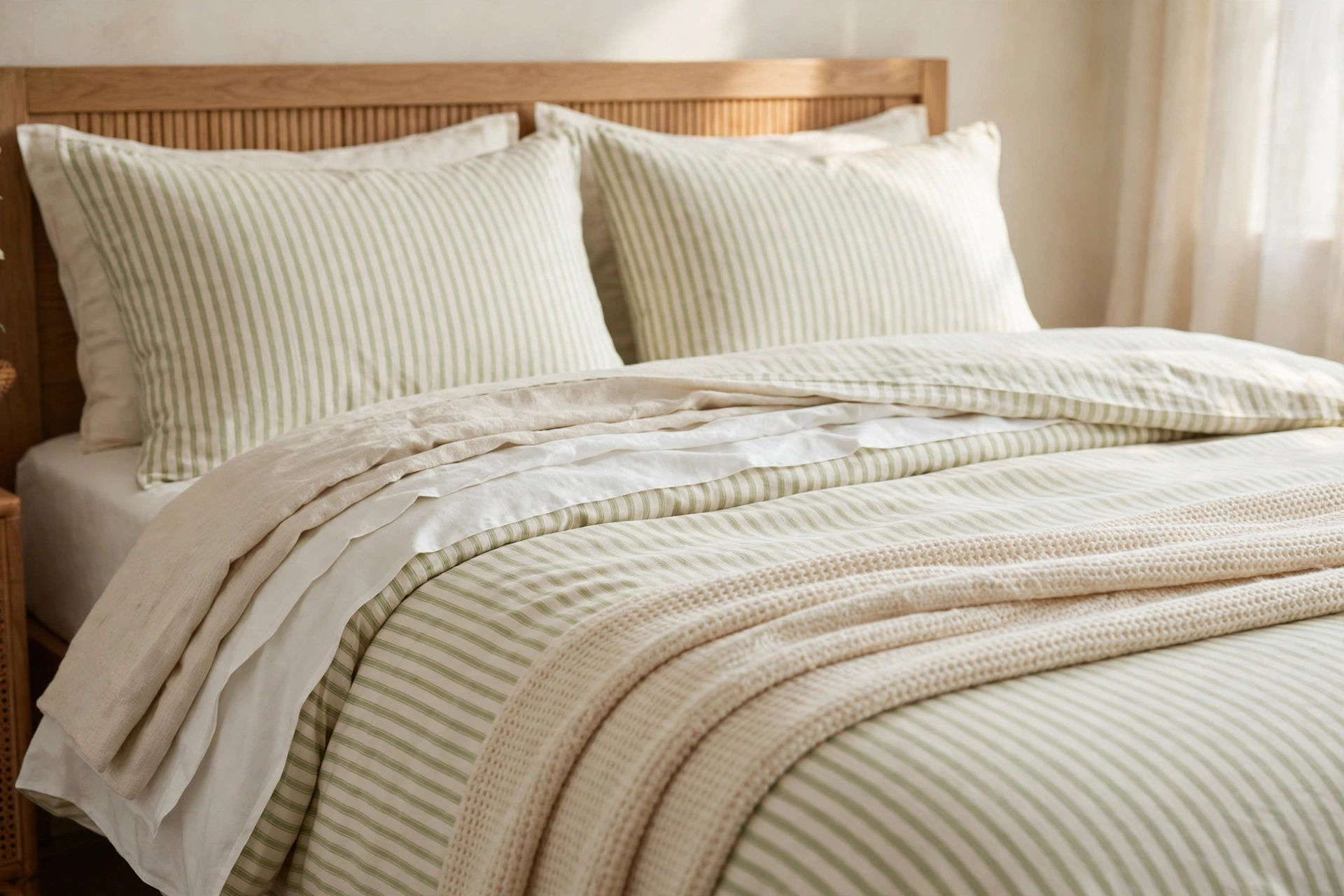
By letting the hero lead and making the other two answer to it. Choose the bedding set first, in hand or in cart, and read its color story: the refresh’s palette is whatever the set brings into the room, a deep green, a warm ivory, a soft stripe, and every other decision is graded against it. The bulbs answer to the set by warming the light it is seen under, chosen warm-white rather than daylight so the bedding’s tones deepen instead of flattening. The plant answers by repeating the organic note the set suggests, most naturally when the set is patterned with anything botanical or when its palette includes a green the plant can echo; in a set with no green at all, the plant still works, because green is the one color that behaves like a neutral against fabric.
Composition finishes the unification at the bed itself. Shams standing against the headboard or wall, sleeping pillows in front or behind them by your household’s habit, the cover pulled smooth and folded back once at the top so the bed reads layered rather than shrink-wrapped. A borrowed throw, if the free layer found one, lies across the foot at a slight diagonal or folded in a band; if none exists, the fold-back does the layering alone and nothing is bought to imitate it. Then audit the room’s other textiles against the set: the curtain, the chair’s cushion, the rug if there is one. Anything that fights the palette is swapped to another room or stored, at $0, because subtraction composes as surely as purchase does. Stand in the doorway: bed first, light warm, one green note. If that is what the eye reports, three purchases have become one refresh.
What If a Basket Item Is Unavailable or Costs More Near You?
Substitute by job, not by object, and protect the hero and the bulbs while flexing the finish. If the bedding set is out of stock or priced higher where you shop: the same job is done by any duvet cover set in the same spirit at another big-box store, or by the set’s own other sizes, which are priced individually, so check the price for your bed’s size rather than assuming the figure travels. A strong-colored sheet set, worn as the visible top layer over your existing cover, is the honest understudy: less finished than a duvet set, far better than a tired cover. Secondhand bedding is a legitimate route for the cover set specifically, with one non-negotiable condition: a hot wash before it touches the bed. If the bulbs do not fit your fixtures: match the base and the temperature, not the brand; the job is one consistent warm white across the room, and any retailer’s warm-white LED pair that fits does it. If the plant is unavailable: the cutting in water, a hardy real plant where light allows, or nothing at all; the refresh survives its absence, which is precisely why it is the flexible line. What does not substitute is the order: hero first, light second, finish last, and never let a substitute for the finish eat the hero’s share.
What Should You Deliberately Not Buy on a $50 Budget?
The purchases that photograph as effort and read as clutter. More decorative pillows: the shams in the set are the bed’s composition; a third and fourth cushion in competing fabrics spends the plant’s money and the bulbs’ money to make the bed harder to make, which quietly unmakes the refresh every morning. Scent as a refresh: candles and sprays change an evening, not a room, and they are invisible in every test that matters here. A new lamp when the bulb is the problem: lamps are furniture-priced; the $4.99 line exists because temperature, not hardware, is what most bedroom light gets wrong. Wall decals and word art: they date quickly, they fight the palette the hero just established, and renters inherit the removal. A bedroom-in-a-bag set: its price forces thin fabric across many pieces instead of decent fabric on the one surface that matters, and its built-in matching removes the contrast a composed room needs. Anything whose job is storage: bins, organizers, and closet hardware solve a different problem, an important one with its own budget and its own guides on this site; in a $50 refresh they are invisible spending. The shelf test from the living room plan applies here unchanged: name the item’s job in the composition in one sentence, or it stays in the store.
How Do You Know the Refresh Actually Worked?
By the same doorway discipline, in the bedroom’s own light. The doorway test: from the door, the bed should read as one composed surface, color story clear, shams standing, fold in place, and the eye should finish at the green note rather than snagging on the nightstand or a textile that fights the set. The lamplight test: at night, lamps on, the room should feel visibly warmer than it did before the bulb swap, because a bedroom’s real hours are lamplight hours and the refresh was designed for them. The morning test: after a real night’s sleep and a two-minute bed-make, the room should return to refreshed on its own; a refresh that only exists on day one, before anyone sleeps in it, was a staging, not a system. Give it a week of mornings before judging the details, and let the judgment be about those three views rather than about any single object.
Keeping it costs nothing further. The bed-make is the maintenance, the nightstand stays at its essentials by the habit the free layer installed, and the set goes through the wash in rotation like any bedding. When the room eventually tires again, it will tire honestly, in the fabric or the light, and the same $50 logic will apply: free layer first, hero protected, finish flexible. That is the whole method, and it is the same concentration that runs the living room makeover under $100 elsewhere in this cluster: small budgets do not need more objects, they need fewer, larger decisions.


Mike Maan writes practical home organization and small-space living guides for CozySorted. His work focuses on apartment-friendly storage, clutter-free routines, bedroom organization, and simple systems that help renters, apartment dwellers, and small-space homeowners create calmer, easier-to-maintain homes.