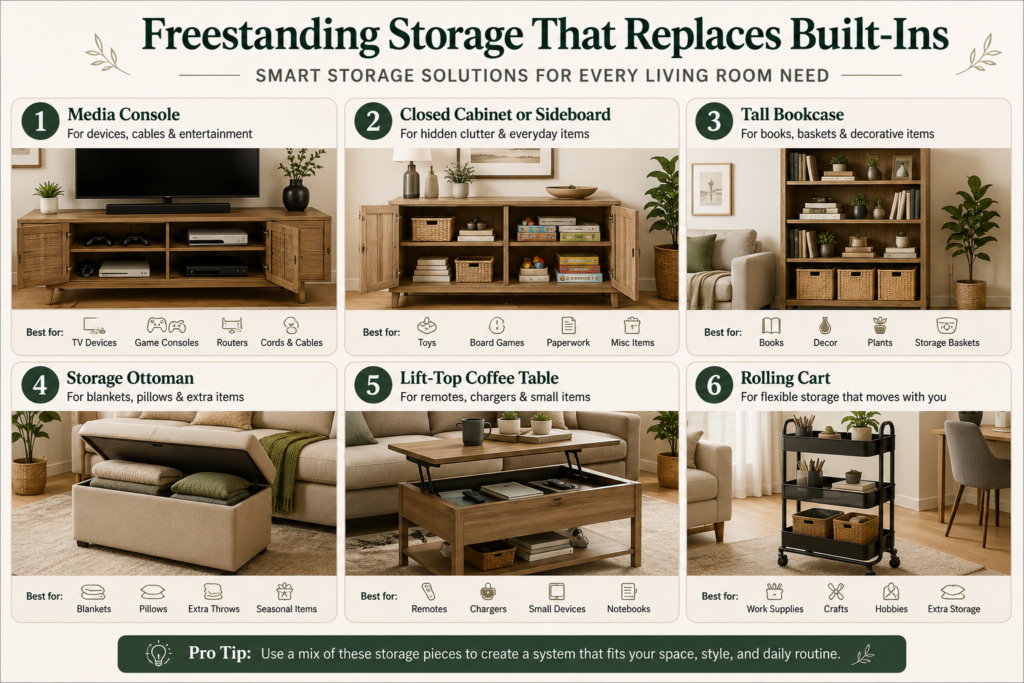
65% of renters in the US live in spaces under 900 square feet [site: U.S. Census Bureau, American Community Survey, 2024], and the living room carries the hardest load. It holds seating, storage, screens, and sometimes a desk — all in one compact space where every bad decision stacks on top of the last.
The plan that works: organize first by function, store second by type, then style last. That order is not flexible. Reverse it and the room fills back up inside a week.
This guide covers layout measurement, decluttering, zone assignment, storage furniture, vertical storage, styling choices, layout options, common mistakes, and the reset routine that keeps a small apartment living room organization system running long term.
What are small apartment living rooms?
Small apartment living rooms are compact, multi-use spaces inside apartments, studios, rentals, or small homes. The average small apartment living room measures between 100 and 200 square feet [site: National Association of Home Builders, 2024]. In that space, seating, TV viewing, storage, work, dining, guest sleeping, and decor all compete for the same floor.
In a renter’s home, the living room is often the only shared space. That makes organization, storage, and layout decisions more consequential here than in any other room.
Why do small apartment living rooms need an organize-store-style plan?
Small apartment living rooms need an organize-store-style plan because planning layout, storage, and decor separately creates three systems that conflict with each other. A sofa bought before measuring the room blocks the walkway. Storage added before decluttering holds things that should have left. Decor placed before storage is planned fights for the same surfaces that functional items need.
The three-step plan treats the room as one connected system, not three separate projects. Each step builds directly on the one before it.
Limited square footage means every decision has consequences. A 130-square-foot living room has no room to absorb mistakes in furniture scale, storage volume, or decor placement. Shared functions — TV, reading, work, guest hosting — increase daily friction when there are no clear zones. Rental limits remove most permanent storage options. All three factors make a single integrated small space organization plan the only reliable starting point.
How should you measure layout, traffic flow, and focal points?
Key layout checks for a small apartment living room are listed below.
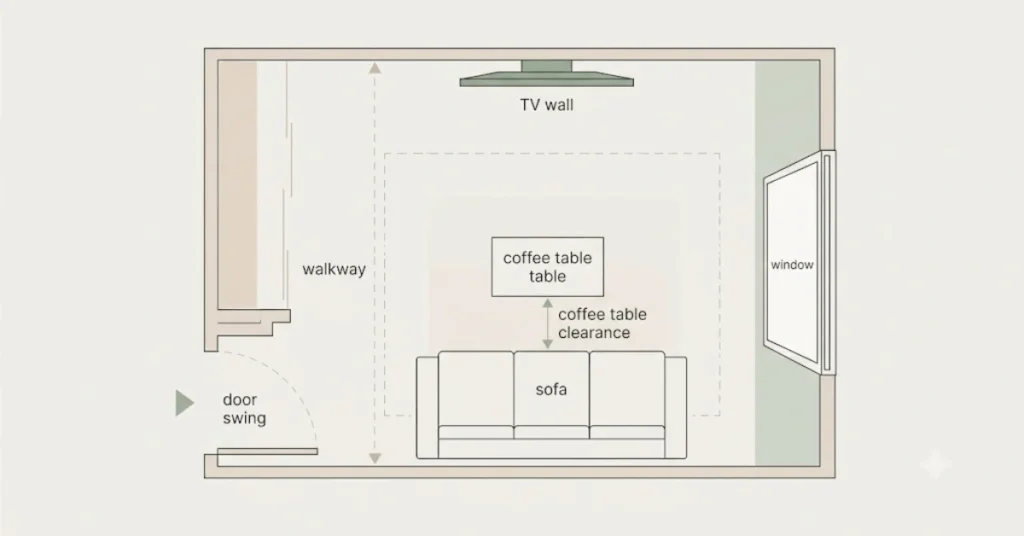
- Room length and width: Measure wall to wall, then subtract 3–4 inches per side for baseboard depth.
- Door swing radius: Mark the arc a door travels. Most interior doors swing 28–32 inches. Furniture placed inside that arc blocks daily movement.
- Window placement: Note sill height and width. Furniture in front of low windows kills natural light.
- Outlet and switch positions: Map all outlets before placing furniture. Appliances cannot move away from fixed points.
- TV wall: Find the wall with the fewest windows and doors. That wall becomes the focal point.
- Sofa depth: Standard sofas run 32–38 inches deep. A 36-inch sofa in a 10-foot-wide room leaves under 18 inches of walkway before the coffee table.
- Coffee table clearance: Leave 14–18 inches between the sofa and coffee table for comfortable leg room [site: National Kitchen and Bath Association, clearance guidelines, 2024].
- Walkway width: Keep at least 36 inches of clearance on all main paths — more for households with kids, pets, or mobility aids.
- Focal point check: Stand at the room entrance. The eye should land on one clear anchor — TV, fireplace, or large window — not scattered furniture competing for attention.
- Traffic flow test: Walk the three most-used paths in the apartment. Each must stay fully clear after all furniture is placed.
How should you declutter before adding storage?
Declutter before adding storage so you do not organize items that should leave the room. Storage products hold clutter in a tidier form. They do not solve the problem of having too many things in too small a space.
Sort every item in the living room into five categories: keep, relocate, donate, trash, and seasonal. Keep only items used at least once a week or needed for guests. Relocate anything that belongs in a closet, bedroom, or entryway. Donate duplicates and items untouched in 3 months. Trash anything broken or damaged.
Common living room clutter includes books no longer being read, more than two blankets per person, old magazines, mail piles, cables without active devices, extra remotes, hobby items used elsewhere, kids’ toys from other rooms, and random purchases without a designated home.
One practical test: pull every item off shelves and out of baskets before buying a single new bin. If the room looks fine with less, the answer is not more storage. It is fewer items.
How should you assign zones for seating, TV, work, dining, and entry overflow?
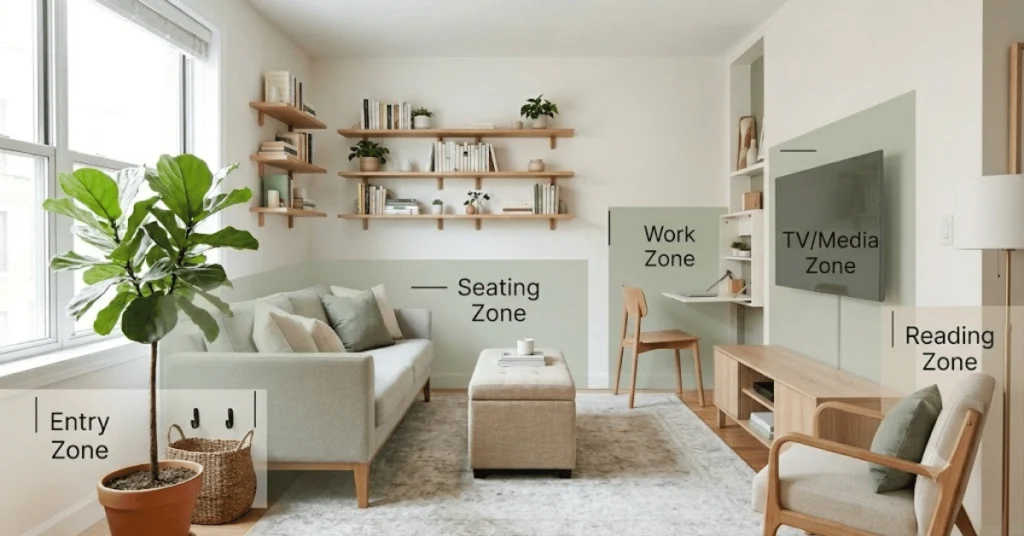
Zones help small apartment living rooms handle multiple functions without feeling messy. A zone is not a divider or a wall. A zone is a defined area with a specific purpose and at least one nearby storage point.
Identify every function the room handles. Assign each one a clear physical boundary.
- Seating zone: Anchored by the sofa. Includes a side table, lamp, and remote storage.
- TV and media zone: Anchored by the screen and console. Cables, devices, and controllers stay here and nowhere else.
- Work corner: A wall desk or slim table with a task light. Work supplies close in one box or drawer after hours.
- Dining edge: In open-plan apartments, a small table or bar cart marks the boundary between eating and seating areas.
- Entry overflow zone: A hook, basket, or bench near the door catches keys, bags, and shoes before they reach the sofa.
- Reading spot: One chair, one lamp, one shelf of current reads.
- Toy or pet zone: One basket or corner for kids’ items or pet supplies — labeled and fast to reset.
Each zone needs a visual edge — a rug, a piece of furniture, or a light source — and one storage option that keeps the zone tidy without requiring daily effort.
How should small apartment living rooms be organized first?
Small apartment living rooms should be organized first by function, not by decoration. That means grouping items by how they get used — not by how they look on a shelf together.
Organization by function works like this: items used daily stay at arm’s reach, items used weekly go one level deeper into storage, and items used monthly or seasonally go in closed or under-furniture spots. This hierarchy alone cuts daily reset time in half.
Clear surfaces happen when items have assigned homes — not when things are hidden in random baskets. Every remote, charger, and blanket needs a specific location. When the location makes practical sense, people return items without being reminded.
Styling comes after the functional system is running. A room that looks good but does not work well fills back up within a week of the last reset.
How should everyday items be grouped by use?
Everyday living room item groups are listed below.
- Remotes and chargers: One tray or drawer near the TV or sofa arm. Every device charges here.
- Books and magazines: Current reads on one open shelf — three to five titles maximum. Finished books return to the bedroom.
- Blankets: Two per household member, maximum. Folded in a basket, ottoman, or bench beside the sofa.
- Toys: One labeled basket per child. Not spread across the floor.
- Games and puzzles: Stacked in a closed cabinet or low shelf. One label per container.
- Pet items: One bin near the sofa. Leash, toy, and treat storage in one spot.
- Work supplies: One closed box or drawer if work happens in the living room. Cleared after work hours.
- Media accessories: Controllers, headphones, and cables stored inside the media console.
- Guest items: One folded blanket and one spare pillow inside an ottoman or trunk — not on the sofa daily.
- Candles and decor: Grouped on one tray. Rotated out when not in active use.
Each category gets exactly one home. No duplicates and no overflow zones.
How should visible clutter be reduced without hiding everything?
Visible clutter should be reduced by hiding low-value items and displaying only intentional decor or high-use items. The goal is not a sterile room. It is a room where everything visible was chosen on purpose.
Use closed storage — drawers, cabinets, lidded baskets — for cables, papers, toys, extra blankets, and anything without visual value. Use open surfaces for items that earn their place: one plant, a curated book stack, a single decorative tray, or a lamp.
Breathing room on surfaces signals control. A surface with three items looks styled. A surface with eleven items looks cluttered even if every item has a use.
Cable boxes, power strips, and routers belong inside or behind the media console. One cable management box costs under $15 and removes four visible clutter points in one step. That return is higher per dollar than almost any decorative purchase.
How should shared living rooms stay easy for everyone to use?
Shared living rooms stay easier to use when every person can find where items belong without training, labels, or daily reminders. A system that only one person can maintain is not a real system. It is a personal habit that collapses when that person is away.
For roommates: assign one zone or one basket per person for personal items. Shared remotes, cables, and chargers go in one central tray that anyone can access.
For families: place kid-accessible storage at a low level. Kids should be able to return toys without asking for adult help. Clear bins or simple labeled containers make the system work without requiring anyone to read the label first.
For guests: keep a folded blanket and one clear surface in the guest seating area. Guests should not feel like they are disrupting anything by sitting down.
Simple labels — even handwritten ones — reduce daily friction in shared homes more reliably than expensive organizer sets.
How do small apartment living rooms store more without feeling crowded?
Small apartment living rooms store more without feeling crowded by using hidden storage, vertical storage, slim furniture, and a balanced mix of open and closed pieces. Storage adds volume to a room. The right storage type adds capacity without adding visual weight.
The core rule: storage that sits on the floor takes up floor space and visual space at the same time. Storage that floats on walls or hides inside furniture uses capacity only. Every apartment storage decision should ask — does this clear the floor or add to it?
A room with a storage ottoman, a floating shelf above the sofa, and a slim media console holds roughly the same amount as a room packed with floor baskets and standalone shelving units — but it reads as calm instead of crowded.
Renter-friendly options matter here. Most small apartment renters cannot bolt shelving to studs or mount permanent cabinets. Tension rods, adhesive rails, freestanding bookcases, and furniture-based storage solve the same problems within lease limits [site: HUD Office of Policy Development and Research, rental housing study, 2024].
| Storage Type | Floor Impact | Best Use | Renter Friendly? |
| Storage ottoman | Low | Blankets, remotes, magazines | Yes |
| Floating wall shelf | None | Books, plants, curated decor | Yes — Command strips or studs |
| Slim media console | Medium | Cables, devices, accessories | Yes |
| Tall freestanding bookcase | Low footprint only | Books, bins, mixed decor | Yes |
| Under-sofa rolling bins | None | Seasonal items, extra linens | Yes |
| Lidded basket | Low | Blankets, toys, pet items | Yes |
| Cube shelving unit | Medium | Modular storage, fabric bins, books | Yes |
Which storage furniture works best in a small living room?
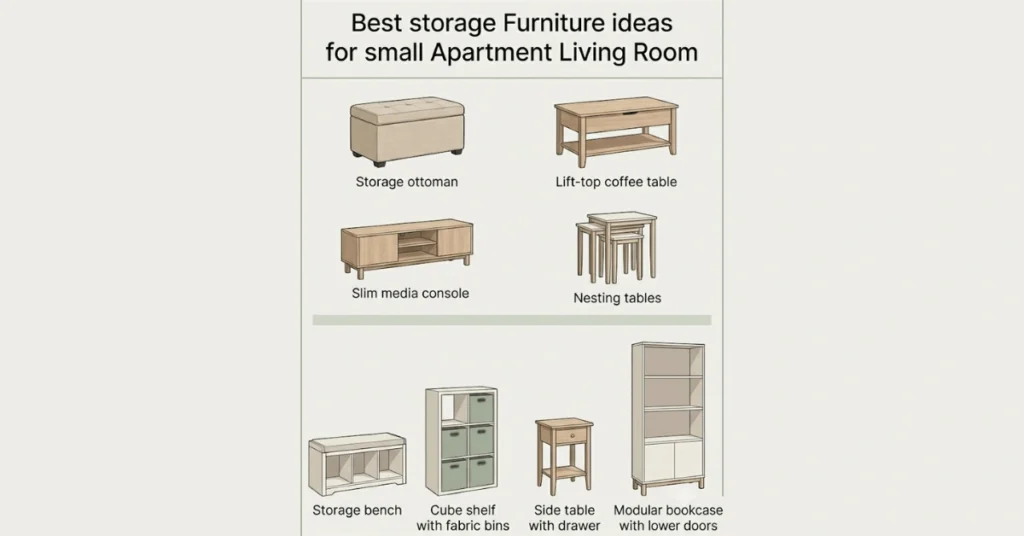
Storage furniture that works well in small living rooms is listed below.
- Storage ottoman: Replaces the coffee table and stores blankets, remotes, or magazines inside. Doubles as extra seating. Choose a size that leaves 14 inches of clearance from the sofa front.
- Lift-top coffee table: Opens upward to reveal a storage cavity for work supplies, games, or charging cables. Best in rooms where the ottoman already serves as seating.
- Slim media console: Keep it under 18 inches deep. It holds media devices, cables, and accessories while clearing the floor of cord clutter behind closed doors.
- Nesting tables: Two or three tables stored inside each other. Pull one out for a guest’s drink. Tuck them back when done. No permanent floor space lost.
- Storage bench: Placed at the foot of the sofa or under a window. Holds shoes, blankets, or seasonal items. Adds seating during guest visits.
- Cube shelving unit: Modular and freestanding. Add fabric bins to close off messy sections. Leave other slots open for books or decor.
- Side table with drawer: Replaces a surface-only end table. Stores remotes, reading glasses, chargers, and small items out of sight without adding a separate storage piece.
- Modular bookcase with lower doors: Upper sections display books and curated decor. Lower doors close off cables, games, and bulkier items. One unit handles both display and hidden storage.
How should vertical storage use wall space?
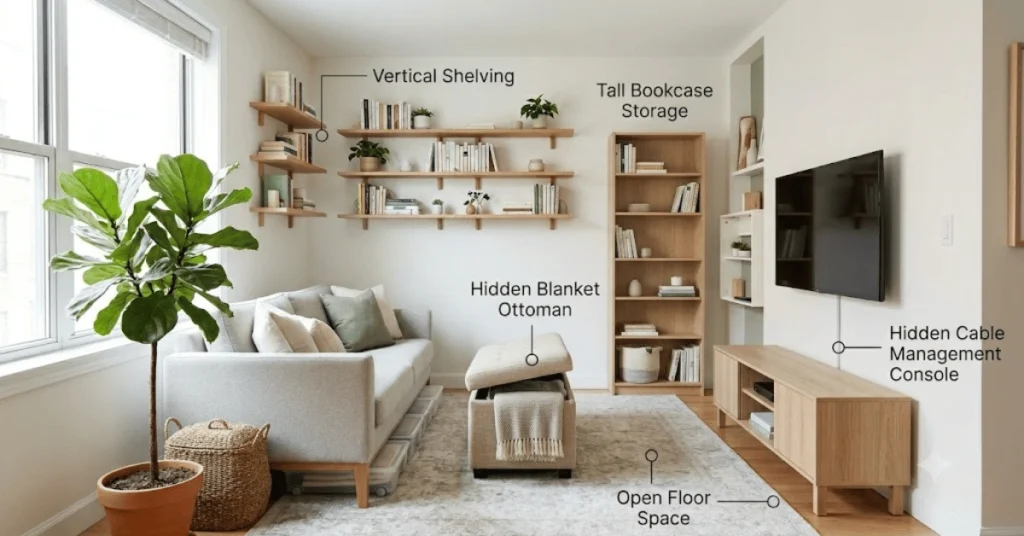
Vertical storage uses wall space so the floor stays open. Every inch of wall above furniture height is unused storage capacity in a small apartment living room — and it activates with floating shelves or wall-mounted rails at no floor cost.
Install floating shelves above the sofa at 66–72 inches from the floor. That height clears most headroom issues and stays reachable from a standing position. Keep shelves 8–10 inches deep — enough for books and small bins without feeling like they intrude on the room.
Tall bookcases at 72–84 inches use vertical real estate without expanding the footprint. A unit 12 inches deep and 36 inches wide stores 6–8 linear feet of books plus decorative bins, all in a floor space smaller than a single armchair.
For renters who cannot drill: adhesive-mounted wall strips hold shelves up to 15–20 lbs when installed correctly on painted drywall [site: 3M Command product load specifications, 2024]. Tension-rod shelving in alcoves and doorways adds storage with zero wall damage.
Above-door shelves are consistently overlooked. A shelf mounted 1 inch above the door frame stores seasonal items, rarely used books, or extra linens in space that otherwise stays permanently empty.
How should hidden storage control blankets, remotes, cables, and toys?
Hidden storage controls small items by giving them a concealed but reachable home. The practical test: can you open the storage with one hand while the other is occupied?
- Blankets: Folded into a lidded wicker basket or inside a storage ottoman beside the sofa — not across the room. One basket holds 2–3 folded throws.
- Remotes and chargers: A drawer in the coffee table or media console. One drawer, one location — not a tray sitting on top of the surface.
- Cables: A cable management box on the floor behind the TV stand. The lid stays closed. USB hubs mount inside.
- Toys: Fabric bins inside a cube unit. One bin per toy category. The bins pull out completely, which turns cleanup into a single physical step.
- Games: Stacked inside a lower media console cabinet — not on open shelves where box graphics compete with the rest of the decor.
- Under-sofa bins: Flat wheeled bins slide under most sofas with 4 inches or more of clearance. Useful for seasonal items, extra pillows, and board games.
How should open and closed storage be balanced?
Open and closed storage should be balanced so the room feels styled but not cluttered. The 70/30 rule works well in small apartment living rooms: 70% of storage hidden, 30% on display.
Open shelves work for books, plants, a few uniform baskets, and curated objects. They require regular editing. A shelf with 12 items looks crowded. The same shelf with 5 items looks styled.
Closed cabinets, drawers, and lidded containers handle cables, papers, toys, extra blankets, and everything else without visual value. When the choice is unclear, close it off. Visual calm in a small room comes from reduction — not from clever arrangement.
| Zone | Recommended Mix | Why It Works |
| TV wall | Slim closed console + one open shelf above | Hides cables; displays 2–3 decor pieces only |
| Sofa zone | Closed ottoman + side table drawer | Daily items hidden; surface stays clear at all times |
| Bookcase wall | 70% books or bins, 30% open display | Balanced without looking bare or overwhelming |
| Entry corner | Lidded basket or closed bench | First drop zone resets in under 30 seconds |
| Window wall | Low closed bench | Keeps sightlines clear to the window |
How should small apartment living rooms be styled after storage is planned?
Small apartment living rooms should be styled after storage is planned because decor only works when clutter already has a home. Styling a disorganized room adds conflict, not calm. Styling an organized room multiplies the effect of every design choice.
Start with a three-color palette: one neutral (cream, soft white, warm grey), one mid-tone (sage, taupe, blush), one accent (terracotta, navy, or black). Small rooms absorb visual complexity poorly. Three colors applied consistently across cushions, throws, rugs, and art create cohesion without requiring expensive matching sets.
Light and furniture scale are the two most powerful tools in a small room. Light opens the space up. Correct furniture scale prevents the room from looking like a showroom piece dropped into a closet.
Style decisions must serve function first. A rug that defines the seating zone does more work than three decorative pillows. A mirror placed to reflect the window does more work than a gallery wall covering the same space.
How should color, lighting, and mirrors make the room feel larger?
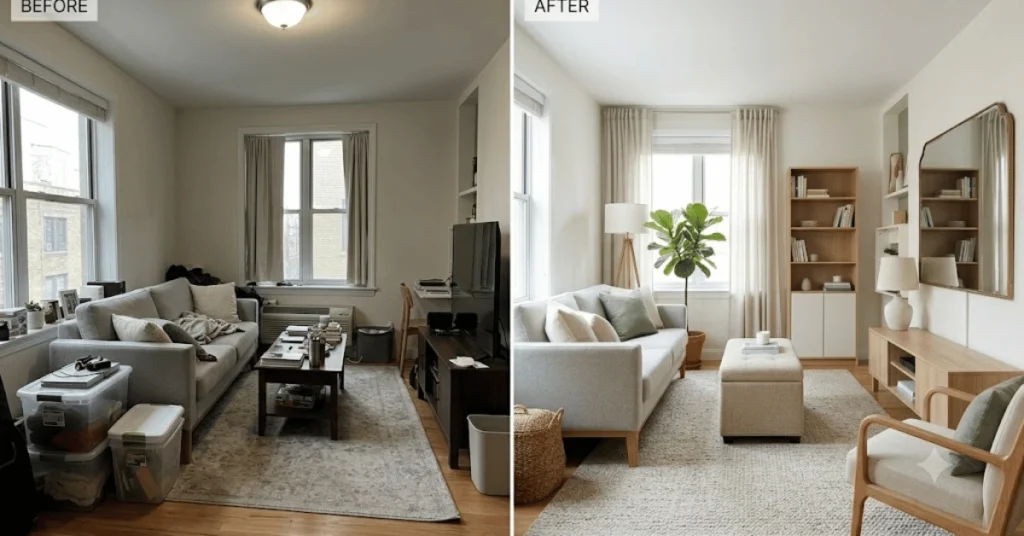
Color, lighting, and mirrors make a small living room feel larger by improving brightness, depth, and visual continuity across the space. These three tools work together. Using only one limits the effect.
Paint walls in light neutrals — soft white, warm ivory, or pale greige. Light reflects off pale walls and makes the ceiling feel proportionally higher. Dark accent walls in rooms under 150 square feet create a visual boundary that shortens the room.
Layer three types of light: ambient (overhead or floor lamp), task (reading lamp), and accent (table lamp or wall sconce). A single overhead light casts flat shadows that make small rooms feel more compressed [site: Illuminating Engineering Society of North America, residential lighting practice guidelines, 2024].
Place one mirror on the wall opposite the room’s main window. A 30-by-40 inch mirror reflects the window view and doubles the perceived depth of the room. Avoid placing mirrors to reflect cluttered zones — they amplify disorder as effectively as they amplify light.
How should rugs, curtains, and furniture scale define the space?
Rugs, curtains, and furniture scale define the living room without adding walls. Each one shapes the room visually — and each one carries a common sizing mistake that undercuts the effect.
A rug should be large enough for all front sofa legs and the coffee table to sit on it. In a standard small living room, this means a minimum 5-by-8 foot rug. A rug that is too small makes furniture float disconnected from the floor and visually shrinks the seating zone.
Curtains should hang from 2–4 inches below the ceiling and reach the floor. This vertical length makes the ceiling feel taller and the windows larger than they are. Curtain rods mounted at window height create the opposite effect.
Choose furniture with visible legs — sofas, chairs, and tables that show the floor beneath them. Leggy furniture reveals floor space and makes the room feel open. Low-profile sofas under 34 inches high keep sightlines clear across the full room.
What layout works best for small apartment living rooms?
The best layout for small apartment living rooms depends on room shape, focal point, furniture scale, and daily function. There is no universal arrangement. A 120-square-foot square room needs different furniture placement than a 180-square-foot rectangle with a bay window.
The first decision is always the focal point. Every layout builds from one anchor: the TV wall, a fireplace, a large window, or a built-in unit. Once the focal point is fixed, the sofa faces it. Everything else arranges around the sofa-to-focal-point axis.
The second decision is traffic flow. Every layout must preserve three clear paths: from the entry to the main seating, from seating to the exit, and from seating to the kitchen or dining area. These paths must stay clear without requiring anyone to turn sideways or step over furniture.
Three layouts work in most apartment living rooms: the straight layout (sofa against one wall, TV across), the L-shaped layout (sofa and chair forming an L around the focal point), and the floating layout (sofa pulled 12–18 inches from the wall, with a narrow console or shelf behind it).
How should seating be arranged around conversation, TV, or both?
Seating should be arranged around the room’s main use: conversation, TV, or both — because the arrangement is different for each.
For TV-primary rooms: the sofa faces the screen directly. The ideal viewing distance is 1.5–2.5 times the TV’s diagonal measurement. A 55-inch TV works best at 7–11 feet from the sofa. Add one or two chairs at a slight angle for secondary viewing without forcing a full-room rearrangement.
For conversation-primary rooms: two seating pieces face each other at 6–8 feet apart with a coffee table or ottoman between them. This layout works well in apartments where the bedroom handles TV viewing.
For both: an L-shaped configuration with the long side facing the TV and the short side angled inward allows natural conversation without requiring anyone to turn sharply. A round coffee table or large ottoman in the center removes sharp corners and keeps walking paths clear — a useful detail in rooms under 150 square feet.
How should a work-from-home corner fit into the living room?
A work-from-home corner should fit into the living room without taking over the seating area. The key is full containment: all work items stay in the work corner and close off after hours.
A wall-mounted fold-down desk takes up zero floor space when closed. A laptop stand and folding chair occupy 6–8 square feet when in use and fold flat when not. Both options work in rooms where a permanent desk would crowd the main layout.
For rooms that need a permanent desk: choose a corner model under 40 inches wide. Position it behind the sofa rather than beside it. Add a slim shelf above for supplies. That placement puts work behind the room’s focal point — so the seating zone still looks complete from the entry.
Task lighting is not optional in a work corner. A direct-beam desk lamp keeps work light from spilling onto the TV wall and making the room feel like an office at night.
After work hours: one closed box or drawer holds the entire work kit. Laptop, notebook, charger, and headphones go inside. The desk surface clears. The room becomes a living room again.
How should studio apartments separate living and sleeping zones?
Studio apartments should separate living and sleeping zones with furniture placement, rugs, shelving, curtains, screens, lighting, or color blocks — not with permanent walls or bulky dividers that shrink both zones.
The most effective single separator is a bookcase placed perpendicular to the wall between the bed and sofa. A 72-inch-tall open bookcase creates two distinct zones, stores items on both sides, and adds vertical structure without blocking light or airflow.
A floor-to-ceiling curtain on a tension rod creates full visual separation with zero drilling. Pull it closed at night. Open it during the day to let the studio function as one connected space.
Two rugs — one in the living area and one under or beside the bed — create distinct floor zones without moving any furniture. Different textures in the same color palette signal separate functional zones while keeping the full space visually cohesive.
Lighting is the fastest separator available: a warm-toned floor lamp over the sofa and cooler task lighting at the desk or bedside make each zone feel purposeful even when they share the same 400 square feet.
How should common small living room shapes be arranged?
Long, narrow rooms (roughly twice as long as wide) arrange best along one wall: sofa against the long wall, media console opposite, and storage concentrated at the far short end so the walkway stays a single straight line. Square rooms (under roughly 12 by 12 feet) work around a center anchor: seating grouped on one rug in the middle, storage pushed to the perimeter walls, and nothing tall in the center sightline. Open-plan studios arrange by zone rather than by wall: the living zone gets the window end for light, the sleeping zone gets the quiet end, and one double-sided piece, an open bookcase or a low console, marks the boundary without closing it off. In every shape, the order is the same: fix the walkway first, place the largest piece second, and let storage fill the leftover edges instead of competing for the center.
What should you store in a small apartment living room?
A small apartment living room should store items that directly support sitting, relaxing, watching, reading, hosting, working, or daily family routines. That is the full scope. Anything outside that list belongs in a different room.
The clearest storage test: does this item get used in this room — or does it get used elsewhere and just end up here by habit? Items used elsewhere become clutter the moment they land on the coffee table or sofa arm.
Storage capacity in a small apartment living room is finite. A 130-square-foot room has roughly 40–50 linear feet of functional storage across all furniture and wall surfaces combined. Every unrelated item stored here takes capacity from something that actually belongs.
Use a simple priority system: daily-use items go in the most accessible spots. Weekly-use items sit in deeper or closed storage. Monthly and seasonal items go under furniture, inside an ottoman, or in the highest and lowest shelf positions.
Which items should stay out of the living room?
Some items should stay out of the living room because they create visual clutter or belong to a different zone entirely. The living room is not the apartment’s catch-all space, even though it tends to function as one.
Items that consistently migrate out of their storage homes and take over surfaces are the first targets.
Remove these from the living room storage plan entirely:
- Mail and paper piles — they belong in an entryway tray or desk zone
- Extra shoes beyond one pair per person
- Bulky seasonal storage (holiday decor, unused sporting equipment)
- Cleaning supplies
- Duplicate blankets beyond the two-per-person limit
- Items bought but not yet assigned a home
- Unused decor left over from a previous apartment
- Random purchases waiting to be returned
Every item on that list has a better home. Moving it there is not optional if the small living room storage plan is going to hold past the first week.
How should seasonal items be rotated out?
Seasonal items should be rotated out so the living room only holds what is useful right now. Seasonal storage is a rotation system with a defined in date and out date — not a permanent accumulation.
In winter: extra blankets, heavier throws, and holiday candles come in. Summer-weight cushions, lighter throws, and seasonal florals go into labeled bins.
In summer: the reverse. Heavier textiles move to under-bed bins or closet shelves. Lighter materials replace them on the surfaces and in the baskets.
Use labeled, airtight bins for textile rotation. A standard 18-gallon bin holds 3–4 folded blankets or a full set of seasonal cushion covers. Store bins under the bed, on a bedroom closet shelf, or in an entryway cabinet — never stacked inside the living room itself.
Set a calendar reminder at the start of each season. Four reviews per year, 20 minutes each, keeps the room current and prevents seasonal items from becoming permanent fixtures that quietly take over storage capacity.
Should you use open shelves, closed cabinets, or hidden storage in small apartment living rooms?
In a small apartment living room, no storage choice is invisible. Every shelf, cabinet, and basket sits inside the room’s visual field, so choosing between open shelves, closed cabinets, and hidden storage is a space decision before it is a storage decision: the wrong balance makes a small room feel smaller even when it is technically organized. Start from visual weight. Open shelves add display but also visual noise. Closed cabinets calm the room but can read as bulky blocks. Hidden storage inside furniture keeps sightlines clean while floor space stays fixed. The sections below weigh each option first by how it changes the room you see, then by what it holds.
Each storage type has a specific job. Open shelves handle curated display. Closed cabinets handle items with low visual value. Hidden storage (inside furniture) handles daily-use items that should not be visible between uses.
Most small apartment living rooms need all three types working together. A room with only open shelves accumulates visible clutter within days. A room with only closed storage feels sterile and difficult to use. A room with only hidden furniture storage lacks structure for larger items.
The 70/30 rule guides the overall balance: 70% of items stored out of sight, 30% intentionally displayed. Applied to a bookcase wall, that means roughly two shelves of closed bins or drawers for every one shelf of open display.
When do open shelves work better?
Open shelves work better when you want to display books, plants, baskets, or a small curated collection — and when you are prepared to edit that display on a regular schedule.
Open shelves in a small apartment living room require active maintenance. Without editing, they become a landing zone for everything that does not have another home. The shelf fills. The room reads as cluttered. The “display” becomes overflow storage by accident.
Rules that keep open shelves from failing:
Use matching containers for anything stored on open shelves — same basket material, same color, same size. Visual uniformity converts even a busy shelf into something that reads as organized.
Leave 20–30% of the shelf surface empty. That is not wasted space. It is what makes everything displayed on the shelf look deliberate.
Limit open shelf content to items with visual value: books facing forward, one or two plants, a decorative object, and a grouped candle tray. Everything else belongs in a drawer or closed bin.
When do closed cabinets work better?
Closed cabinets work better when the room needs to hide cables, paperwork, toys, games, media devices, and extra supplies — categories with no visual value that create clutter on every open surface they touch.
A slim media console with two or three closed doors handles the full cable and device load of a modern small apartment living room. A 48-inch console stores a streaming device, cable box, router, gaming controller, external drive, headphones, and all associated cables behind closed doors with room to spare.
For renters: choose a console or sideboard that matches the wall color as closely as possible. A piece that blends into the wall recedes visually and reads as part of the room’s architecture rather than as furniture taking up space.
Closed storage also works for the work zone. A two-door sideboard or small armoire on the living room wall holds a laptop, notebooks, and all work supplies behind closed doors — making a functional home office corner disappear completely when the workday ends.
When does hidden storage work better?
Hidden storage works better when furniture can serve two purposes without adding extra pieces to the room. This is the most space-efficient storage format available in a small apartment living room.
An ottoman that stores blankets costs the same floor space as one that does not. A lift-top coffee table that hides game supplies and charging cables takes up the same visual weight as a solid one. The storage version does twice the work at zero additional cost in space.
Choose multi-function pieces with hidden storage over standalone storage products whenever the item is a daily-use surface.
- Storage ottoman — replaces coffee table and blanket basket
- Lift-top coffee table — replaces coffee table and game or work storage
- Storage bench — replaces entry seating and shoe or seasonal storage
- Side table with drawer — replaces side table and remote or charger storage
- TV bench with doors — replaces TV stand and media storage in one piece
The rule for hidden storage: it must be openable with one hand and reachable from the main seating position. Hidden storage placed too far from daily use gets ignored, and items pile up on top of the lid instead of going inside.
What mistakes make small apartment living rooms look smaller?
Common mistakes make small apartment living rooms look smaller by blocking light, crowding walkways, increasing visual clutter, or using furniture that does not match the room’s actual scale. Each mistake amplifies the others. One problem makes the room feel tight. Three problems together make it feel unusable.
The most common sequence: oversized sofa bought first, then storage bins added to manage the resulting clutter, then dark curtains added for privacy — and a 160-square-foot room suddenly reads as 80.
Catching mistakes before purchase prevents the most expensive errors. A sofa return costs $80–200 in transport fees at most retailers [site: National Retail Federation, return logistics cost data, 2024]. Measuring twice and buying right costs nothing.
| Mistake | Visual Effect | Straightforward Fix |
| Oversized sofa | Blocks walkways, covers outlets, kills clearance | Measure sofa depth; under 34 inches for narrow rooms |
| Too many floor bins | Adds visual weight, reduces open floor | Move items to vertical or hidden furniture storage |
| Blocked walkways | Movement feels forced, room feels cramped | Keep minimum 36-inch clearance on all main paths |
| Dark walls or curtains | Absorbs light, drops perceived ceiling height | Light neutrals on walls; curtains ceiling-to-floor |
| Mismatched storage containers | Creates competing visual noise on shelves | Uniform container shape and color per zone |
| Rug too small | Furniture floats, seating zone shrinks | Minimum 5×8 ft; front legs of sofa must sit on it |
| Single overhead light only | Flat shadows, room reads as compressed | Add floor lamp, table lamp, and accent light |
Why does oversized furniture shrink the room?
Oversized furniture shrinks the room when it blocks walkways, windows, outlets, or the visual flow between zones. It is the single most common mistake in small apartment living room layouts — and the most costly to reverse after the purchase.
A standard three-seat sofa runs 84–96 inches wide and 34–38 inches deep. In a 10-foot-wide room, a 38-inch-deep sofa leaves only 82 inches between the sofa back and the opposite wall. Subtract a 36-inch coffee table and a 14-inch clearance gap, and the walkway effectively disappears.
Measure sofa depth before purchasing — not just width. A sofa 30 inches deep with a low profile opens the same room by 6–8 inches of clearance and drops the sightline by 4–6 inches, making the ceiling feel proportionally taller.
Bulky recliners, oversized sectionals, and heavy media units create identical problems. Choose furniture with exposed legs, slim arms, and lower backs. Each characteristic returns visual floor space to the room without removing any function.
Why does too much visible storage create clutter?
Too much visible storage creates clutter when every shelf, basket, and surface is filled with organizing products. A room full of storage bins is still a cluttered room. The bins just make the clutter look intentional.
Open bins in three different sizes, unmatched baskets in four different materials, and a cube unit where every slot holds a different category of object create more visual noise than a single pile on the coffee table. The problem is not the volume of items — it is the competing visual signals from uncoordinated storage.
Reduce visible storage to matched containers. Same basket type, same color, same material on every open shelf. Visual uniformity converts storage into decor.
Exposed cables are the fastest single source of clutter in an otherwise organized room. One cable management box, one clip rail behind the TV console, and one charging station drawer eliminates 80–90% of cable clutter in a standard small apartment living room setup.
Why do blocked walkways make the room feel cramped?
Blocked walkways make the room feel cramped because movement becomes uncomfortable and furniture feels forced into a space that does not fit it.
A walkway under 30 inches is physically uncomfortable for most adults. Under 24 inches, it requires turning sideways. Neither is acceptable as a daily condition in a home — yet both are common outcomes when small apartment living room furniture is chosen without a floor plan.
The three paths that must stay clear in every small apartment living room:
- Entry to main seating — the path taken on entering the apartment
- Sofa to exit — the everyday kitchen-to-sofa route and emergency egress
- Sofa to window or balcony door — relevant for light access, ventilation, and daily comfort
Mark these three paths on a simple floor sketch before placing any furniture. If any path narrows below 36 inches, the piece causing the blockage needs to move or be replaced.
How do you keep a small apartment living room organized long term?
You keep a small apartment living room organized long term by resetting surfaces daily, returning items to zones, editing decor seasonally, and rotating seasonal storage four times per year. The system must be simple enough to maintain in under 10 minutes a day — or it will not hold past the first month.
The most common reason organization systems fail: they require too many decisions at reset time. If returning a remote to its home means opening two drawers and crossing two zones, the remote lands on the coffee table instead. Every time.
Reduce friction at every storage point. Each item’s home should be within reach of where it gets used. A blanket used on the sofa goes in the basket beside the sofa — not in the hall closet. A remote for the TV goes in the console drawer — not in a tray on the opposite wall.
The long-term system that works is the simplest one that matches the real daily patterns of the people living in the room — not the ideal version of those patterns.
How often should you reset the room?
Reset the room daily for surface clutter, weekly for storage zones, and seasonally for decor and blanket rotation. A simple small living room reset routine is listed below.
- Daily — 5 minutes: Return all items on surfaces to their assigned homes. Fold blankets. Close drawers. Clear the coffee table.
- Weekly — 15–20 minutes: Check every storage zone. Pull out items that migrated from their correct spot. Straighten shelves. Wipe surfaces. Edit anything added to the room during the week.
- Monthly — 30 minutes: Review open shelves and closed storage. Remove anything no longer used. Return displaced items to their correct room.
- Seasonally — 1–2 hours: Rotate blankets and throws. Swap seasonal decor. Review all storage zones for items that belong elsewhere. Reassess furniture placement if the room’s main function has changed since the last review.
The daily reset matters most. Five consistent minutes prevents the room from requiring a 2-hour reset at the end of the week.
How should you maintain storage zones and styling balance?
Maintain storage zones and styling balance by checking whether each item still has a purpose, a home, and a visual role in the room. If the answer to any of those three questions is no, the item leaves the zone.
Edit open shelves every 4–6 weeks. Remove items that accumulated without being placed intentionally. Replace them with one curated piece or leave the space empty. Empty space is not a problem to solve — it is part of the system.
Clear baskets and drawers monthly. Items from other rooms accumulate in living room storage faster than in any other zone. A monthly check returns them before the overflow becomes permanent and the original storage purpose gets lost.
Update labels on bins and baskets when the stored contents change. A label that no longer matches what is inside is a signal the storage system has drifted from its original design.
Keep decor intentional. Every decorative item in a small apartment living room should earn its surface spot. If it has sat in the same position for 6 months and you stopped noticing it, it has become visual noise. Rotate it out or relocate it to a different zone.
A small apartment living room that stays organized long term runs on three rules: every item has one home, every surface has a limit, and every zone resets on a schedule. Organize small living room systems hold long term when the rules are simple enough to follow without thinking about them.

Mike Mann writes practical home organization and small-space living guides for CozySorted. His work focuses on apartment-friendly storage, clutter-free routines, bedroom organization, and simple systems that help renters, apartment dwellers, and small-space homeowners create calmer, easier-to-maintain homes.